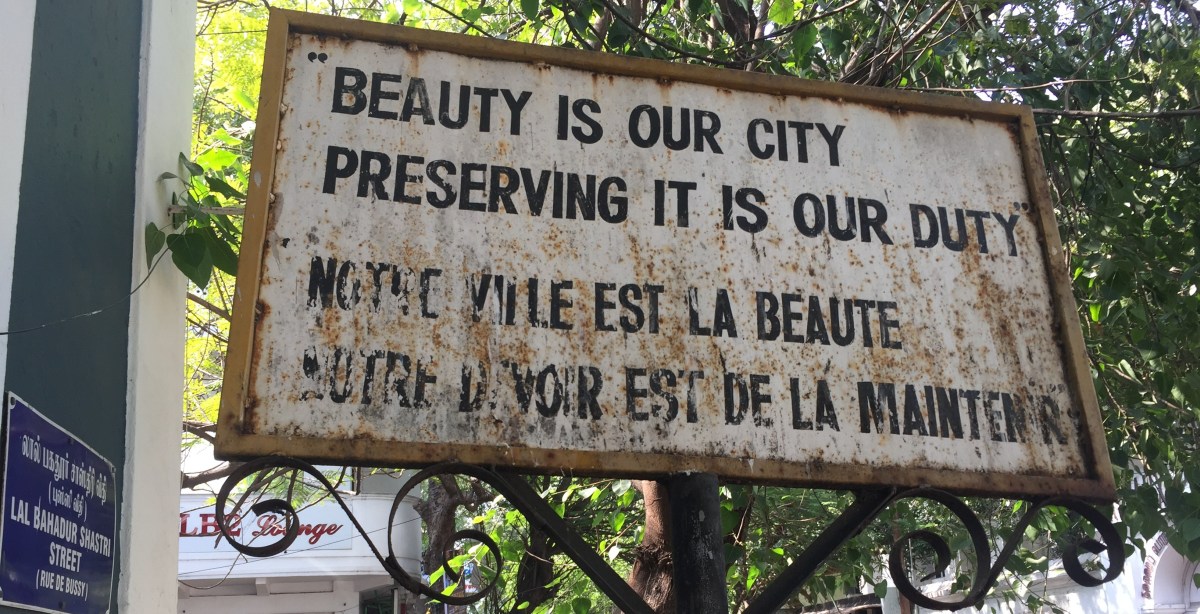
Puducherry (commonly referred to as Pondicherry) is unlike anywhere else we have visited in India. Every city and town has remnants (and sometimes more than remnants) of British and Dutch colonialism, but Puducherry was a French colony and has a completely different feel. Entering the city, you first experience the modern Indian city with familiar stores and traffic, but as you reach the core, it completely changes. The streets are laid out on a grid, lined by lovely buildings with ornamented railings. There are frequent parks and broad sidewalks. And its glory is truly felt along the promenade by the sea, closed to traffic every evening at 6pm so that people can pour out of their houses for, well, a promenade.
We chose Puducherry to be our location for Christmas and carefully selected an Airbnb in a prime location, hoping that the photos on the website were accurate. Happily, they didn’t even begin to do it justice. This was a magnificent place to stay, particularly after the more rustic choice we made for Mahabalipuram. We were able to buy groceries, including good coffee and pineapples. We also got everything we needed for Melissa to cook a pasta feast at home on Christmas Eve. Tom even made carrot paratha on Christmas to go along with the meal that we otherwise ordered in.
Christmas eve dinner
Christmas breakfast
Unusual Christmas dinner
Homemade carrot paratha
Christmas cocktails on the rooftop deck
Our Puducherry stay also coincided with Melissa’s dad’s birthday which she always celebrates with Indian food. Such fun to celebrate at the beautiful Villa Shanti in India.
Puducherry is less about must-see sights and more about enjoying the feel of the place. Although we had a driver for our stay, we wanted to walk everywhere, so we let him go for a couple of days (for which we were later grateful when he told us that his son had been born on our first night there). We enjoyed the market with its jumble of beautiful produce, we found delicious French croissants and other tasty pastries, we strolled through the early 19th century botanical gardens where the French colonists had tested the strength of plants they wanted to plant there (and where the fictitious Pi Patel began his journey), and on Christmas morning we visited the gothic Basilica of the Sacred Heart of Jesus.
It was a wonderful visit, and we look forward to returning for relaxing long weekends, hopefully to stay in the very same Airbnb. But for now, it’s off to Tiruvannamalai.
After the inland adventures in Bokkapuram and Mysuru, it was time to head to the Tamil Nadu coast and the sleepy, backpacker town of Mahabalipuram (also known as Mamallapuram). The town specializes in two things: fresh, daily caught fish, and ancient stone carvings. Rachel, one of our travelling partners, took advantage of the fish. We all took advantage of the antiquities.
A cool carving in one of the walls.
Tom was under the weather but persisted
One of the cave temples
A few blocks off the beach, a park run by the Indian Archaeological Society protects a huge granite outcropping with over a dozen bas relief stone carvings. Ostensibly, they were built as temples. Melissa read, however, that they were really an opportunity for the stone artisans of the time to show off their prodigious skills. And prodigious they were. On the macro level, they carved large chambers from solid granite. That is impressive enough. But then the micro level is just as impressive. The details in these carvings are incredible. The ceilings, pillars, and spaces surrounding the inner sanctum are all intricately decorated. The larger carvings on the walls clearly tell stories that made us wish that we’d hired one of the eager guides at the entrance to interpret them for us. We could fabricate stories based on the tiny bit we know about the stories of the Hindu deities, but it might have been more interesting to discover the actual stories.
The first bas relief carving we came across.
Laurence “holds up” Krishna’s Butterball.
The park itself is a nice sanctuary. It is a quiet, clean, pleasant stroll. There were a lot of other people there appreciating the carvings with various levels of enthusiasm, but we hoped for nothing else. These things deserve to be appreciated. We were also fascinated by the walk and finding along the way small carvings in the granite that were clearly weather worn bits of practice that anywhere else would have been the center of attention. There are also several unfinished caves, abandoned at various depths, with pillow-like carvings where they were clearly preparing to create the void that would one day become a temple/vanity project.
Melissa and Rachel explored the Shore Temple, the Five Rathas, and Arjuna’s Penance while Tom continued to nurse his cold and Laurence opted for a break from the heat. While a bit weathered by the ocean breezes, the 8th century Shore Temple is still truly impressive. It is now primarily a tourist site but does still have an active temple with devoted visitors at its core. The 7th century Five Rathas (or Pancha Rathas) are actually in better condition thanks to their inland location. They are apparently shaped like chariots, but we couldn’t quite see that. They look like incredibly ornate little houses to us. Arjuna’s Penance depicts the story of Arjuna’s austerities to earn Shiva’s weapon for his ultimate battle. It is strikingly beautiful. We were even more impressed, though, by the smaller unfinished cave temples right next to it that seemed to depict normal activities like milking a cow and carrying a child.
Walking between these various monuments, you pass present day stone carvers. Sometimes you just see wares for sale, larger than life and small enough to put in your pocket. Other times you see people sitting and carving beautiful works right there on the sidewalk. It’s easy to imagine that these are the descendants of the stone carvers who built these monuments 1,000+ years ago.
Mahabalipuram is not intended to be a foodie paradise, and we struggled to find truly exceptional food. We all agreed: most of it was good, not great. Dinners were all about the view (and the seafood). The first night we ate at Bambino’s, where Rachel took advantage of what Mahabalipuram really specializes in: fresh seafood. She had prawns caught that day. Most notably, though, the rooftop restaurant had a beautiful view of the beach and the Bay of Bengal. The second night we ate at the Sea Shore Garden Restaurant, just down an alley from our guesthouse. Again, it was good enough. But mostly, it was right on the beach. Laurence was amused by his interactions with the wait staff at both dinners, about what Chettinadu means — we now think it is a region of a district of Tamil Nadu — and what Chicken 65 is — we now know it is a breading and frying process, not just for chicken, invented in 1965 (these links are probably only accessible if you are one of our facebook friends). We had two meals, a lunch and a dinner, at Golden Palate. These were quite a bit tastier and a little bit off of the main tourist area, though at a hotel. The breakfast at our guesthouse was forgettable except for one amazing detail. We all ordered pineapple juice from the menu, but were told that we could only have watermelon juice. Two people at the table actively dislike watermelon so declined, at which point we were told that we could order pineapple juice after all. Seconds later, we saw the the proprietor race out of the restaurant, hop on his motorbike, and speed away, only to return moments later with two whole pineapples that soon became very fresh and tasty juice.
Speaking of the guesthouse, we definitely got what we paid for at about $15 per night. We set out on this vacation to have the variety of experiences that India has to offer. Sure, it would be glorious to always stay in luxury, but we also wanted to stay in more authentically Indian (and Lankan) places, too. Guesthouses are usually simple, amenity-free, and run by charming hosts in great locations. This one was all of those things. We had a bed and (bonus!) A/C. The little table and chairs outside our rooms were perfect for chatting about the day to come. And it did not inspire any desire to spend the day lounging about the hotel — we were ready to get out and explore.
We enjoyed our stay in Mahabalipuram, but we were pretty sure bigger things were in store in Puducherry.
When we last visited Mysore, it was for Mysuru Dasara, an important celebration that brings an extra million or so people to this sweet little city, so we were eager to return at a quieter time. It felt to us, minus the extra million people, a city that could have the feel of Portland — a big enough city that there are always a variety of things to do, but small enough to feel personal and homey. Rachel and Laurence’s visit gave us the perfect opportunity to visit the city at a quieter time. This would be our second stop on our three week vacation, after a visit to a lovely private home in Bokkapuram, so it has a lot to live up to.
It turned in to a weekend of showing Rachel and Laurence some of the things we enjoyed doing on our first visit: we toured the Mysore Palace, walked through the market, went to the temples at the top of Chamundi Hill, dined at some fabulous places, and stayed at Southern Star Hotel (complete with their delicious paid-for-in-the-price-of-the-room breakfast buffet). All of these, minus the million extra people, were far more enjoyable and relaxing and meaningful the second time around.
This slideshow requires JavaScript.
There were some things that were different. We checked out the Cauvery Arts and Crafts Emporium (very cool). Our dinner at The Royal Orchid (next door to Southern Star) was at the courtyard restaurant Shikari instead of the indoor restaurant Tiger Trail (way more beautiful and way more delicious, but that might be because we remembered to ask for hotter than white people spice). Melissa, Rachel, and Laurence walked up the thousand steps to the top of Chamundi Hill instead of taking the bus up and walking down. Tom thought it was a good idea to get a nasty chest cold, so he spent the one full day in Mysore in bed ordering mediocre room service food. He could have done without that part, but all of the rest of it was just what we hoped.
As part of the pilgrimage up the 1000 steps, the faithful mark the riser of each with vermilion and turmeric, making for an impressive sacrifice of a walk, and for a beautiful stair way. Also, most of the photos on this page are by Laurence. Thanks, Laurence!
Mysore is just simply a nice little city that moves at a much nicer pace than we are used to. Now we are off to the coast, Mahabalipuram and its awe-inspiring antiquities.
Once in a while, if you’re very lucky, things turn out even better than you planned. This is the case with the first stop on our 3-week adventure with Rachel and Laurence. Our friend Kaveri connected us with her aunt Jagu, uncle Mohan, and cousins Hari and Aarti in Bokkapuram (between Masinagudi and Ooty for anyone searching on a map), who opened their home and made us welcome. Their property borders a national forest that is home to abundant wildlife which they love and respect, always maintaining an awareness that they are on the animals’ land rather than the other way around.
A beautiful banyan tree in the yard at the house.
The small 200-year-old temple on the property.
The ever-changing beauty of the rock face.
More lush beauty in the yard.
Bison killed by a tiger eight months ago.
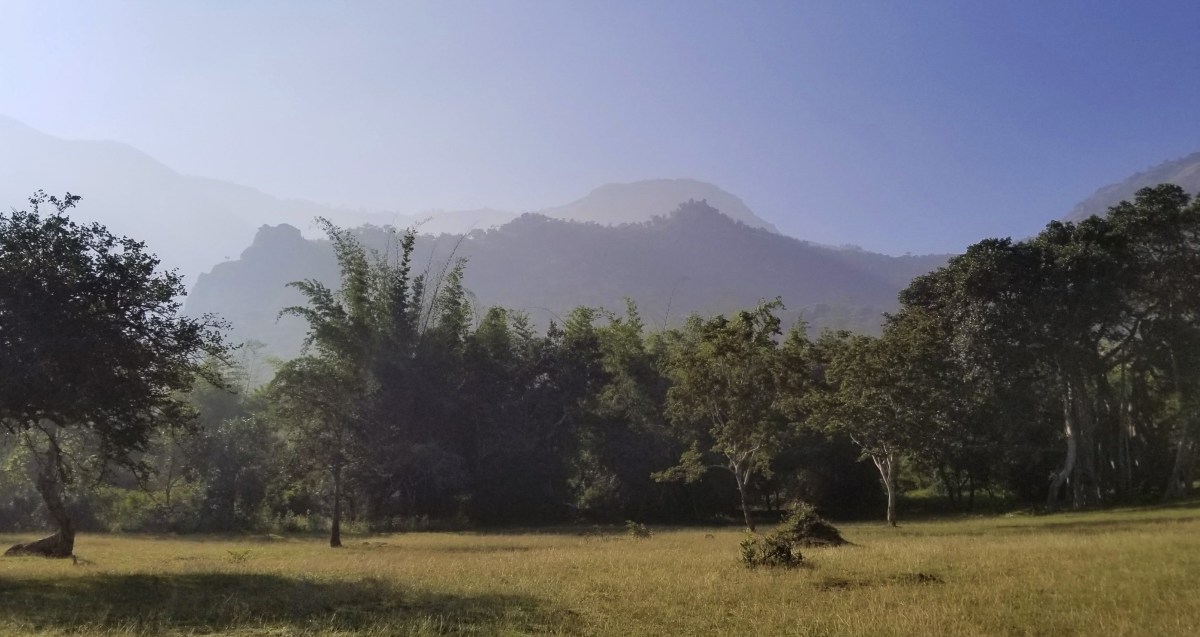
The western ghats as seen from the yard.
At every moment of the day, there’s something to see, but the property really comes to life at dusk. The moment we arrived, we sat on the deck, enjoying first tea and cookies and then chips and wine while gazing toward a pool fed by water pumped from an underground stream. In the space of two hours, we saw the resident herd of spotted deer, a large sambar, a powerful old bison, a trio of younger bison including a small calf, two wild boar, a bounding rabbit, a peacock, and rooster-like jungle fowl. We also heard a variety of distinct birdcalls and the “sawing” call of a leopard. It was thrilling. The next day we added to that list a giant Malabar squirrel scampering in the nearest tree, and the next evening a large elephant showed up just after dark, still visible with binoculars. Perhaps most exciting was our final morning when an 8-year-old elephant emerged from the forest and spent quite a while enjoying the water in the dappled sunlight. He also enjoyed shooing away the birds. Apparently, he’s a known bully who was forced out of his herd, a common occurrence at his age. When not actually seeing live animals, we heard stories from Mohan and Hari about their animal sightings: an elephant who broke a large branch from a tree by the house, a tiger who brought down a bison calf in the yard, a herd of wild dogs who rather gruesomely attacked a spotted deer, and a boar who used to visit regularly and knew Mohan’s voice. So incredible. And then, when it was too dark to marvel at the animals, we were awed by the stars.
This slideshow requires JavaScript.
Mohan and Hari also liked to talk about their unique philosophy of co-habiting with the animals. Bokkapuram is starting to fill with resorts serving tourists who take safaris in an attempt to have the wildlife-communing experience that we had in our front yard. They build amazing compounds with beautiful flora, some of which attract the elephants, bears, big cats, and other critters that show up regularly at Mohan and Jagu’s home. Then, when they realize that these very dangerous animals are coming around and threatening their guests, they go to great lengths to keep the animals away — electric and barbed wire fences, plants that are supposed to repel the animals, firing weapons, and all kinds of things that aren’t good for the animals. In other words, they invite the animals to come around, then threaten them with bodily harm when they do. A long time ago, Mohan decided he would be different. He built a beautiful home that also serves as a barrier when dangerous animals threaten. He planted a few things the animals like, and then sat back to watch the show every night. Over the years, the animals have come to trust Mohan’s property, so deer and bison sleep in his meadow every night, and the menagerie inspires Mohan to exclaim, “Who needs television?!” Also, he and Hari both are very careful to make sure their guests know that they are not to wander aimlessly — there are dangers out there.
Jagu outdid herself with the fresh, home-cooked meals. Each one was beautiful, varied, and so very delicious, with special meat dishes for Laurence, the lone meat-eater among us.
When we weren’t eating or animal gazing, we were either going for long walks or relaxing with books in this idyllic setting. The walks were simply lovely. We walked through Bokkapuram, a cute little village; we climbed a hill to a temple with an incredible view; and we walked through a gorgeous back lane by a little creek. In addition to reading, we even napped, something we never do, but which felt perfect here.
This slideshow requires JavaScript.
We may have set the bar too high with the start of this trip. It will be very difficult for anything else to measure up! First attempt at living up to the standard Jagu and Mohan set, Mysuru!
To this point in our life in India, we have stayed in four and five star hotels. Mind you, we’re not complaining; it has felt like we’re spoiling each other for less than half the price we’d pay in the States. For our first couple of nights of our Diwali vacation, we decided to try out something a little less Western. We found Chiramel Residency, a well rated homestay right in the middle of the old, charming neighborhood of Fort Kochi.
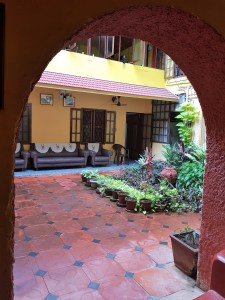
The rooftops from our room.
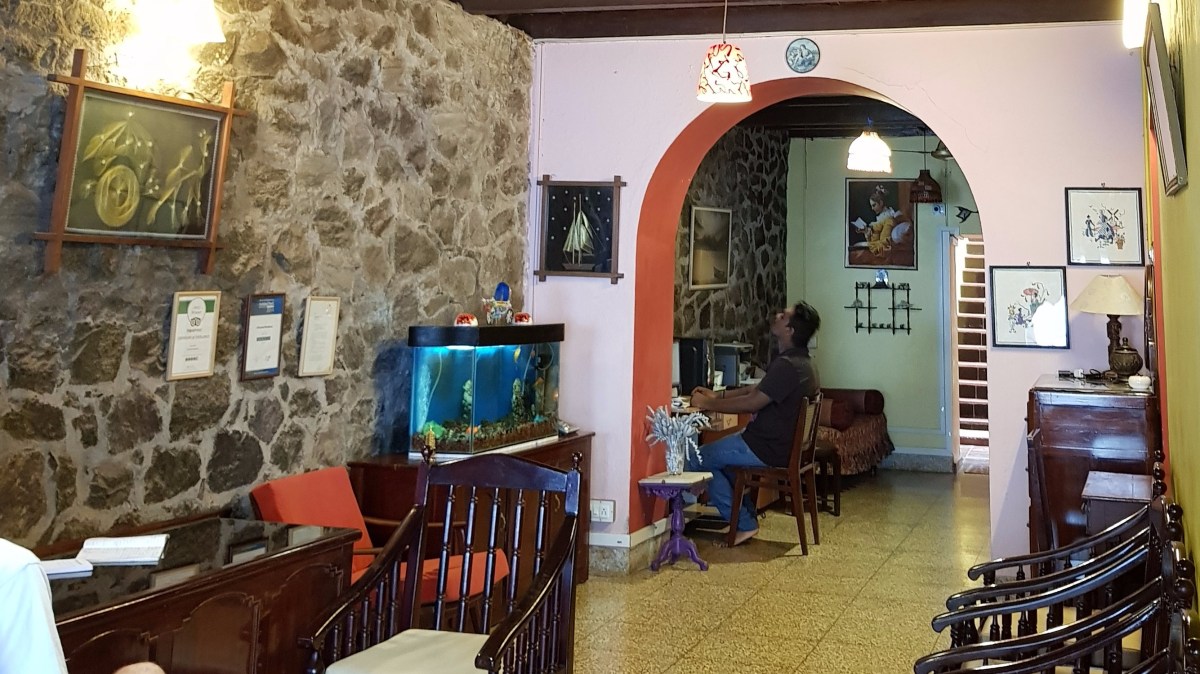
Everything about the place was perfect. All three people we interacted with were warm and eager to please. They gave us a choice of two rooms; we chose the one on the top floor that looked out over roof tops and let us listen to the rain as we fell asleep. The bed was a standard super firm Indian bed, but we expected that so it was fine. We weren’t intending to spend much time at the hotel, but if we were, we would have enjoyed the pleasant reading and game room.
We learned a very important lesson here that we believe is going to serve us well. When
The beautiful courtyard. Our breakfast was served in the windows you see above the courtyard.
we checked in, we were given a breakfast menu and asked us what we wanted and at what time. We were a little disappointed by the options: eggs, corn flakes, fruit bowl, and white bread toast. Patel, our taxi driver from the airport, had suggested that if we wanted a dosa we should ask for one, but we didn’t want to look like pushy Americans, so we didn’t ask. After eating our basic breakfast the next morning, our host chased us down with a question as we left for our walk around the Fort Kochi area. We figured this was our chance to ask about the dosas and were so glad the next morning! The dosa breakfast was incredible, every element — the coconut chutney, the potato masala, the sambar — was delicious. We were able to apply our little bit of learning a couple of days later at the Amaana Plantation Resort, and it paid off just as brilliantly.
Chiramel Resort was a wonderful first stop on our vacation, and we came away with a nice lesson that is going to make our life in India even more delicious.
Our stay in Kochi was a pleasant kick off to our Diwali vacation in Kerala.
Not wanting to waste a moment of Tom’s time off (but also excited to return to Bengaluru on Friday night to welcome our brother-in-law Michael for a visit), we decided to start our trip to Kerala with a flight to Kochi on Friday evening. It was our first time back to the Bengaluru airport since arriving at 3 am on July 31. Our first time through, we were a bit too bleary-eyed to appreciate what a lovely airport it really is. It’s clean and airy, with a wide variety of eateries. Not a bad place to wait for a flight. Once boarded, we arrived in Kochi (also called Cochin) less than an hour later. Our bags arrived quickly, and we were greeted by Patel, holding a “Ms. Melissa” placard. Patel had been sent by the Chiramel Residency, a really lovely spot to stay in Kochi, and he took us directly there. We arrived at the homestay around 9:30 and were greeted with question of whether we wanted to go have dinner now, but all we wanted was our bed.
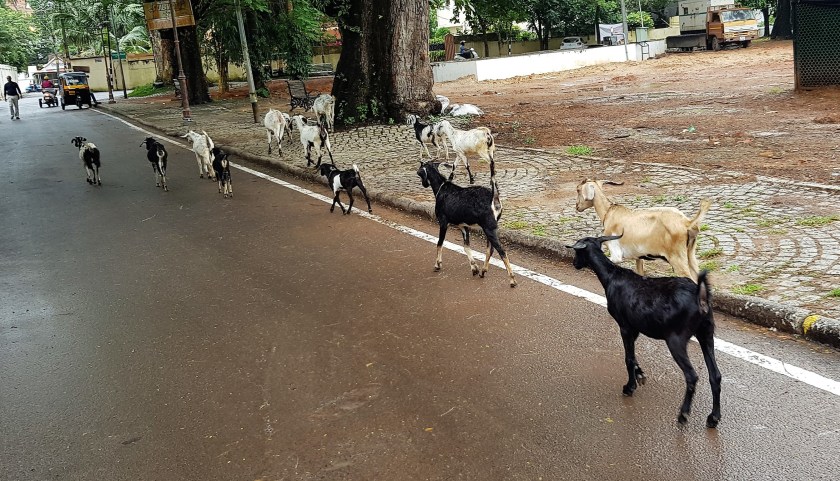
Goats walking the streets of Kochi.
Saturday was our day to explore Kochi. We got up to a breakfast of scrambled eggs, toasted white bread, and corn flakes, not having yet learned that we would only be offered bland white person food if we didn’t specifically ask about Indian breakfast. It was perfectly fine, though, and provided all the sustenance we needed for the morning. We then headed out to be greeted by an adorable herd of goats walking down the street. We were soon to learn that goats are everywhere in Kochi, mostly untended although some have collars. They were crazy cute.
From our homestay in the Fort Kochi neighborhood, it was just a short and pleasant walk to our first sighting of the Indian Ocean. It was cloudy and grey, but still kind of thrilling to be looking out over a whole new ocean. All along the rocky waterfront, it looks like they’re developing paths and patios that will probably be lovely public spaces in the coming years. Interestingly, the first 10-15 feet of the water are completely filled in by greenery that could be some kind of flowering kelp or maybe salt water lilies or lotuses. It’s so dense that it put Tom in mind of the man-eating island in Life of Pi, and made him wonder if this could have been the inspiration for that segment of the book.
This slideshow requires JavaScript.
As we walked along the water, we quickly came to the Chinese Fishing Nets, famous in Kochi. It is believed that they were introduced to the area by a Chinese explorer in the 14th century, and are still in common usage today. They’re really beautiful and kind of amazing to watch, as a system of pulleys and rock weights lower and raise theses huge winged nets in search of fish. We didn’t see much being caught, but we did see impressive displays of fish for sale very nearby, accompanied by places that would cook your fish for you on the spot. Not being fish eaters, we moved on.
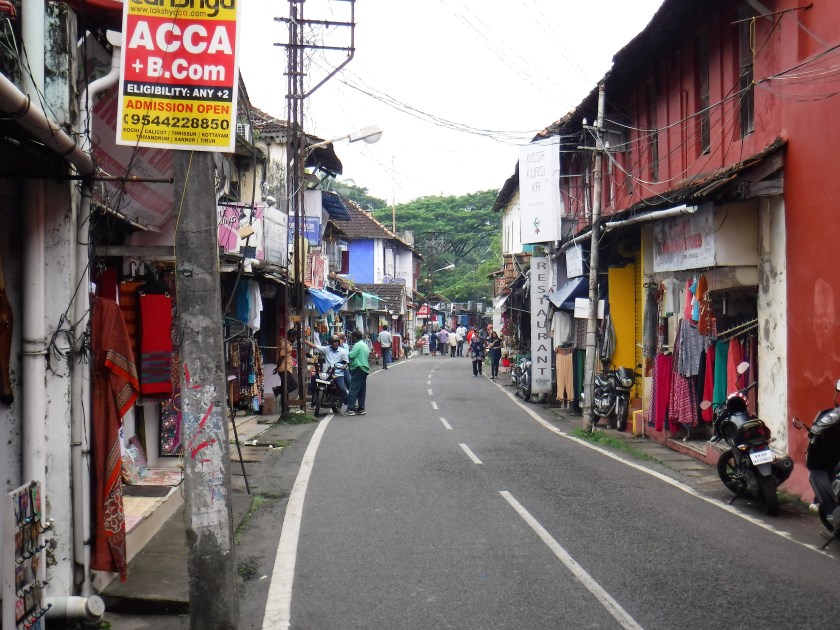
From there we walked through nice neighborhoods, marveling at the minimal garbage and well-maintained sidewalks, totally charmed by the lovely storefronts and pretty buildings. We eventually found our way to Mattancherry Palace, built by the Portuguese as a gift for the Maharaja in the 16th century (largely as an apology for sacking the temple) and then expanded by the Dutch when they established themselves in the mid-17th century. From the outside, it doesn’t look like much, but inside there are magnificent 16th century murals covering the walls and an impressive display of old artifacts. There are also a lot of really informative panels that explain the history of Kochi and the whole Kerala region. We learned there about the matrilineal heritage of the royal family that ensured a valued place for women in the culture. One impact of this was an early commitment to educating girls as well as boys through the kingdom.
This slideshow requires JavaScript.
We left the palace feeling hot and hungry so happily wandered through the Heritage Arts Antique Shop to the Ginger House restaurant in the back on the water. The antique shop was chock full of cool old stuff and the restaurant provided a truly lovely setting for a tasty meal. The Heritage Arts Antique Shop is on Jew Town Road near the intersection with Jews Street in, you guessed it, an area called Jew Town. There is a very old Jewish community in Kochi that traces its roots to the time of Solomon. The community grew in the 16th century with Jews fleeing the Iberian Peninsula, and shrank in the 1950s with many emigrating to the newly formed state of Israel. Today, the community is quite small but well regarded. Their 16th century synagogue is down a lovely little alley with a big clock tower at the end (added in the 18th century). Sadly, it was closed when we were there, but we look forward to returning some time. The outside is a bit nondescript, but the inside is supposed to be beautiful.
Having walked the waterfront perimeter of this peninsular part of the city, we decided to cut straight across on our way back to our hotel. This gave a us a chance to walk through residential neighborhoods, encounter many more goats, and stop off at the Kerala State Beverage Center. The first two things were very nice, the last one not so much.
Kerala is not a dry state, but it seems a lot of people wish it were. We had read suggestions to bring alcohol with you and not to expect it to be served in most hotels and restaurants. In fact, we didn’t visit a single hotel or restaurant that served even beer and wine during our whole stay in Kerala. We thought it would be nice, though, to have some wine with us in our hotel rooms and it seemed easy enough to stop off and buy some. Little did we know that the alcohol buying process in Kerala is awful. There is a clear intention to create a furtive, shameful process. We almost walked right past the store, because it isn’t an actual store. It is a dimly lit storefront with a heavy wire cage in the front of the window, which you can’t even seen from the street because of the cement wall constructed to force you to move through an uncomfortably narrow opening to talk to the people inside. We waited in a long line with a bunch of men and one other western woman. When it was finally our turn to tell the men what we wanted, they refused to make eye contact and generally looked at us like scum, which seemed to be how they looked at everyone. They were willing to sell us the wine we requested because they had to, but they wanted us to know what a disgusting thing we were doing. We walked off feeling a bit demoralized, but perked up when we got back to our lovely little room for a rest.
At Restaurant 51
That night, we headed to a romantic dinner at Xandari Harbour’s Restaurant51. Such a lovely setting! We had the restaurant to ourselves since we arrived at the absurdly early hour of 7:30. There was a woman playing a keyboard softly as we listened to the waves from the water next to us. The food was very nice and the service was lovely. When we returned to the hotel, we headed to bed, ready for the next day’s adventures in the mountains.
On Sunday, we knew to ask for masala dosas for breakfast – yum! We expected to be picked up at 9 by Ansu, the driver who would be our companion until he left us at the airport on Friday evening. At 8, we were told that Ansu was already there. This was a sign of things to come – Ansu was always early, always prepared, and completely reliable. At 8:30, we headed down to load up the car and got on the road to Munnar (see Into the Keralan Mountains).
After spending a couple of days in Kochi, we were ready to get out of even that small city. We were headed out to the spice and tea region of Kerala for what we hoped would be a week of relaxation and isolation. Melissa had worked hard to find activities that got us out in nature and away from crowds, and hotels with a sense of isolation, which isn’t always easy to assess from a website.
We had had a wonderful and huge Indian breakfast at Chiramel Residency, so we weren’t ready for lunch. Ansu needed a bite though, so he stopped at a charming little restaurant mid-way to the mountains called Rasa Restaurant. Two things were clear: first, the food looked great and we wished we weren’t still so full; second, the little stream overlooked by the restaurant was actually clean. This was this first real indication we were truly somewhere different than Bengaluru, where most streams are not only not clean but gag-inducing. It was lovely.
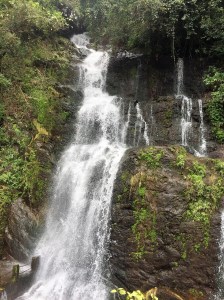
One of the many waterfalls along the road up into the mountains of Kerala.
It is a 4.5 hour trip from Kochi to Munnar, plenty of time for our driver Ansu to get to know us a little bit and listen to us talking about what we hoped to do. We talked a lot about how we were excited to go to a spice plantation, that we had heard they smelled amazing. We also knew we were up against a deadline, because Eravikulum, the National Park where we were headed, closed at 4:30, and we wanted to get to our hotel before it was dark. Ansu insisted on stopping at Periyar Spice Garden despite our weak attempt to protest. It was weird. Basically, we paid 100 rupees each for a 15 minute tour through a nursery, and were then asked to sit on a couple of stools for a hard sell. The tour itself wasn’t uninteresting; it just wasn’t what we wanted to be doing at that moment. Mostly, the tour guide described for us all of the Ayurvedic uses for the plants, including several, she was sure to point out to Tom, that grew back hair.
Back on the road to Munnar, we tried out our new-found understanding of just how insistent we needed to be with Ansu. He tried to push four wheeling on us. Hard. We’re guessing that most of the tours he leads in to the mountains love the four wheeling. We had the hardest time convincing him that it’s not our thing, that we were looking for quiet excursions. He even dismissed our explanation of Melissa’s motion sickness. Once we finally convinced him, though, and we made it clear that we were looking for a quiet, slow week, we had a great time with Ansu. He’s smart (speaks 5 languages), kind, and patient.
One tangent about this pushing stuff on us thing. We have struggled with trust issues. It starts with the rickshaw drivers who are insistent that you must you get in their autos, and that you don’t want to go where you’re going but over there to this other really great store instead. If you argue, you’re told (contrary to reality) that your destination is closed so you must do what they say. We have been told that they get kickbacks from the stores every time they bring in a customer. This then gets displaced to nice people like Ansu. Did we stop at the spice garden because he got a little on the side? It was feeling very clear, especially when he pulled over to get a brochure, that he was getting a kickback from the four wheeler outing he was pushing on us. If that was true, what can we trust as honest suggestions? It made us feel icky.
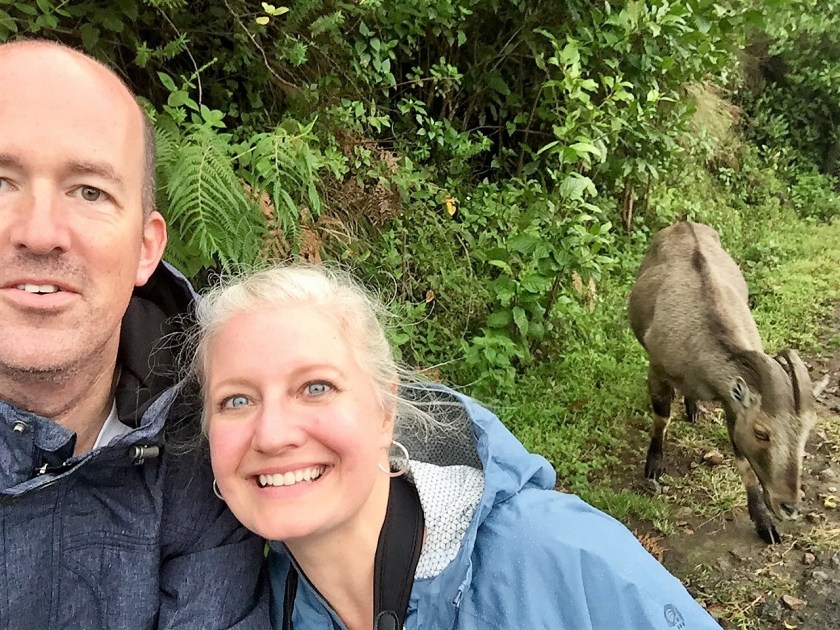
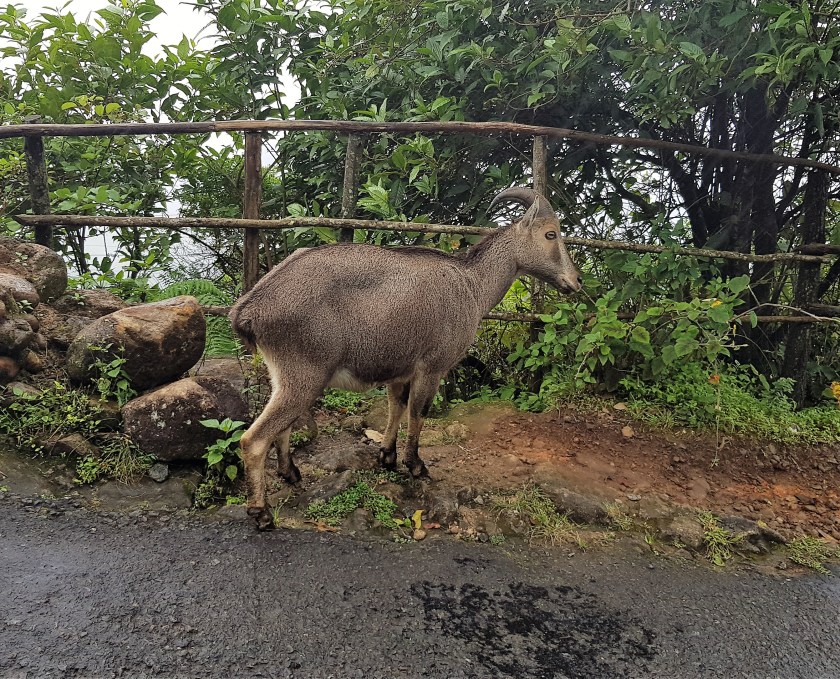
We finally got to Eravikulum National Park. The park is most known for the presence of Nilgiri Tahrs, described as an endangered evolutionary link between antelope and goats. The two hour time limit and early closing time were already signs maybe we wouldn’t be going out to the middle of nature. It turned out it was one big shared experience. After standing in line for their turn, visitors load onto a bus up a mountain, walk about a kilometer in close company with many fellow visitors, and then walk back. Most people seemed to be there for a fun outing with each other, but with very little regard for the nature around us – one group was particularly boisterous and almost kept us from seeing the one thing we were there to see by insisting that we pose for photographs. Our souring mood (mostly Tom’s souring mood) wasn’t helped by a good, steady downpour.
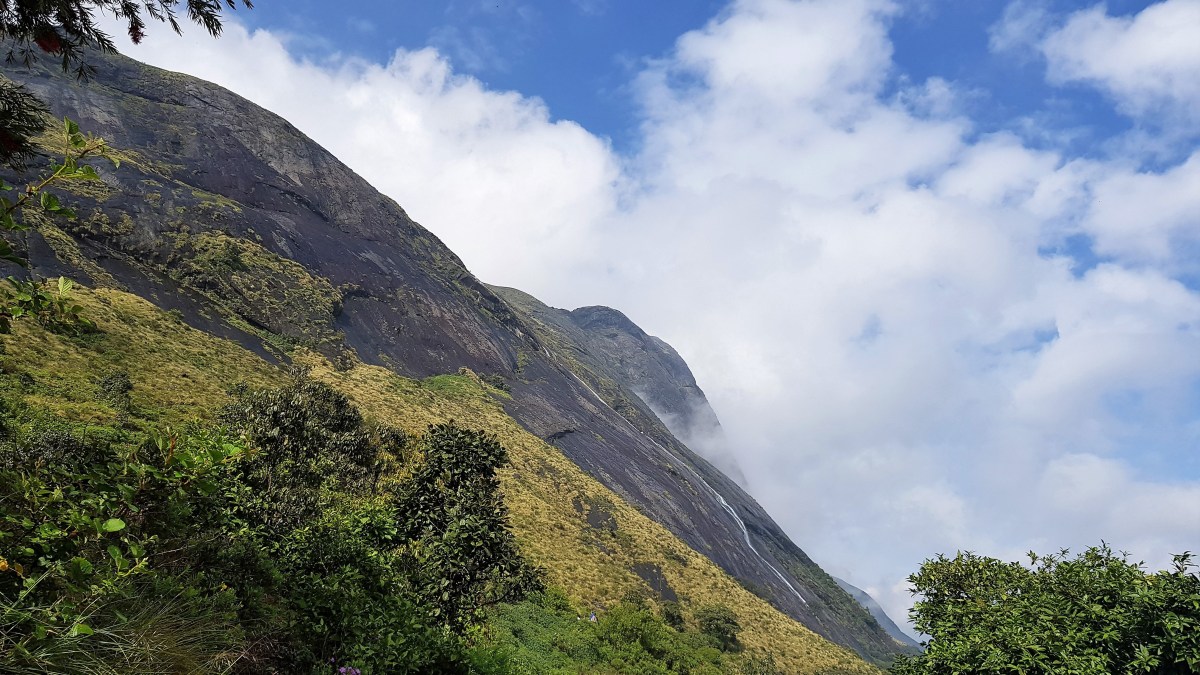
When we were able to put aside our frustration, it was quite stunning. We got to see a tahr up close, right by the side of the path. The views (what we could see through the rain and clouds) were stunning. This is, after all, the second highest peak south of the Himalayas. And the surrounding tea plantations were sights to behold. We simply had a case of missed expectations (and in Tom’s case, a healthy dose of burnout and sleep deprivation).
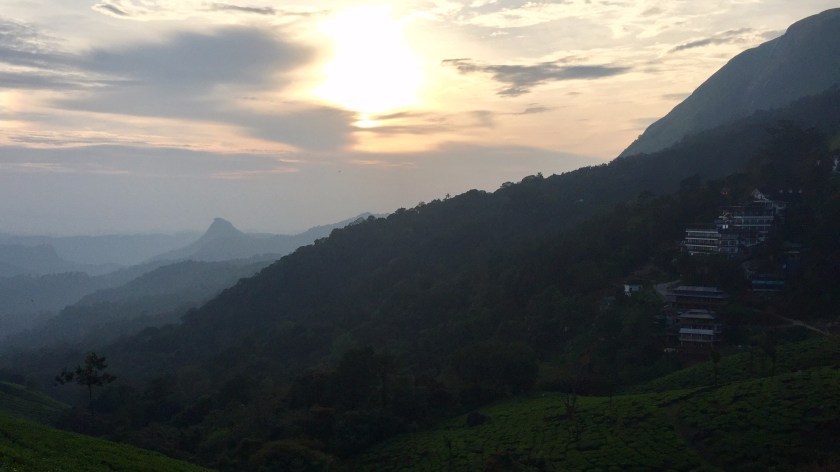
That’s our hotel perched on the side of the hill on the right.
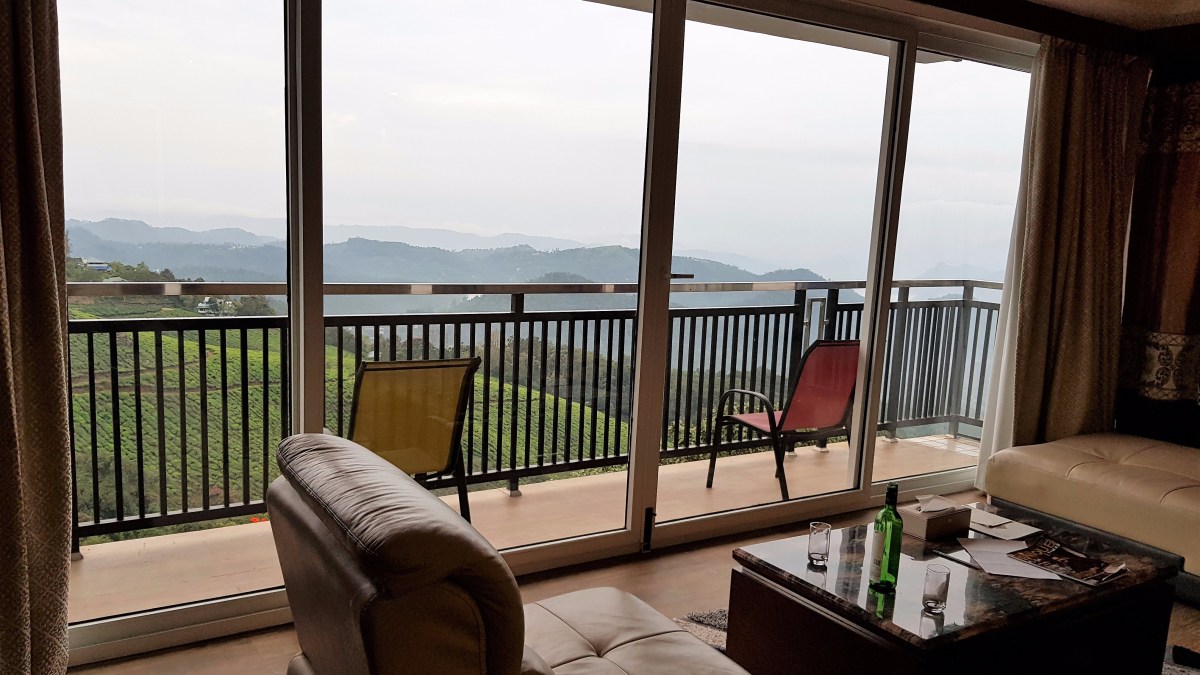
Then it was off to our hotel, Parakkat Nature. It is gorgeous, overlooking a huge tea plantation. Here, we had one small case of missed expectations, where it wasn’t quite the isolated experience Melissa was led to believe. We did have a nice walk in the tea plantation led by an eager if not super knowledgeable staff member who mostly wanted to pose us for glamour shots for our social media.
On Sunday’s drive up the mountain, Ansu broke the news to us that there was going to be a state-wide strike on Monday, and if we wanted to get to Thekkady before dark on Monday, we should leave at 4:00 or 5:00 am, getting us to our next destination before 7:00 am. With our burnout, we couldn’t imagine getting up that early. We got him to reluctantly agree to leave at 7:00 am, still way earlier than we wanted to get moving. It turns out he was exactly right and we regretted not taking his advice, but again we were having trust issues.
The strike was called by Kerala’s Congress Party and its allies over petrol and diesel prices. At the major intersection of every town, there were small groups of men pulling cars over to question the drivers about what was up. All commerce was supposed to be shut down, including taxis and tourist activities. Ansu guessed there were four or five towns we needed to look out for. His worries appeared to come true in the first big town. The group of men sourly directed him over to the side of the road and told him to go get himself some tea — there was no use waiting around; he wasn’t going anywhere anyway. So we sat. And sat. The longer we sat, the more people gathered. The more people gathered, the more worried we got that this was going to be an ugly, all day thing, as the strike wasn’t scheduled to end until 6pm. Ansu came back when they let a couple of other taxis go, but still we sat. Finally, whether Ansu convinced them that he and his dad are proud members of the Congress Party, or they felt like they had made their point, or they just got bored of us, they finally let us go.
A few more strikers in a few more towns pulled us over for a few minutes each. Each time we worried that this was going to be the one that lasted until evening, but each time — once because we were following a car full of police who were instructed to bust them if they disrupted traffic, once because we were five minutes from our resort anyway, once from pure apathy — they sent us on our way pretty quickly with a bit of cajoling by Ansu.
The grounds at Amaana Resort that put us instantly at ease.
We got to Amaana Plantation Resort around 10:00, with all day to do nothing but deal with that aforementioned burnout and sleep deprivation. It was exactly what we needed. Finally, the quiet and isolation we came to Kerala to find was ours. The first sign of the kind hospitality we were to experience for two nights was that even at that crazy early hour, they had our room ready for us. All we had to do was kick back, take naps, read books, play games, take walks in the cardamom plantation, and eat delicious food. It was amazing.
You can read about the details of the next couple of days here: Periyar Tiger Reserve, and here: our review of the resort. The end result that sour, burned out moods were turned into relaxed, revitalised, happy folks. On Wednesday, we were ready for our strike free drive back to the coast for a night at Kondai Lip in Alappuzha, followed by a night on a houseboat. The trip into the mountains was exactly what we needed to turn our outlook around.
Our first attempt at escaping civilization met with mixed results, mostly through no fault of the Resort itself. It was billed as providing an isolated experience, but it is part of a small village on a fairly busy road. To their credit, the rooms are situated to minimize the effects of being part of a bustling community. Our room, an upgrade to a suite thrown in by the resort, looked out over a beautiful tea plantation which we toured just before sunset.
Our attempt at the tilty selfie.
In the tea plantation.
The tour guide wanted us to pose for him.
That’s our hotel perched on the side of the hill on the right.
The tea plantation tour was both weird and fun. Our guide, an eager if less-than-knowledgeable young man from the hotel, took us on a very brisk walk that started on a shoulder-less, well-traveled road. Just when we thought this was our entire tour, we turned into a Tata tea plantation. He described the difference between white, green and black tea — process, not tea varietal — and the difference between the different types like Assam and Darjeeling — there is none, there is only one type of tea plant grown in different regions, suspiciously like terroir of wine. Every other question was met with a recommendation that we go to the Tata Tea Museum up the road; they’ll have the answer. We spent most of our time posing somewhat awkwardly for pictures we assume he really wanted us to post on social media. The best part was walking up to a large boulder perched on a hill where we watched the sunset. It was ridiculously beautiful. Our trust issues came up again when we walked the opposite way of the hotel and hopped on a city bus, a step for which we were not anticipating nor prepared. The bus was fine, we just would have much rather walked home.
Dinner was good. The restaurant has two choices: a la carte or buffet. We went with the buffet. We find sometimes that we discover a new favorite something-or-other on a buffet. Everything we had was very good, but there were nine things that excited us on the a la carte menu, and we ultimately wished we’d ordered off the menu. Still, we were full and happy. After dinner, we were a little concerned abut being directly below the restaurant with a table being set up for a large party. As it turned out, that wasn’t a problem. The problem was the kids who were screaming and playing in the hallways late into the night. Yes, we were those hotel guests . . . we called the front desk. Fortunately, it had the desired effect. Clearly, the staff responded promptly, because the noise quieted down almost immediately.
Because of the Kerala-wide strike (described here), we missed out on the chance to enjoy the breakfast buffet while seated on the veranda overlooking the tea plantation. That was a bit of a disappointment. We enjoyed Parakkat Nature and appreciated the good service, but would probably seek a more secluded resort on a return visit.
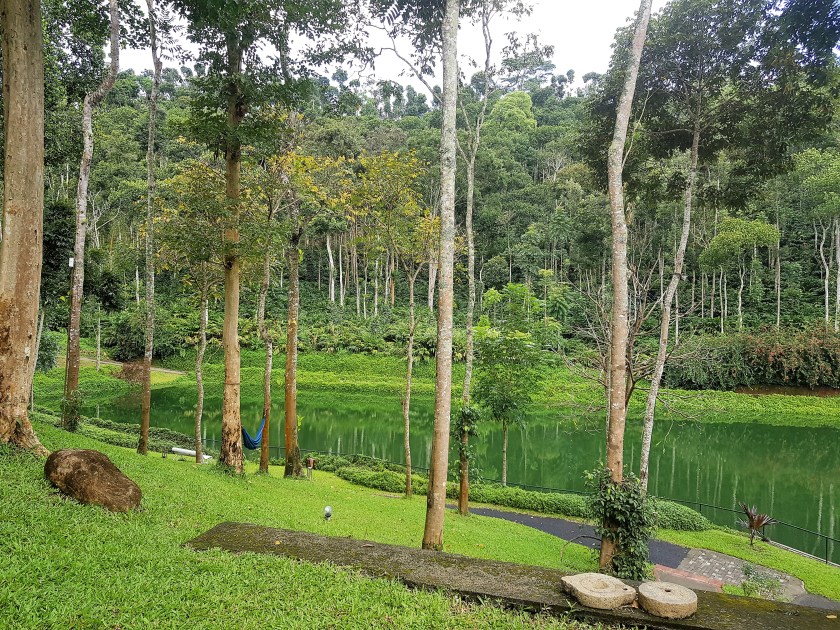
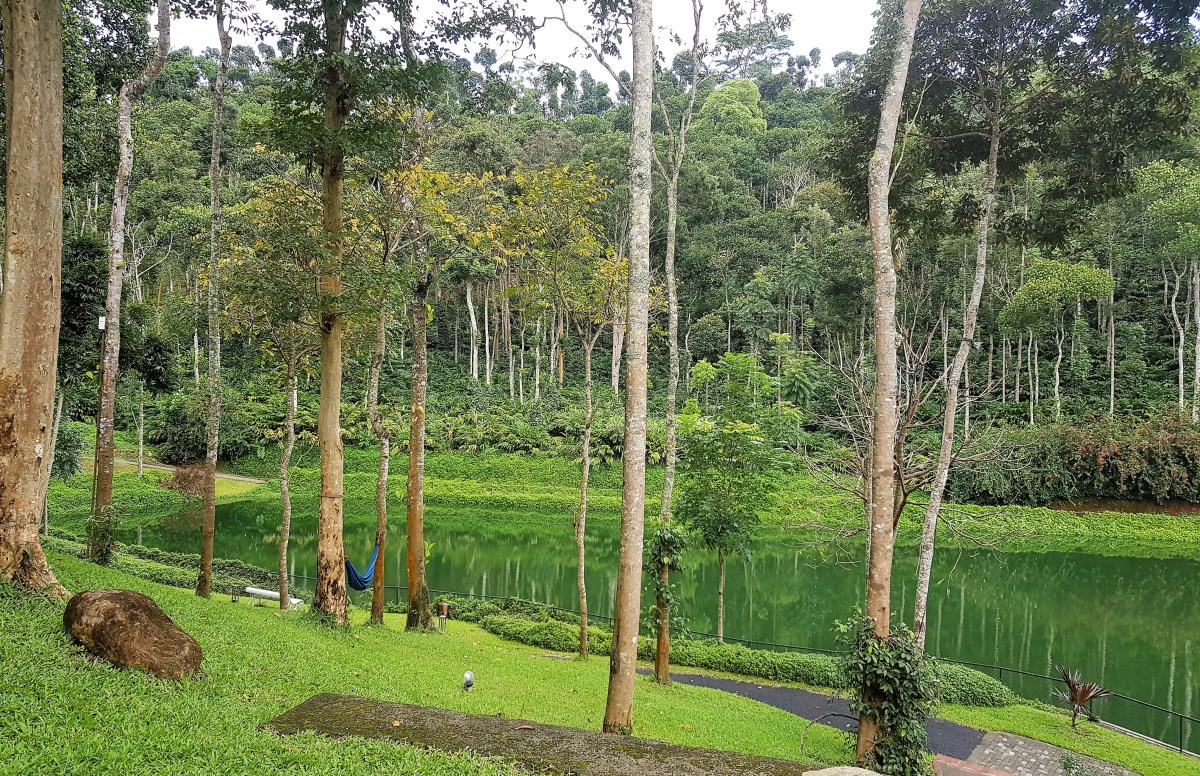
If our goal in coming to Kerala was to escape the crowds and urban-issues-gone-amok of Bengaluru, we finally succeeded the moment we pulled into Amaana Plantation Resort in Thekkady. The general manager welcomed us with necklaces of cardamom pods and a lovely fresh juice. With only five units located in a small glen surrounded by a cardamom plantation, it is the very picture of isolation. Because we had to get through the state-wide strike (described here), we arrived at 10:30, with plenty of time for the important business of the day: reading, naps, games, walking in the plantation, and lunch brought by room service.
This slideshow requires JavaScript.
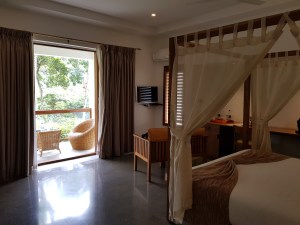
Our room was lovely, with a big four-poster bed and a bathroom nearly as big as the bedroom. Perhaps the best part, though, was the deck with comfortable chairs from which we could gaze across the pond to the greenery all around us. Although there were other guests there, we rarely saw other people, which was kind of perfect for us.
Our oh, so comfortable room.
All of the food we had at Amaana was amazing. We enjoyed lunch in our room, two fabulous breakfasts, and two dinners. Although we considered finding another restaurant on our second night there, we couldn’t really think of a good reason to do so. One of the effects of such a small resort is that there is a small enough staff that you get to recognize them as you encounter each other in the dining room, on the walking paths, or delivering things to your room. We even got to apply our bit of learning from the Chiramel Residency. When the manager asked how we wanted our eggs and toast for breakfast the first morning, we asked if they had masala dosas. They were delighted that white people wanted Indian breakfast, and were willing to have it ready for us before the dining room is usually open, since we were racing off to our day at Periyar. The second morning they brought another amazing Indian breakfast, including some dishes we had never had before: Uttapam, a flat dosa with onions and other deliciousness on top, and poori (a puffed bread), with the same potato masala from the dosas. It was all amazing, and served in a perfect setting.
We ate every meal at the table in the corner.
The food was so tasty. And they understood that not all white people like bland food. Yum!
Banana Split!
We can be certain: when we return to Thekkady, we will return to Amaana Plantation Resort.
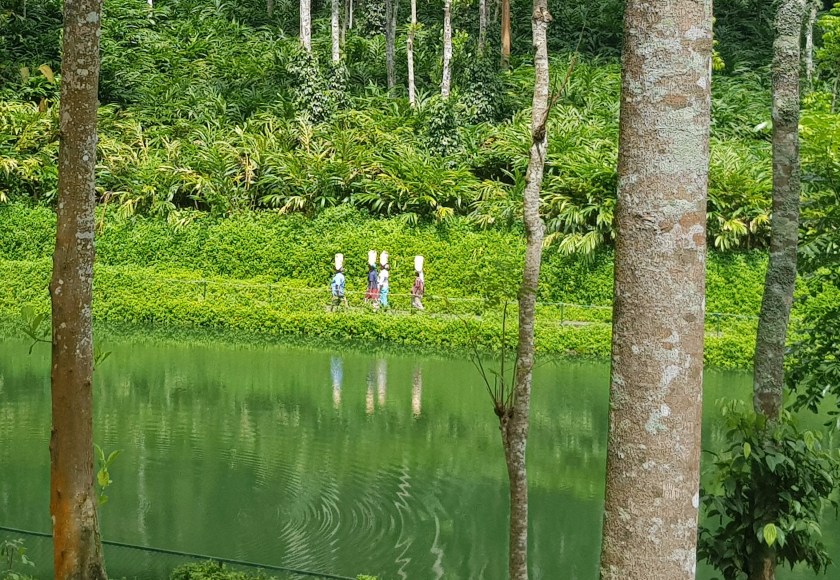
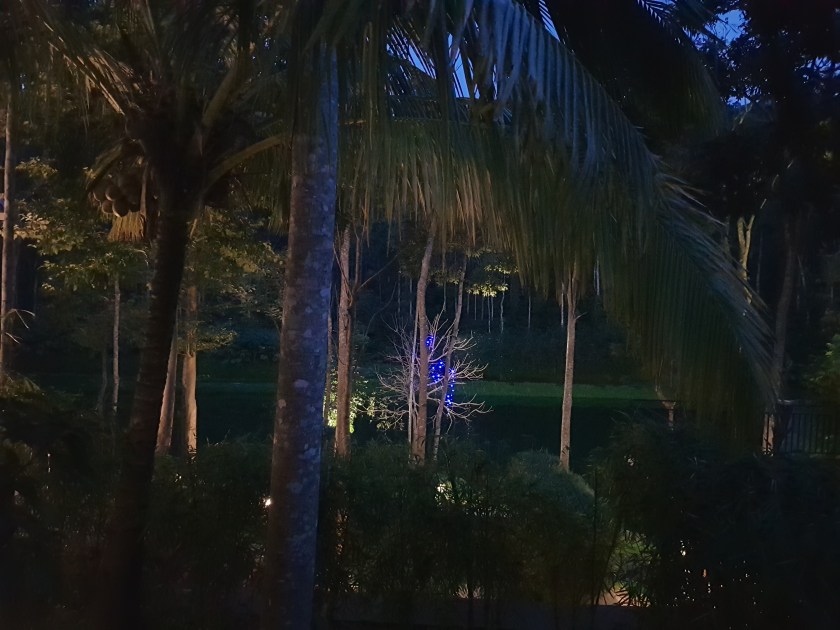
Women arriving for work on our last morning.Tinkly Lights! Happy Diwali, festival of lights!
After three wonderful days in the mountains of Kerala, we returned to the coast, this time to Alappuzha (also called Alleppey, thanks to the Brits). We spent very little time in town, but went straight to our lovely resort north of the city. Kondai Lip was a delightful surprise – it had been recommended by the tour company that arranged for Ansu, our driver, and we knew next to nothing about it before getting there. It continued the theme of peace and quiet that we had so valued in Thekkady, and which we truly needed after all of the bustle of life in Bengaluru.
We found a happy place.
While they told us about options of things to do (we could get a cab to a nearby beach or take out a paddle boat), all we really wanted was to sit and gaze at the beautiful view out our window. We interrupted the gazing only to read our books or play cards. This afternoon just felt like one long contented sigh. As dusk fell, the mood changed a bit. As we were reclining on the bed reading, we noticed a couple little gnat-like insects . . . and then a couple more . . . and then we looked toward the foot of the bed where the white cover was coated in insects and up toward the ceiling which was equally covered. Suddenly the peace was gone and Melissa called the front desk to tell them about it. They immediately sent two men over who said it was because of the rainy season, but that they would take care of it. Since it was almost time for dinner, we headed for the lovely outdoor dining room a bit early and left them to work some magic.
Dinner was entirely pleasant (if a little bland because we forgot to mention that even though we’re white, we still enjoy a bit of spice), and we were happy to see no evidence of the bug apocalypse when we returned to our room. Peace was restored!
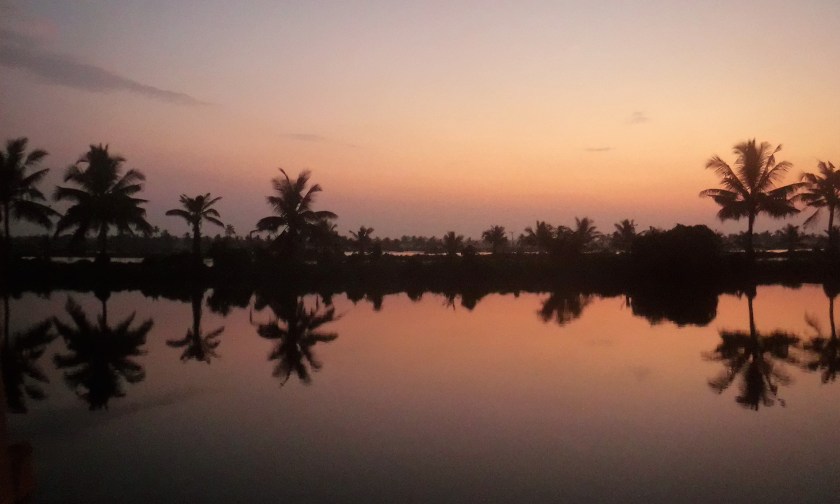
Melissa got up early to take in the sunrise from our deck.
Early the next morning, Melissa got up to watch the sun rise over the pond and backwaters beyond. The gorgeous view was worth the interrupted sleep. A few hours later, it was time to leave Kondai Lip and head for our houseboat. While sad to go, we were full of happy anticipation. Ansu met us back at the car and we drove an hour to a busy little dock area right at the edge of the sidewalk where we waited for our houseboat to arrive. When it pulled up, we were greeted by two young men who ushered us aboard our Bethel Tours boat and gestured for us to head up to the upper deck where two comfortable chairs were waiting for us. And so began 20 hours of watching the world go by as we cruised through the busy, idyllic backwaters of Kerala.
This slideshow requires JavaScript.
The next morning, our final morning in Kerala, we were greeted by a smiling Ansu who took us straight to the long, beautiful Marari beach where we put our feet in the Indian Ocean for the first time. Surprisingly few people were there, perhaps because we were there a bit early. All those on the beach with us seemed entirely happy about it. We took
Ansu was a fabulous fellow and delightful driver
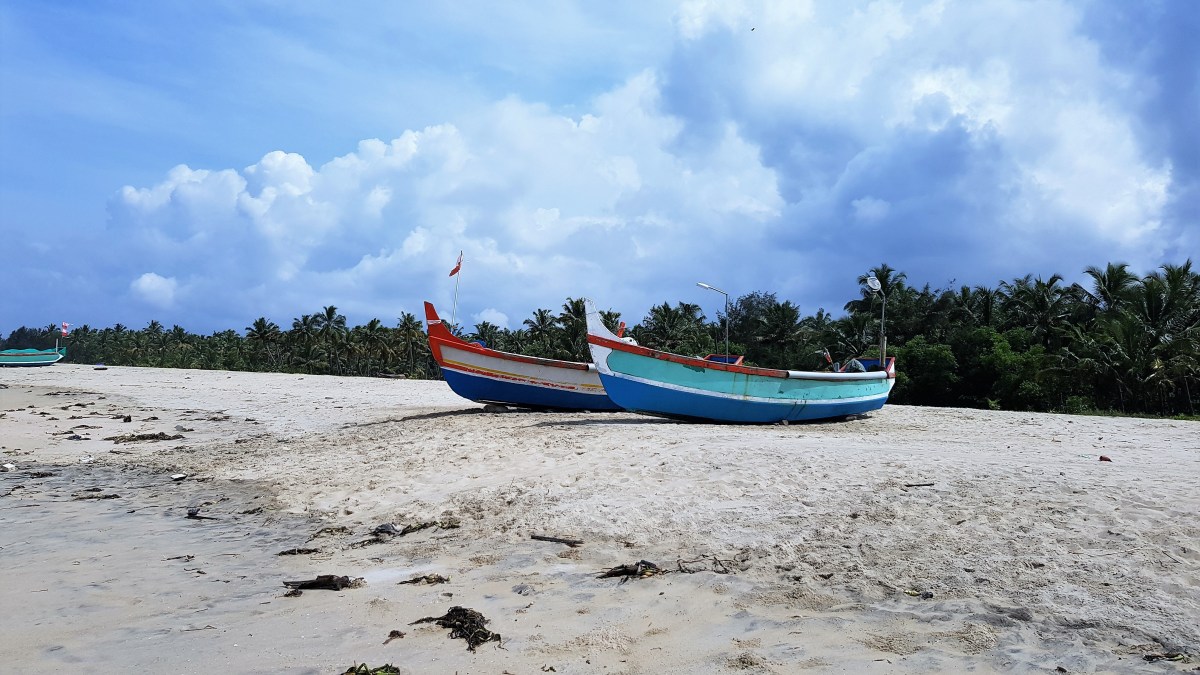
a nice walk along the beach, joined by Ansu who seemed perplexed by our lack of destination, but willing to go along. As we walked, we saw fishing boats and birds, and beautiful shells, but mostly we saw the vast blue ocean. With the temperatures and humidity rising, we agreed with Ansu that it was time to move on. He suggested that we spend the day at a big mall in Kochi. While that wouldn’t normally be much of a lure for us, the thought of air conditioning was appealing, and there really wasn’t anything else on our vacation agenda. Besides, we had the distinct feeling we were a bit of a disappointment to Ansu because the entire week we were on a mission to relax and didn’t really let him pick our activities based on what past tour goers enjoyed. We were in such a good mood after all of our relaxing, we even agreed to stop at a “local handicrafts” store that Ansu wanted to take us to. There wasn’t actually anything local about it, other than one small corner of the big 3-story store, and the many people working there were eager to the point of pushiness. We once again suspected that Ansu would get some kind of kick-back for taking us there, although if it was dependent on our purchasing anything, he was out of luck. The store was full of beautiful things, but our bags were full and we weren’t there for shopping. Our afternoon at the mall was largely spent walking in circles around each of the 5 floors, eating some adequate pizza and delicious ice cream, and brainstorming ways to take our restored equilibrium home with us.The flight home was effortless and uneventful – just the way we like it. It was good to be back home to our own bed and our own things, but Kerala will remain in our minds for a long time and we’ll certainly return.


 didn’t even begin to do it justice. This was a magnificent place to
  stay, particularly after the more rustic choice we made for Mahabalipuram. We were able to buy groceries, including good coffee and pineapples. We also got everything we needed for Melissa to cook a pasta feast at home on Christmas Eve. Tom even made carrot paratha on Christmas to go along with the meal that we otherwise ordered in.


 had been born on our first night there). We enjoyed the market with its jumble of beautiful
  produce, we found delicious French croissants and other tasty pastries, we strolled through the early 19th century botanical gardens where the French colonists had tested the strength of plants they wanted to plant there (and where the fictitious Pi Patel began his journey), and on Christmas morning we visited the gothic Basilica of the Sacred Heart of Jesus.


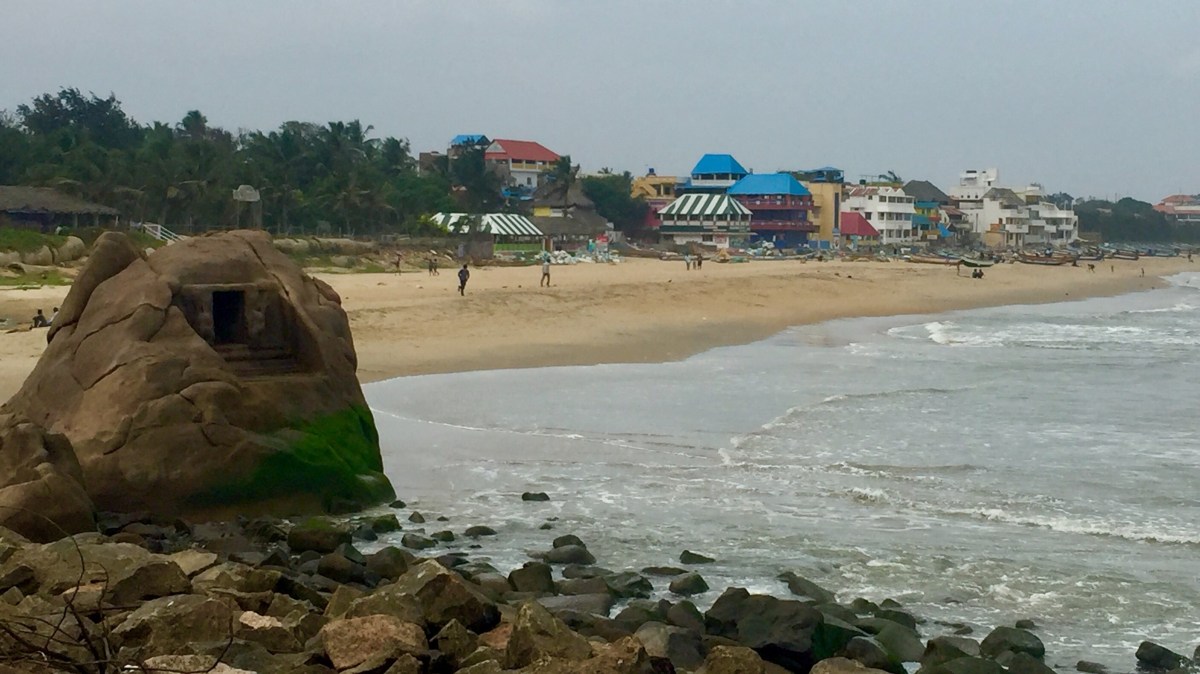


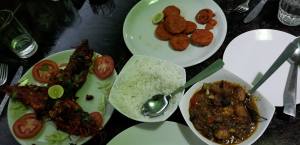 mostly, it was right on the beach. Laurence was amused by his interactions with the wait staff at both dinners, about
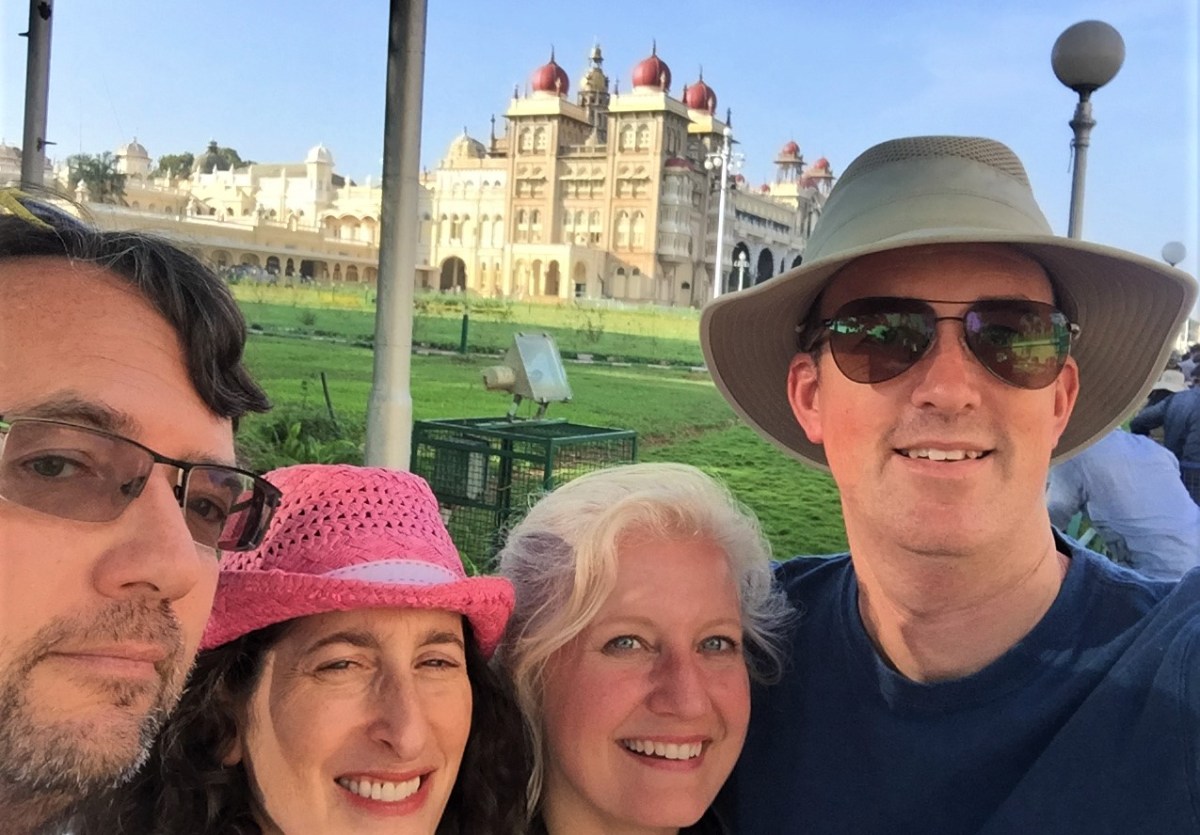
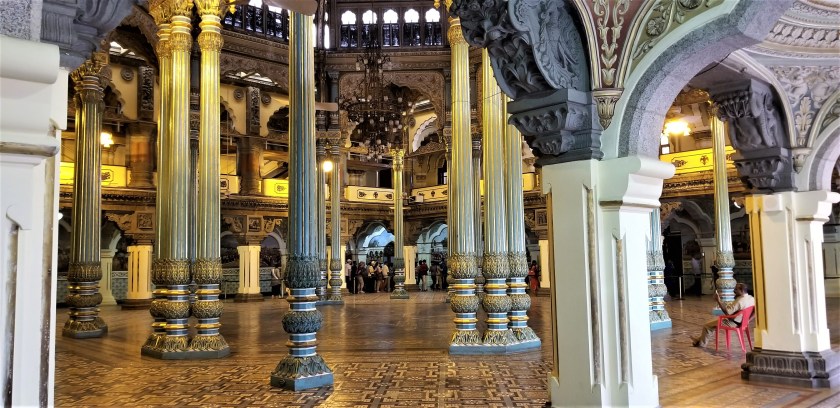 It turned in to a weekend of showing Rachel and Laurence some of the things we enjoyed doing on our first visit: we toured the Mysore Palace, walked through the market, went to the temples at the top of Chamundi Hill, dined at some fabulous places, and stayed at Southern Star Hotel (complete with their delicious paid-for-in-the-price-of-the-room breakfast buffet). All of these, minus the million extra people, were far more enjoyable and relaxing and meaningful the second time around.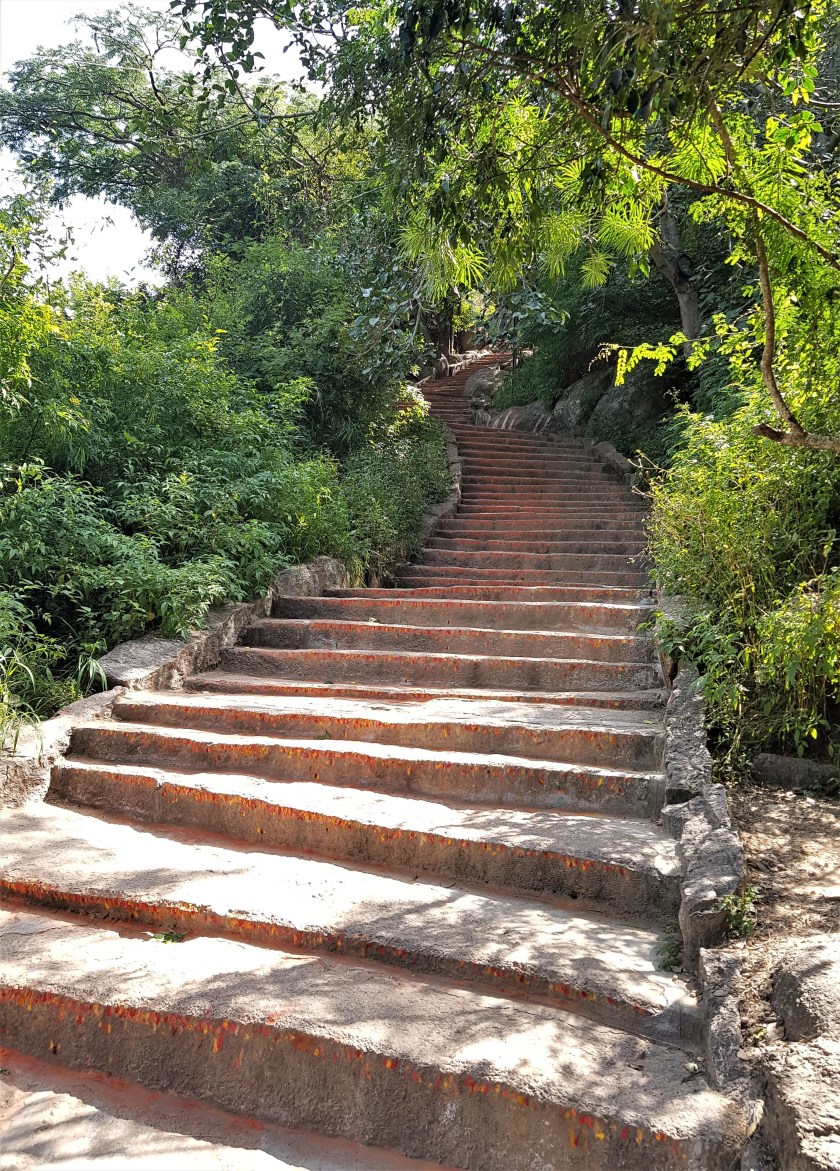





 From there we walked through nice neighborhoods, marveling at the minimal garbage and well-maintained sidewalks, totally charmed by the lovely storefronts and pretty buildings. We eventually found our way to Mattancherry Palace, built by the Portuguese as a gift for the Maharaja in the 16th century (largely as an apology for sacking the temple) and then expanded by the Dutch when they established themselves in the mid-17th century. From the outside, it doesn’t look like much, but inside there are magnificent 16th century murals covering the walls and an impressive display of old artifacts. There are also a lot of really informative panels that explain the history of Kochi and the whole Kerala region. We learned there about the matrilineal heritage of the royal family that ensured a valued place for women in the culture. One impact of this was an early commitment to educating girls as well as boys through the kingdom.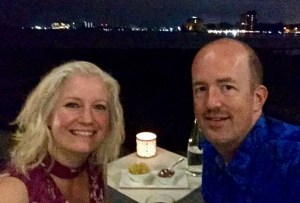










 Wellserton Wanderings