The Royal Afghan is the poolside restaurant at the ITC Windsor Hotel, a beautiful hotel built to look as though it’s been there for at least a century even though it was actually built in 1982. It opens at 7:30 and we got the earliest possible reservation at 8 pm. A sweet desk clerk walked us through other beautiful restaurants to get to ours where Melissa was greeted by name at the entrance (one benefit of making a reservation). We were led to a table apart from all others, right next to the pool. It was lovely with a nice view of the building and grounds, although the peace was a bit broken by the honking of cars on the other side of the wall.
The waiters were kind and attentive, putting bibs around our necks (for meat-eaters, this is a barbecue place) and bringing an array of wine bottles for us to consider. They actually had Erath on the wine list, which would have been an obvious choice if it hadn’t cost $150. Knowing Erath as well as we do, we also knew just how inflated that was and couldn’t bring ourselves to do it. Melissa chose the shiraj sangiovese Vino Della Casa, made by Fratelli, an Indian winery who we think brought in an Italian wine maker. It isn’t necessarily our new favorite, but not bad for Indian wine. They also brought us hand towels and explained that we would be eating with our hands, although they said they could bring silverware if we needed it. We assured them that we would eat the food the way it’s meant to be eaten, which made them happy.
After perusing the menu, we told our waiter what we wanted to eat, and he basically said no. We had neglected to order their signature dish, the Dal Bukhara, a black lentil stew that simmers over charcoal fire for 18 hours, and he was disappointed that we would not be able to taste more things. His solution was to offer half portions of four different
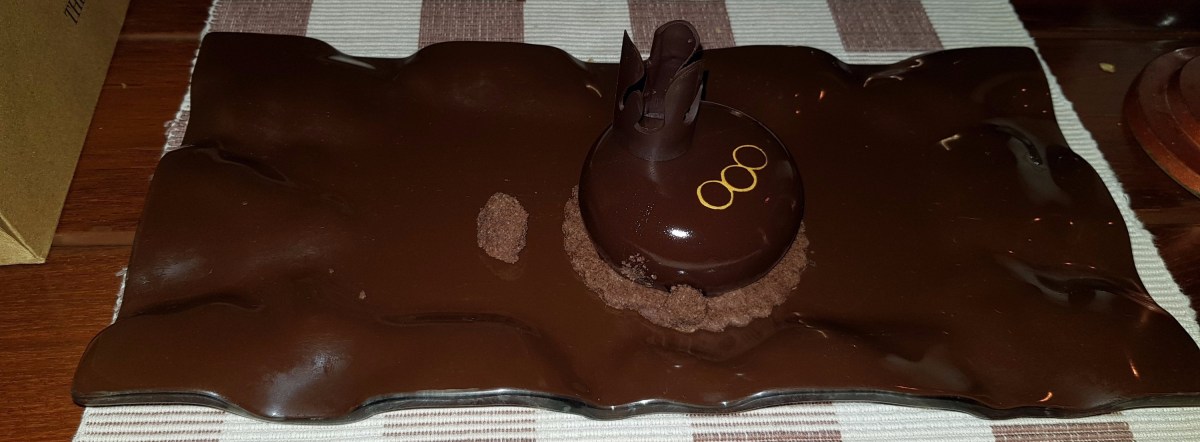
This is an entirely inadequate photo of an amazing meal.
dishes in addition to the dal, paneer makhani, and breads. It was a magnificent, if overly plentiful, meal. Melissa’s favorite was the Tandoori Phool, roasted spiced cauliflower that is breaded, fried, and then finished on the tandoor. It was amazingly delicious with complex, smoky flavors inside and a nice crispy outside. The Tandoori Simla Mirch was unlike anything we’ve had before, a green pepper stuffed with spiced veggies and cashews, then roasted. So good. The Tandoori Aloo was a peeled, hollowed potato, stuffed with cumin-seasoned potato mashed with cashews and raisins, then roasted in the tandoor so the outside became crispy while the inside stayed soft and flavorful. The Subz Seekh Kabob was probably our least favorite, while still being a very tasty blend of minced, rolled veggies, baked in the tandoor. The Dal Bukhara was just as good as our waiter suggested it would be, and the paneer in a flavorful gravy was quite nice.
At dessert time, we were asked whether we would like an Indian dessert or a chocolate dessert. As good as we’re sure the Indian desserts are, Melissa wanted chocolate for her birthday. A woman came out from the chocolate shop with an iPad to show us the chocolate desserts we could choose. They also gave us a quick primer on the growing chocolate industry in India. Apparently, they are still buying the chocolate itself from Brazil, but there are more and more chocolatiers here. There are also some farmers in Kerala experimenting with growing cocoa. We selected a gorgeous confection of chocolate mousse on a crispy chocolate cookie, coated in dark chocolate ganache.
Flechazo means “love at first sight” in Spanish. While the environment is perfectly pleasant, it wasn’t the sight that got us – it was the delicious food and enthusiastic service. The idea of MediterrAsian food lets them effectively cover all bases, which could have meant mediocrity across the board, but somehow didn’t. The approach was clever and fun and tasty.
There were a few signs of the quality that was to come. First, we had both independently found fabulous reviews of the place. Tom went to Melissa very excited to find a good idea of his own only to find out she already had her eye on the place. Then, there were only two reservation times available: 6:30 and 9:30. We opted for 6;30, which also happens to be opening, since we are usually in bed by 9:30. Finally, by the time they opened, there was quite a crowd gathered, eager to start their experience.
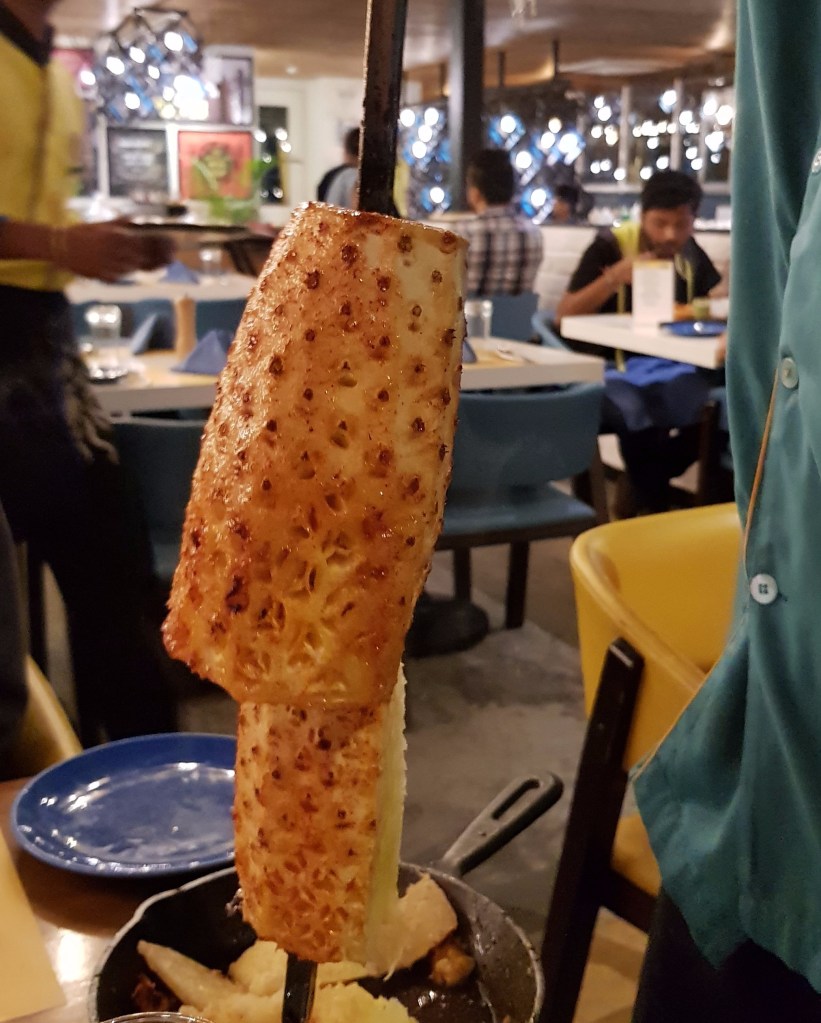
Spiced, grilled pineapple sliced at the table.
Despite two waiters giving us an introduction to our experience, we had no idea what was coming with the starters and were a little overwhelmed as they just kept coming. We had tandoori paneer tikka, smashed potatoes with cheese, breaded cauliflower and mushrooms with a tasty sauce, and a few other tasty treats. They even offered us french fries, which we opted to decline.
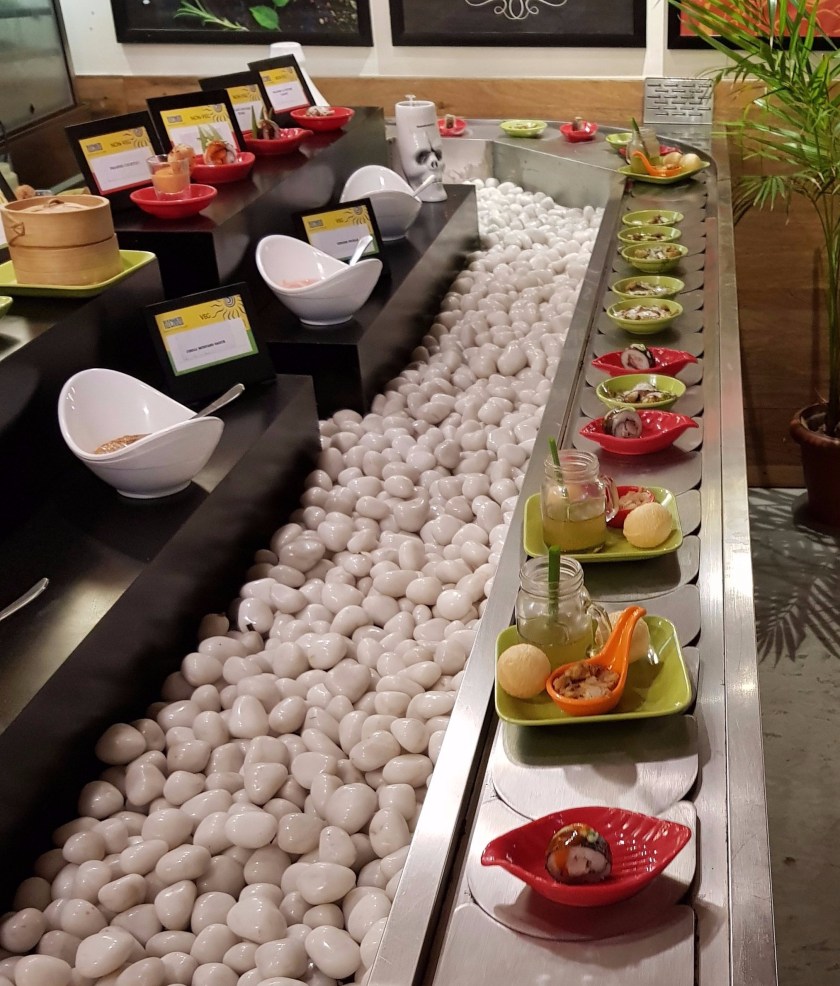
The sushi-go-round style Asian appetizers had veg items on green plates and meat items on red. The veg sushi had lots of wasabi, and the chaat with crispy crackers and delicious sauces was really tasty. We wanted the garlic spinach served in a little bamboo basket, but kept missing it as it came out.
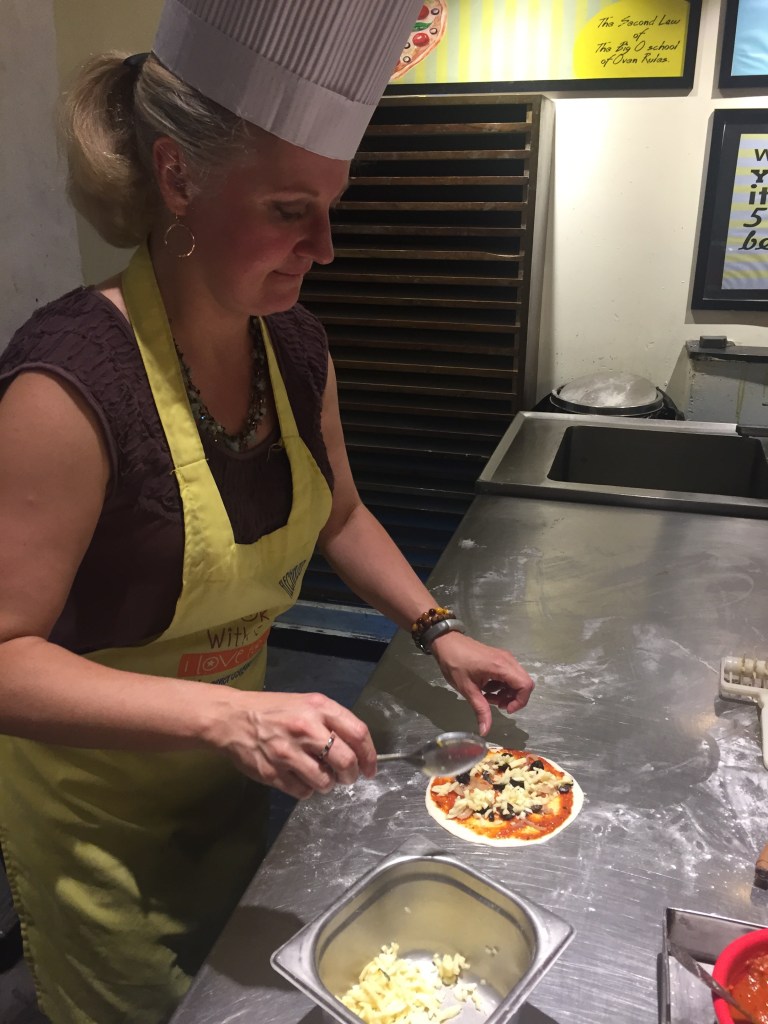
The pasta/pizza station was very much the highlight of the kid-friendly nature of Flechazo. Melissa made us a very tasty pizza. The waiter recommended a pav bhaji, a sort of a sandwich on a soft grilled bread with a potato lentil patty. As with everything else our waiter recommended, it was delicious. We ordered pasta from the pasta station – though it sounded delicious, we were kind of relieved that it didn’t show up. There was simply too much good food!
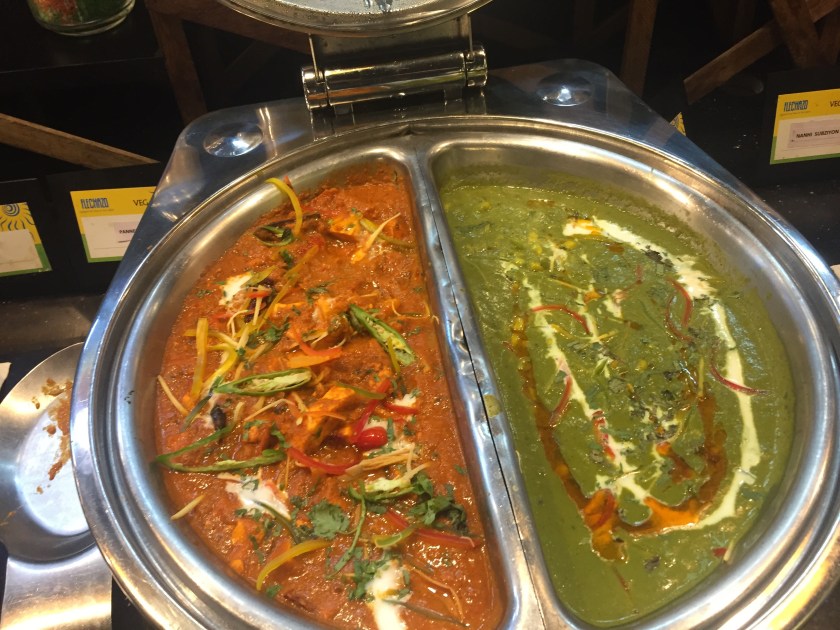
Although we were getting full, the Indian main courses awaited. We had the familiar — biryani and aloo muttar — and some new to us dishes — such as dal makhani. These were as good as any other we’ve had here. They delivered fresh made butter naan to the table as we returned with our full plates.
Finally, it was time for dessert. They have a huge, colorful, chocolatey display of desserts, but the highlight is the ice cream made to order using liquid nitrogen. Melissa enjoyed the mocha while Tom had the caramello, all while reminiscing of our favorite ice cream back in Portland, What’s the Scoop, made with the same process.
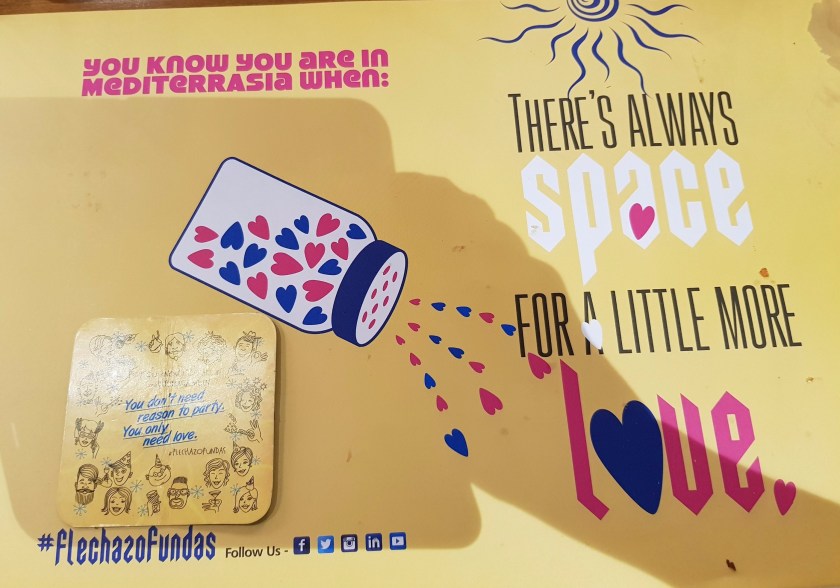
What Flechazo is all about.
As much as we enjoyed it, it’s probably even more fun with a group. We’ll plan an outing and go back with friends!
Even though we don’t live in a cloistered expat community, there is still the potential to live in a bubble, unaware of many of the challenges around us. That is not the way I want to live here. Sure, I will occasionally seek the bubble, but I also want to truly understand and be a part of life in India. With that in mind, I went on a social awareness tour conducted by Five Oceans, a local club that gave memberships to teachers at Tom’s school.
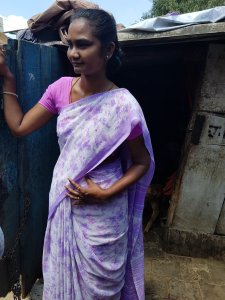
I was part of a group of five women who met our guide, Kaveri, a cultural anthropologist who has long interacted with and supported the community that she took us to visit. This particular slum was initially formed when the government gave a 25-year land grant to villagers lured to Bengaluru to work on new road development in this ever-growing city. Twenty-nine years later, it’s still there, home to 25,000 people who live in small homes of their own creation without plumbing, running water, or garbage collection. Children who grew up there now raise their children there, and yet there is joy among the garbage.
This slideshow requires JavaScript.
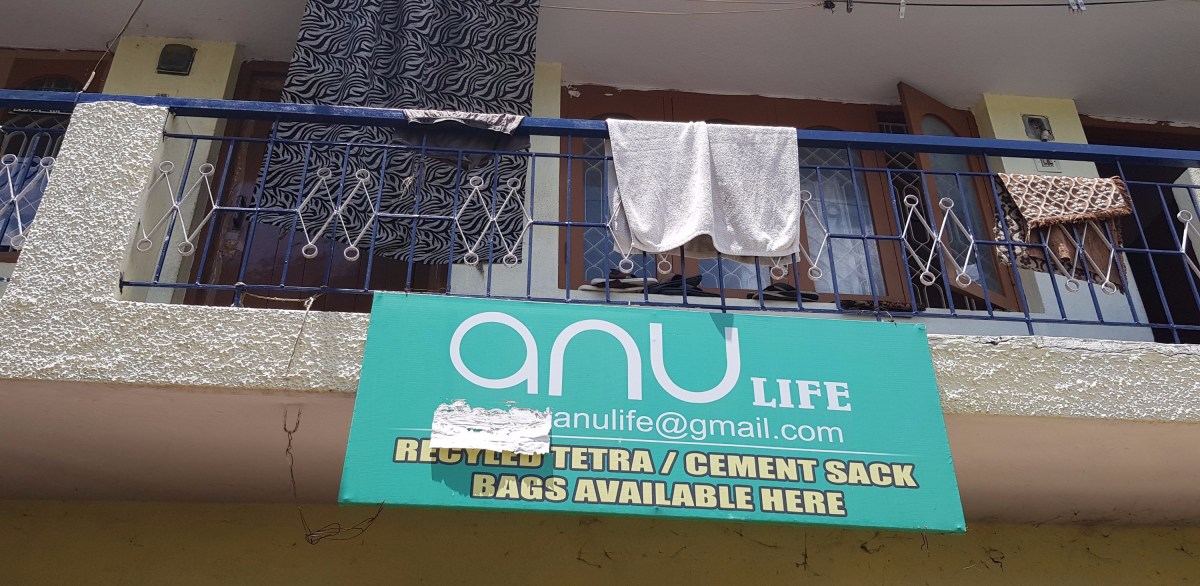
The focus of our tour was a group called Anu Life, created 8 years ago to give women in the Janakiram Slum the tools to support their families. It has done so much more than that for the 11 women who work there. Officially, it offers healthcare and education for the women and their children, helping them to learn the English that they need to succeed here. Unofficially, it offers pride and confidence, both unknown to these women before their involvement.
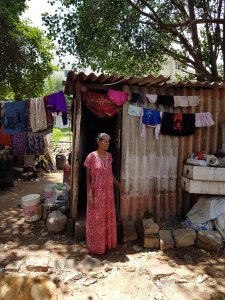
Kamala in front of her home
Kamala came to Bengaluru as a young child and worked with her parents on road building with no protection from chemical exposure or general safety. She grew up, got married, and had four children. When the fourth was born, she and the infant were both very ill with tuberculosis. Her husband sent her to his parents’ village, far away, where she was horribly mistreated. Eventually she was strong enough to leave with the baby and return to home in the slum. When she got there, she learned that her husband had run off with another woman and
Kamala tells us about her work with Anu Life
abandoned their children alone to scavenge in the streets. Kamala brought them all together again and got a job working nights for 100 rupees per night (about $1.40). It was a constant struggle. And then Anu Life recruited her as one of its first members. She is paid 200 rupees for every bag that she weaves (each taking about three hours to create), she receives healthcare for herself and her children, and she’s proud of what she does. She said that when she began, she was always scared and wouldn’t talk to anybody, but now she’s confident enough to talk to anyone. And she’s proud of her three older children in boarding school.
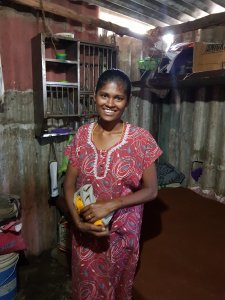
Sophia in front of her bed
Sophia proudly invited us into her home to see her two prized possessions: a large blue plastic rain barrel and a double bed on a metal frame. Water is a major factor in these women’s lives – it is an effort to get clean water to drink, do dishes, wash clothes, wash themselves; they are also at the mercy of any flooding. Sophia is able fill her rain barrel, occasionally with help from Lalitha, and doesn’t sleep on the floor where it’s often damp. Like Kamala, she has three older children at boarding school and one at home with her. She told me that she visits a different child each month so only sees the older kids every three months. She also told me that she is not sad when she says good-bye “because they must have a beautiful life and they can’t have that here.”
Lalitha’s home is up a flight of stairs. It’s tiny (about 5 feet by 6 feet with a 3 foot square L
Lalitha’s home as seen from the doorway
off one side which serves as her kitchen). As small as it is, she has two distinct advantages: the height means that she is not subject to flooding, and she has actual running water for two days each week which she shares with friends in need. She also has a distinct disadvantage. She shares her small home with her husband and three children. When she was asked if her husband works, she said, “No, he drinks.” We were then told that he beats her often and she’s just getting over a black eye. She also told us, though, that through Anu Life she has learned to stand up to him so it’s not as bad as it was. The other women spoke of her strength and generosity.
Anu Life means a great deal to the women who serve as its collective workforce and owners. They were taught the craft of making baskets and bags out of tetra packs (juice boxes) and of embroidering on old cement bags. Their supplies are otherwise garbage, but the things they make with them are lovely. They do, however, constantly struggle to find buyers for their work and nearly had to end their operation last month when they had no sales. Happily, a woman placed a large order and kept them going, and everyone who tours their operation buys something (I bought two bags that I love). If you’d like an Anu Life bag, let me know and I’ll make it happen!
Onam is an annual festival, generally occurring in September, that is celebrated across Kerala (to the southwest of us) and everywhere the Malayali people of Kerala live. Happily, that includes right here in Bengaluru, so we got to experience this multi-day festival in a few different ways. It’s notable that we were each told the Onam story a few times by different people with some significant variations so we’re not totally sure of the official version, but we’ll offer a little composite story here to get you in the spirit of the holiday.
Around 8000 BC, there was a wonderful king of Kerala named Mahabali (sometimes referred to as a demon king). Under his rule, everyone was happy, all their needs were met, and life was universally good. Because of this general contentment, people no longer felt a need for the gods (or alternatively, he conquered the gods to establish his rule). The gods were not happy with this and appealed to Vishnu to do something about it. Vishnu took the form of a small dwarf and went before the king during a festival when Mahabali had promised to give people whatever they requested. When Vishnu came forward, the king offered him riches and boons, but he said all he wanted was three paces of land. Mahabali, of course, agreed to such a small request. Vishnu then grew to immense size. With one pace, he claimed the earth and with a second pace, he claimed the heavens; he then turned to Mahabali and asked where he could take his third pace. Mahabali bowed his head for Vishnu to step upon. Because of his goodness and piety, Vishnu granted him one wish. He asked that he be allowed to return and walk among his people again once a year. During the ten days of Onam, it is believed that he is in disguise among us, so it is essential that everyone be kind to strangers just in case they are actually in the presence of Mahabali.
September 4 was the midpoint of Onam and a particularly auspicious day for celebration, so we each had the opportunity to celebrate separately last Monday. On Sunday, there was a celebration in our apartment complex that we participated in with some of our new friends. For all Onam celebrations, we were to be dressed in white or off-white so we got to do a little shopping in advance.
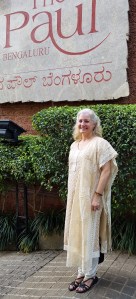
Melissa’s Monday: I was invited to an Onam lunch at the Paul Bangalore Hotel, a
small 5-star hotel built around a central covered courtyard where they have a restaurant with a lovely outdoor feel. It was fully decorated for Onam with flowers, hanging palm leaf decorations, and tables all preset with big banana leaves. I attended with a group of 5 women from the Overseas Women’s Club of Bangalore and the husband of the woman who organized us. As always, it was an interesting group of women. One from Malaysia who lived for years in the UAE before permanently relocated to Bangalore, one from South Africa with family ties in Tamil Nadu, one originally from Kerala who has lived in Minnesota for the last 30 years, and one who relocated from Texas just two weeks earlier. The lunch was an incredible experience with a man dressed as Mahabali wandering around the tables, constant live singing and drumming, women dancing, and a whole team of young men walking between the tables with metal buckets of food to serve. There was an unlimited supply of everything, but I couldn’t make it past my first round.
Melissa’s Monday: I was invited to an Onam lunch at the Paul Bangalore Hotel, a
Dressed up for Onam
small 5-star hotel built around a central covered courtyard where they have a restaurant with a lovely outdoor feel. It was fully decorated for Onam with flowers, hanging palm leaf decorations, and tables all preset with big banana leaves. I attended with a group of 5 women from the Overseas Women’s Club of Bangalore and the husband of the woman who organized us. As always, it was an interesting group of women. One from Malaysia who lived for years in the UAE before permanently relocating to Bangalore, one from South Africa with family ties in Tamil Nadu, one originally from Kerala who has lived in Minnesota for the last 30 years, and one who relocated from Texas just two weeks earlier. The lunch was an incredible experience with a man dressed as Mahabali wandering around the tables, constant live singing and drumming, women dancing, and a whole team of young men walking between the tables with metal buckets of food to serve. There was an unlimited supply of everything, but I couldn’t make it past my first round.
This slideshow requires JavaScript.
Tom’s Monday: Mine was far less lavish. We have a number of Keralans at CIS, so most of the staff dress up in the white and off white of Onam. It also means that the men wear a mundu, a traditional wrap with the gold trim of Onam. It was the only school day so far I have ridden the bus, so I got there super early to make sure I didn’t miss it. For a good long time, I was the only person, a big white person at that, dressed in such finery on our busy street. Those who know me will not be surprised to find out I was super self-conscious. Some of the Kerlan staff members brought some Kerala snacks — delicious fried banana chips and payasam (Kerala’s word for kheer). That was it for me.
This slideshow requires JavaScript.
Sunday at the clubhouse: Because we still can’t quite get the hang of India time, we left our apartment at 9:05, fearing we might be late for the 9am event. In reality, it started closer to 10:30.
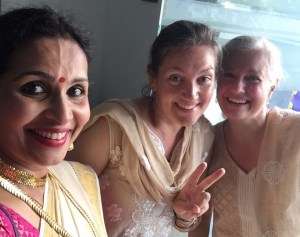
Colleen’s yoga teacher wanted a selfie
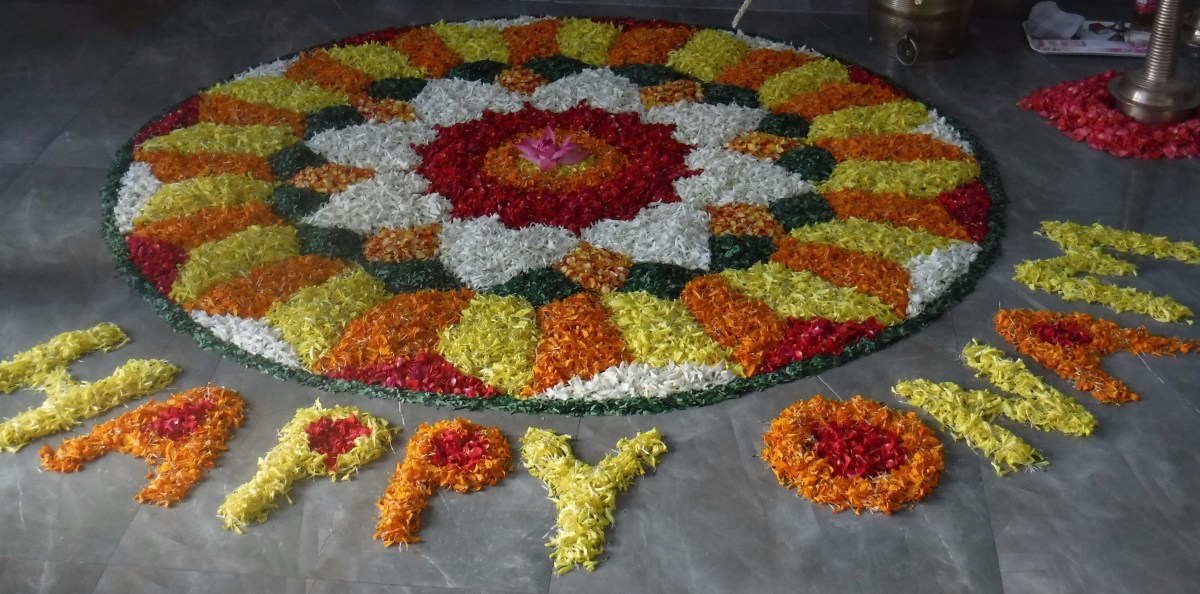
No worries – we had a lovely time in the meantime, admiring the beautiful flower mandala, chatting with people, and wandering around the complex. Everyone was beautifully attired with most of the women in white and gold saris with lots of gold jewelry. Even children were decked out for the day and many had important parts to play. The event
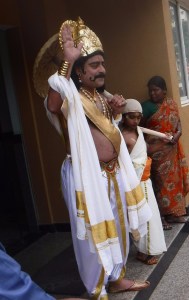
Look! It’s Mahabali!
started with the arrival of Mahabali and a young boy whose role we never quite determined. They were greeted with much joy and enthusiastic drumming. Then began the slow procession through the complex led by the drummers who were immediately followed by 16 little girls carrying plates filled with flower petals and candles (no one caught on fire, thanks to the woman watching them like a hawk from the sidelines), followed by Mahabali and all of the members of the community.
This slideshow requires JavaScript.
At times it had the feeling of a community block party, particularly when we got to ritual dances and songs which felt a little like a spirited community talent show.
This slideshow requires JavaScript.
After that, we all began lining up for lunch. Happily, we were advised to hurry for the first seating or we might have waited quite a while and we were hungry. The meal was served in the traditional manner on banana leaves without silverware and everyone was very pleased to see us enjoying it.
After the big bonanza of activity last weekend, we decided that this weekend it would be nice to slow. it. down. And so we did.
On Friday, we had a lovely lazy morning, enjoying our newly delivered furniture. It’s so nice to take some steps toward making this feel like an actual home.
When we’d had enough of the apartment, we headed for Angsana Spa and Resort.
We were told that Angsana is only about 10 minutes north of us and has nice grounds and good restaurants that welcome lounging. That all sounded pretty great to us, so we
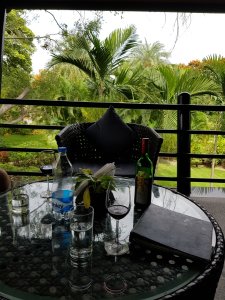
Lovely view for the afternoon. Note the bird in the upper left!
packed up some books and called an Ola. Ten minutes turned into a very long half hour when we came across construction that shut down half of the road. Kind of a bummer, but we were undeterred. Angsana itself looks like it’s seen better days – it could definitely use some paint and some pruning. The pool, though, is beautiful. If we’d been there to swim, we would have been delighted.
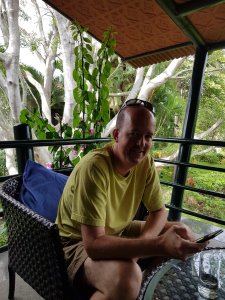
Tom relaxing
The first restaurant we checked out was lovely but closed. The second offered a tired looking buffet. The third was a charm – a deck with comfy wicker chairs and tables that we had all to ourselves. With a bottle of wine and a snack of cheese chili toast, we were happy to spend a couple hours watching the active birdlife in between reading.
The relaxation was a bit undone when we got home to a stuffy apartment without electricity. Power outages here are not uncommon – they happen multiple times a day, sometimes multiple times an hour – but usually last for just a minute or three before the generator kicks in and makes the essential ceiling fans start to rotate again. We could tell that there’d been no electricity for a while because the back-up battery on our UPS (uninterrupted power supply) which protects the wifi was fully drained. We asked a friend if her power was out and she responded, “Did you pay your electric bill?” Oops. It seems the receipt-looking thing in the mailbox did not belong to the previous tenant, but was actually our responsibility, and here in India, there are no warnings or second chances. Luckily, Tom was able to go downstairs to the maintenance office and learn how to pay online, a half hour after which our power would be restored. An hour later, he went to check on progress, and the nice guy in the office looked at the online receipts for payment and flipped the magical switch. Whew! That’s a mistake we’ll try not to repeat. New mistakes every day, right?
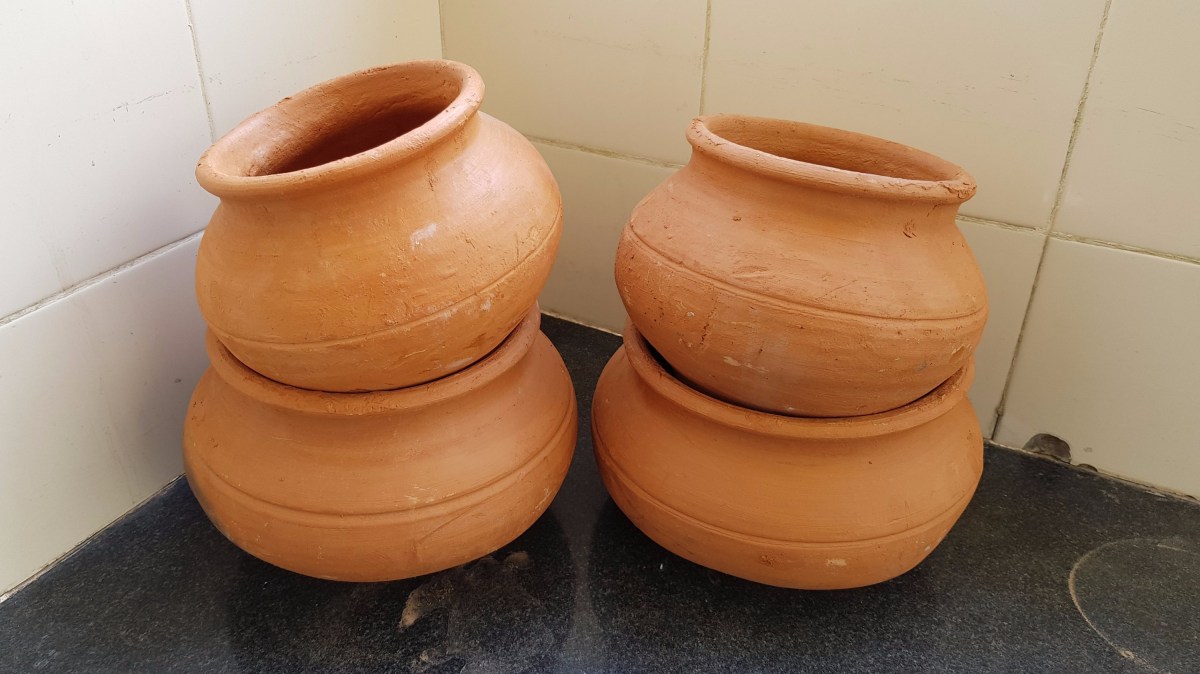
On Saturday morning, we continued our pokey pace, but headed out late morning to go to Pottery Town. It’s not actually a town, but a section of Bangalore where potters have lived for generations with each generation learning the craft from the previous. It’s small – just the streets around a single intersection – but each home has pottery arrayed in front or just inside for people to view and buy. Many of them have elaborate Ganesha statues arranged and apparently this neighborhood supplies vast numbers of the figures for the annual Ganesha Chaturthi celebrations. Our mission, though, was to find simple pots for for an herb garden on our kitchen deck and a vase to hold some peacock feathers in the living room, which we happily did.
We had a three day weekend because it was Eid al-Adha, a Muslim holiday which focuses on family and sharing one’s bounty. Part of the holiday comes straight from Abraham. The story goes that God was testing Abraham and ordered him to offer up his son as a sacrifice. When it was clear Abraham was going to obey, God told him to stop and sacrifice a ram instead. Today, Muslims on Eid al-Adha do the same — they kill a sheep (around here it seems to be goats), and the family eats some of the meat and gives away the rest to neighbors and the needy. How this affects us is that on our travels, we kept coming across large herds of goats waiting to be, let’s say, sanctified. Some friends who made the same trip a couple of hours later had very different and disturbing experience.
Melissa waiting for lunch.
From there, we got back in Anand’s car (Anand was our charming driver for the day, supplied by Madesh) and headed to the Jayamahal Palace Heritage Hotel. The Jayamahal Palace was once the home of Mysore royalty but is now an historic but middle-of-the-road hotel. We were there for a late lunch at the lovely garden restaurant, but the downpour kept us comfortably situated in the big wicker chairs on the covered deck. We always feel like we’re doing something right when we aren’t surrounded by white tourists, so this was certainly successful in that regard.
On Sunday, we explored the edges of our comfort zone. For brunch we went to the Mavalli Tiffin Room (read a complete review here) and could not have been more delighted by our choice. The experience was enhanced by the community tables which meant that we were joined by Nagesh, whose family was seated at the next table. He made sure that we ordered all of the best things and ate them properly.
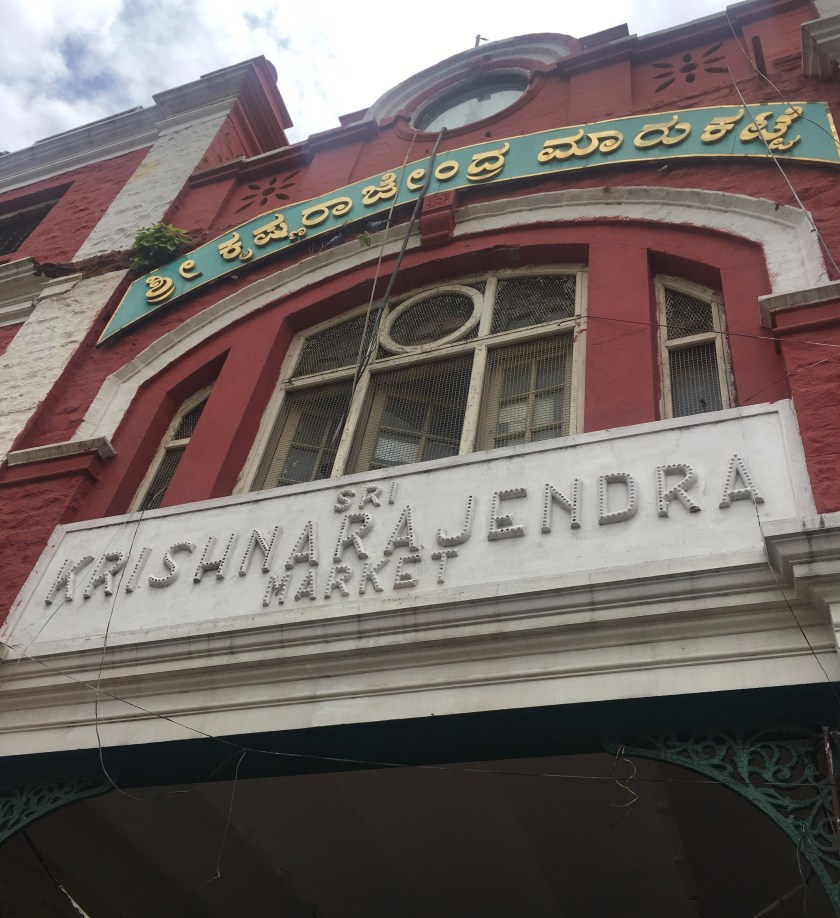
Entirely satisfied by our phenomenal (and very affordable) meal, we started the walk to the KR Market. We were emboldened by our wonderful experience the previous weekend and certain that we would enjoy our weekly shopping experience. The reality was a little different. We approached from a different direction this time and ended up walking down a long, muddy road lined with loading docks and frequented by lots of honking trucks. It wasn’t super pleasant, but we weren’t quite sure how to get out of the maze of streets and onto a better path. Eventually, we got where we wanted to be with much relief. Just outside the archway of the market, we successfully bought pasta without the use of language beyond a number, eventually figuring out that we had to first give him the money and then he would weigh and package the pasta. We then moved onto the fruits and nuts lady, who was very disappointed that we were only purchasing cashews. We were disappointed that the cashews weren’t much cheaper than the packaged ones in the store. We were even more disappointed that we allowed ourselves to be bullied into eating yucky raisins that we didn’t want to sample.
Passing through the archway, we were surrounded by a vibrant cacophony of vegetable sellers calling out their wares. We wanted to walk through and see everything before deciding what we’d buy to put into that night’s pasta sauce. We also wanted to wander through the floors of the market building in search of peacock feathers for our pretty new vase. The market wandering got confusing – as we got a bit lost, it became increasingly difficult to tell whether we’d been somewhere before, and increasingly more evident that there were no peacock feathers for sale. We knew we’d seen some the previous week so had a hard time giving up the search, but we finally admitted defeat when it really just wasn’t fun to look anymore. The combination of smells and chaos were simply overwhelming. Back outside in search of vegetables, we acquired cauliflower, carrots, onions, garlic, and tomatoes, but no peppers or herbs other than mint, cilantro, and curry leaves – time to start an herb garden! We also bought a big pasta pot which should come in very handy.
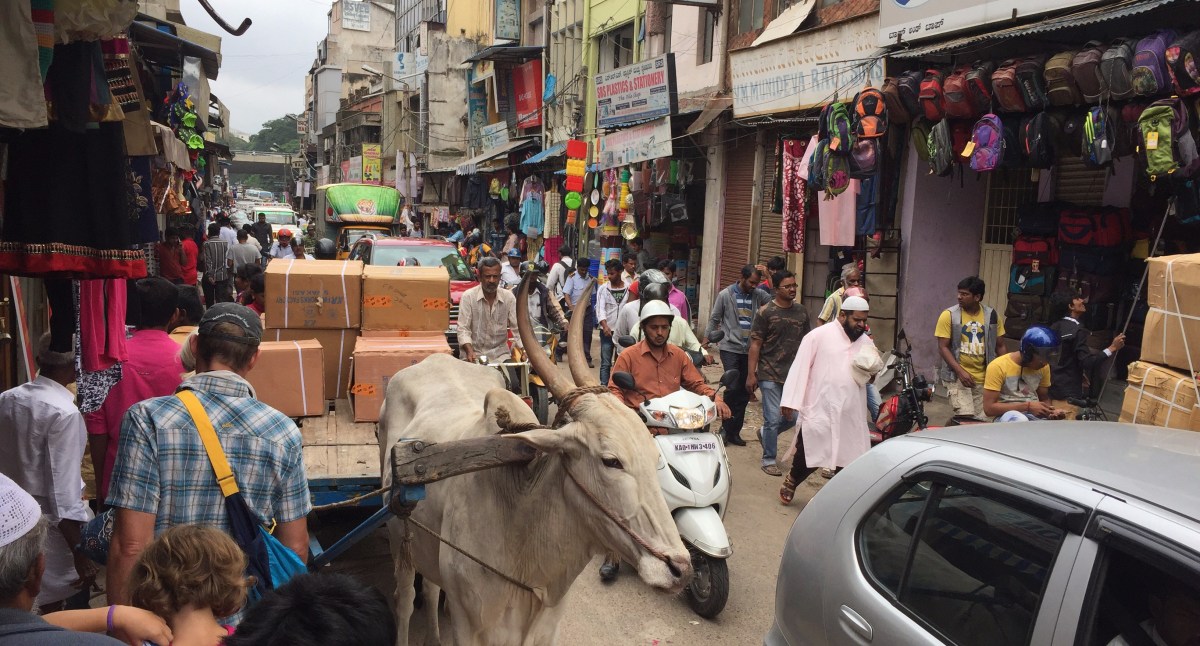
The truly challenging part of the escapade was the walk home. Surrounding the market, there were so many people, so many cars, so many motorbikes, so many trucks. There were also so many puddles, mudpits, and other fecal-related hazards. We needed to find a place from which to call an Ola home so had to find a quieter area, but we just couldn’t seem to get out of this crazy overwhelming maze. We wandered down one street with an unbearably foul odor, Tom stepped in a horrifying black puddle up to his ankle, and our patience was wearing thin. There was a bright spot, though, when Tom spotted someone across the street waving peacock feathers over his head. We bargained him down to half the ridiculous price he was asking, and clearly still paid too much, but were glad to go home with them. Finally we found a quiet alley with a little hotel at the end of it and called an Ola home. Back home, we unloaded our bounty and scrubbed our feet and shoes. Next time, we’ll plan our escape route a bit better. Still, we were proud, if also overwhelmed and exhausted.
In her research about Bengaluru, Melissa kept coming across one must-experience restaurant over and over again: Mavalli Tiffin Rooms (MTR). It was billed as authentic, delicious South Indian food, and a lot of it. Apparently, it is particularly popular around breakfast time; we went in expecting a 45 minute wait for breakfast. As lovers of Gravy back home in Portland, we know that sometimes 45 minute waits happen for breakfast because it’s just good food.
We were not disappointed. The food was delightful, which we’ll get to in a moment, but what made the morning especially great was our dining partner. MTR crams people in as efficiently as they can, so you count on sharing your table with others. Sure enough, the host seated Nagesh with us. Nagesh is originally from Hampi but has lived in Bangalore for 35 years, and MTR is one of his favorites. Today, he came with his kids and cousins. We reaped the benefit of his knowledge. Before Nagesh got there, we were not presented with a menu but were asked to order. We ordered what we know, idli and masala dosa. Once Nagesh got there, he made sure we had the whole shebang.
Eventually, we had six different dishes, each with its own character. The idli itself was much like what Bharti, our cook and cleaning lady, more on her another time, made for us a couple of nights before but had cashews and herbs cooked in. The sambar that came with it was just as delightful. The kharabhath was the first item we had never heard of before and was delicious. It is some sort of a semolina flour cake with all kinds of veggies and spices. Then came the sweets that Nagesh made sure we ordered. The standard jamoon was great, but the highlight was the chandrahara, a hard spiced cardamom cookie in some sort of a coconut custard. Next came our masala dosa, which was as good as advertised, with a nice crispy dosa wrapped around delicious spiced potatoes. We finished with a breakfast dessert called “Fruit Mixture,” basically a fruit salad with what tasted like a mango ice cream topped with more fruit salad. We know a few niece and nephew fruit bats who would have flipped over this.
Rava Idli and Kharabhath
Masala Dosa
Fruit Mixture
After a nice cup of coffee, we were so incredibly satisfied with both our meal and our new friend. After a fabulous brunch splurge at the Leela Palace last week, we were also pretty happy with our bill which came to about $7.40 for the two of us.
For our Ganesha Chaturthi 3-day weekend, we decided on a full downtown Bengaluru immersion. And just like that, we fell in love with this city.
On Friday morning, we called Madesh for a ride to our home for the weekend, the Oberoi Hotel. Melissa had requested an 11 am check-in, but the traffic was so light (likely because of the Ganesha Chaturthi holiday) that we got there just after 10. Nonetheless, they had a lovely room ready for us, overlooking the 100-year old rain tree. Check in at this beautiful 5-star hotel was a very formal process that included an introduction to the ipad that we’d use to control the lights, temperature, and TV; order food or special pillows; or request the services of our butler (!).
Oberoi grounds
The Oberoi lobby
Oberoi grounds
The hotel is located on the Mahatma Gandhi (MG) Road which was classified as a national highway, and a new law passed last year makes it illegal to serve alcohol within 500 meters of a national highway. While it was unfortunate that our hotel was dry, we were prepared with our own bottle of wine and pleased to have gotten a good deal as a result. (This week the MG Road was reclassified and is no longer a national highway. Huge relief for all of the bars and restaurants clustered around it.)
Our plan for the day included a lot of walking so we could see as much as possible of the downtown area while hitting a number of key places. The plan was to start with lunch at the Mavalli Tiffin Room, famous for huge, delicious, south Indian meals. Luckily (or perhaps sadly), we checked on the way there, though, and determined that they were
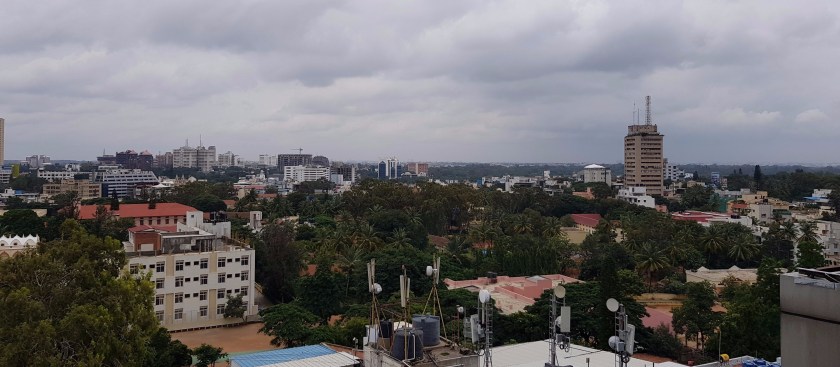
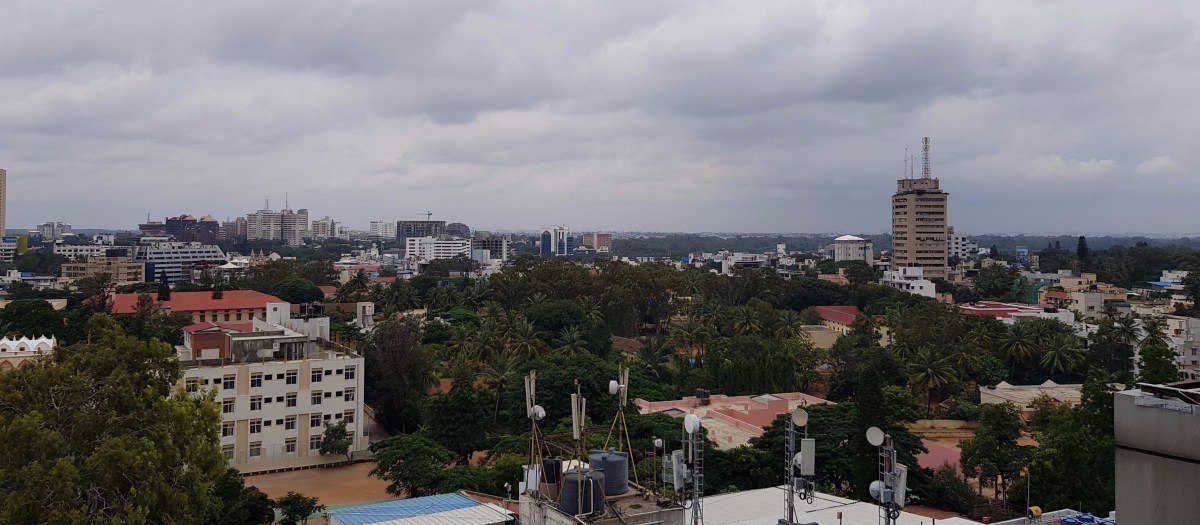
closed for the holiday. We hastily looked for nearby options and salvaged the meal with a visit to Bangalore Brew Works, forever on a quest for a good India Pale Ale in India. The 10th floor rooftop pub was perfectly pleasant, if not ecstasy inducing. The best part was the lovely view of the city, really showing what a green city it is.
View of downtown from the roof top restaurant
The walk gave us exactly the orientation we hoped it would. We walked through a super clean, fancy district, a neglected bit of street, a bustling commercial district that seemed to be mostly car and bike shops, and what seemed like the Catholic district — schools of all ages, a convent, and a church.
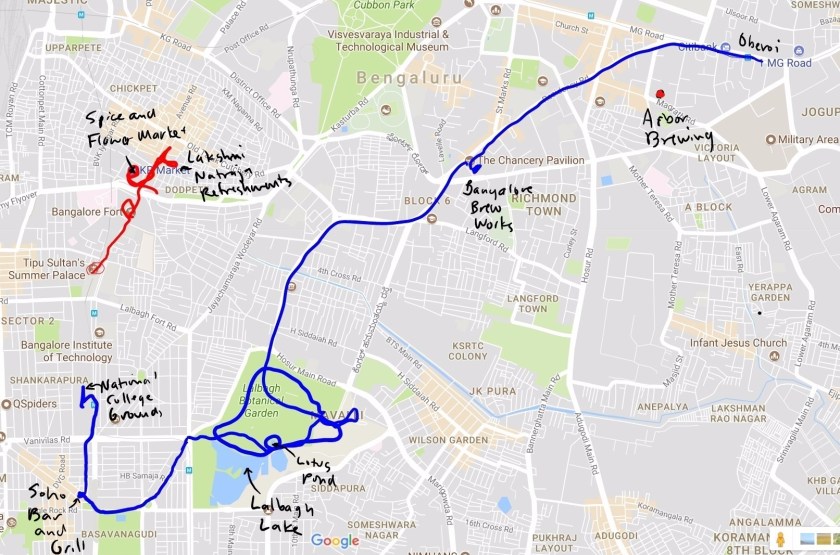
The blue line shows our Saturday walk, while the red shows Sunday.
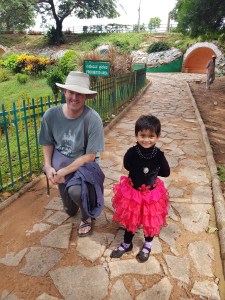
The next stop on our walk was Lalbagh Botanical Gardens where we spent a few hours walking nearly every path of the park. The gardens are lovely, and it would have been entirely relaxing if not for the 15 or so “selfie” requests. These requests are difficult because there is absolutely nothing wrong with any one of these lovely, happy people asking for a photo – it just becomes a problem when we don’t get 10 minutes free between posing. We’re not models.
By the time we left, we were hot and tired and needed a break, so we headed for the Soho Bar and Grill, walking through a really fun and lively bit of town on our way there. Soho, however, is not a place we’ll revisit. Tom’s beer was ok and Melissa’s cosmopolitan was fine, but Soho seems to specialize in hookah, with smoke wafting over both of their otherwise lovely decks. When we finished our drinks and asked for our check, they brought two more and told us it was two-for-one day (or maybe the two-for-one time of day – not totally sure). We had a couple more sips, but didn’t really want two drinks at that point so got going pretty soon.
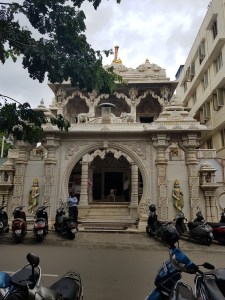
From there, we started our walk to the National College. In an effort to avoid the noise of traffic, we went down a quiet alley filled with motorbikes and happened upon a huge Jain temple with service in progress (Paryushana is an 8-10 day holy event focused on forgiveness, but we didn’t know that when we happened upon the temple). Right next door to the Jain temple was an equally impressive Hindu temple.
We continued our walk, arriving at the National College Grounds for the Bengaluru Ganesha Chaturthi. Quite a spectacle! By 7:45, the main performance hadn’t yet begun and we were fading after having walked about 10 miles that day so headed back to luxuriate in our hotel room.
On Saturday morning, we headed down to the hotel lobby at 7:30 to meet up with some of our new friends (Ivana, a second grade teacher from Spain who taught previously in South Korea; Sarah, a middle school teacher from Virginia who taught previously in South Korea and Puerto Rico; and Colleen, Ethan, and their kids who joined us on our outing to the Nandi Hills, from Lopez Island of all places) and Tej, our guide from Unventured Tours. For the next 5 hours, Tej took us on the Downtown Market Tour – it was great!
Beautiful carving 1
Entering through the gate after stowing our shoes next door
The balcony from which Tipu Sultan addressed the commoners. Elites were on the other side.
The main entrance to the fort has huge doors with spikes at the top to poke the eyes of enemy elephants charging the fort
Pasta and other dry goods outside the market.
These are the powders in bulk. Be careful!
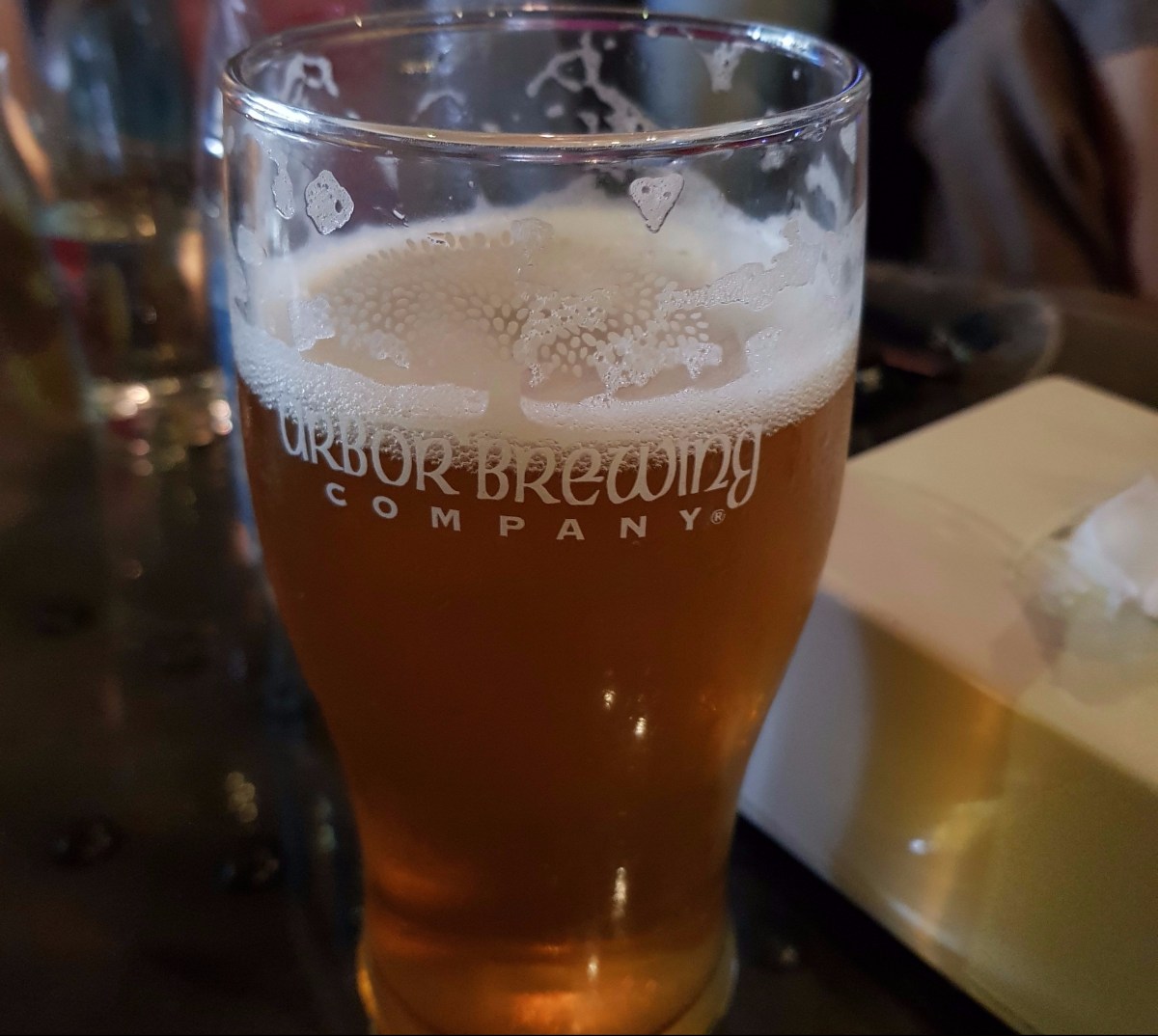
When we parted company with Tej, we went to Arbor Brewing, an off-shoot of a brewery started in Ann Arbor and finally had a really tasty IPA along with some pretty good food.
From there, we began a crazy odyssey in search of the Zefo warehouse sale. Zefo had been recommended to us as a good place for second hand and overstock furniture. Since we’re in need of a household worth of furniture, the sale sounded like a good idea to us. According to the map, it was in Southeast Bangalore where we had not yet ventured, so we called an Ola (Bangalore’s alternative to the ubiquitous Uber) and piled in with Sarah and Ivana. When we got to the address, it was a residential street, and we pulled up to what looked confusingly like an apartment building. As we were trying to figure out what to do, we asked a passing young man if he knew where Zefo was and he told us it was on the 4th floor of this unmarked building. We unwittingly let our Ola driver go and made our way up to the 4th floor only to discover that these were the offices of the Zefo internet company. Baffled, we asked some folks there where to go and they gave us an address 30-45 minutes further southeast. Sarah and Ivana had had enough and wanted to go home so we called them an Ola and sent them on the 90 minute drive home only to then discover that we couldn’t have two Olas in action at once. Tom downloaded the app and we called another car and then we waited and waited and waited.
Finally our driver came and took us to the warehouse which was a disorganized zoo with most of the furniture still packed up and salespeople showing it to you on their laptops – not so different from what we could have done from the comfort of our homes. Actually, it was less comfortable than doing it from home because the demand on the wifi was enormous, so it was slow and frequently dropped. Then we learned that the “sale” was 5% off which didn’t even offset the cost of the transportation to get there. On the upside, they did have unwrapped couches and chairs so we were able to sit on them and determine that many were no more comfortable than what we have (although they all smelled better). We picked out a few things, but felt pretty done with the whole experience and decided to head back to our hotel and continue the shopping from home (which we did – we’re expecting it all by the end of the week).
Back at the hotel, we prettied up in our luxurious room and headed down to Rim Naam for a glorious thai meal that concluded with complimentary dessert, a gift of Oberoi mugs, and, yes, a request from our waiter for a selfie.
The pond we overlooked during dinner
Outside Rim Naam
Inside Rim Naam
On Sunday, we awoke just before our coffee and masala chai arrived with lovely little cookies, and allowed ourselves a leisurely start to the day. We slept fitfully the first night in the hotel (I guess we’re just not used to comfortable beds anymore), but the second night was lovely. At check-out (another formal, seated process), we rather awkwardly asked for assistance making a brunch reservation at the Leela Palace where Melissa had previously gone for a meeting of the Overseas Women’s Club. Not only did he make our reservation, but he also offered to get us a cab. He was clearly surprised when we told him we wanted to walk the 3 km, and perhaps we should have paid attention – it was not a pleasant walk. It was long and muggy, not terribly interesting, and required passing a couple foul smelling dumping sites. Such a relief to arrive at the beautiful Leela Palace where we had a little time to explore before our reservation.
Citrus, the restaurant serving brunch, has a really nice outdoor area with live music and a pretty water feature, but we’d had enough humidity to be pleased with an indoor table. The food was incredible and varied, but perhaps the most exciting part was the cheese. Oh, glorious cheese! This is not a land with many cheese options other than paneer. The “milky mist” cheese is a bit rubbery and doesn’t melt. Even the imported cheeses don’t seem quite the same. But at the Leela Palace, they had camembert and provolone and emmentaler and so many more delicious cheeses. So good!
After our very relaxed and enjoyable brunch, we headed out to walk to Ulsoor Lake, but got caught in a downpour and decided that we were ready to return to our little apartment in the north, entirely contented with our weekend.
It’s debrief time. You have just experienced the most Indian of markets, were overwhelmed with fabulous aromas, beautiful colors, and generous people. How do you process it all? Why, you go to a most American of brewpubs, of course.
After saying goodbye to Tej, our tour guide for the day at the market, our entire crew of eight headed to Arbor Brewing for a late lunch and a beer. As much of a cultural shift as it was, it was a very good choice. The beer was the best we’ve had yet, the food was tasty, and the people were delightful.
Let’s start with the beer. The first surprise was that there wasn’t one but two IPAs, a session IPA, the Beach Shack; and their standard American IPA, the Raging Elephant. We both got the session IPA, which was ever so slightly better than the other IPAs we have had, and Ethan got the Raging Elephant. He won. It was head and shoulders better than anything else we’ve had in Bengaluru. It would have been a middle of the pack IPA in Portland or even his (far inferior) beer town of a home town, Seattle and the San Juans. We were just so excited to have such a tasty beer that we kind of experienced it as the best beer ever. Tom’s excitement was slightly tempered by the fact that the name comes from [shudder] Ann Arbor, Michigan, where the owner graduated college and frequented the pub of the same name before coming home to Bengaluru to open his version.
That’s Ethan in the foreground and his son Quinn at his own table behind.
The next best part of our experience was the staff. They were just so ridiculously friendly and attentive. Instead of the all-too common urgency to please, they just kind of chatted with us and were on top of our every request. The best part was how they handled the kids. Ethan and Colleen’s kids, Shea and Quinn, started out at a table of their own. Once the food started coming, Shea ended up at the adult table with us leaving Quinn on his own. The staff loved on him. They chatted him up, joked with him, brought him his own bottle of water, and generally made him feel important. It was adorable.
We forgot to take a photo before diving in. It was delicious. Trust us.
The food was great. We only ordered the onion rings (really really good) and the Grilled Cauliflower and Broccoli Skewers (outstanding). The skewers came coated in a masala rub that was so delicious we didn’t even bother with the “magic mustard” dipping sauce it comes with. Everyone seemed pleased with what they ordered — pizza, salads, sandwiches, and tacos.
We debriefed the amazing day we had, ate and drank all forms of deliciousness, and headed back out in the world happy and satisfied. We’ll be back.
We were walking through Bengaluru, having a wonderful walk, headed toward the highly recommended Mavalli Tiffin Room for lunch, when we realized, “It’s Ganesha Chaturthi! I wonder if they’re open!” Sure enough, closed. Rats. A quick search for alternatives, though, showed that we were near not one but two microbreweries. We settled on lunch at Bangalore Brew Works (and ended up at the other, Arbor Brewing, the next day).
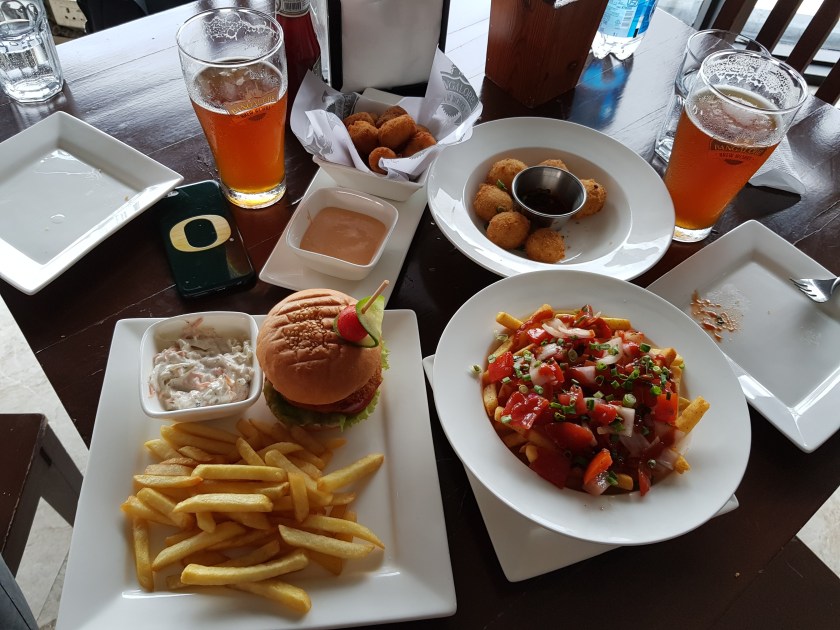
We’re not sure we ordered our food very well. We ended up with three fried foods: corn and cheese balls, Indian loaded pots (essentially India’s answer to poutine), and potato and cheese bites. We also got the “Cottage Cheese Delight Slider”, which came with more fries. Oof. Veggie burgers around here are in general quite good — potato and lentil based with varying amounts of masala flavoring and other goodies — and this one was exactly that, quite good. That other stuff all would have been perfectly fine, if we had only one of them. As it turned out, it was a whole lot of fried food. For what it was, it was good enough.
The beer was ok. This is only the second local IPA we had had, but we were starting to worry that IPAs here aren’t the same. Like the one at Druid Garden, it was a little maltier and the yeast was a little, let’s say, Belgianier.
They highlight of the place was the view. It’s on the 10th floor of a building that looks out over what feels like the entire city. There are several spaces, from quiet to raucous, each with its own version of the view. Down one hall, they even had their own poolside bar.
We got there before it was officially open, and by the time we left, there might have been one other group there, so we had the place to ourselves. To this point, we had pretty much either experienced service that was either overwhelming and pushy (in restaurants and stores) or hard to flag down. The young man helping us here got it right. He kept a comfortable distance, but was on top of it when we flagged him down.
Everything at Bangalore Brew Works was good enough. If we end up here again for whatever reason, we’ll be happy. We probably won’t go out of our way to come again.
The Downtown Market Tour offered by Unventured Tours is also called the Pete (with both e’s pronounced like the E in egg) Walk, and our guide Tej was outstanding. She started by sitting with us in our hotel courtyard and talking a bit about Bengaluru, stressing the fact that she loves her city and the good people in it. In that context, she said, “People will stare at you, but they don’t mean you any harm. They’re just staring at the flamingos.” With that simple statement, she reframed one of the things that has felt really challenging here – of course they’re staring! If we saw a crowd of flamingos walking down the street, or even just one flamingo walking down the stare, we would absolutely stare at it, but certainly without any malice. We might even want to snap a picture 🙂
After giving a brief history lesson, Tej took us to the Shree Jalakanteshwara Swamy Temple, a temple dedicated to Shiva and built before the 13th century. She showed us how to make an appropriate offering of the god’s favorite things (including holy basil, turmeric, coconut, incense, pine resin, and other herbs and spices) and how to then receive the blessing of the priest. The blessing includes waving smoke over our faces, drinking holy water mixed with camphor, sprinkling that holy water over our heads, and then putting a silver cone over each of our heads. Most of these rituals focus on the gods sharing their energy with us.
This slideshow requires JavaScript.
We walked around the temple and got a very brief orientation to Hinduism before heading to Tipu Sultan’s Summer Palace, an absolutely beautiful 18th century building. While there, Tej told us all about Tipu Sultan, a fascinating figure, responsible for not only mightily resisting the British occupation, but also for uniting previously disparate kingdoms to engage in that resistance, a union that ushered in an “Indian” identity for the first time in the long history of the subcontinent.
This slideshow requires JavaScript.
We then went to the Bangalore Fort, built by Tipu Sultan and still well-maintained and very impressive. One thing you won’t see in forts in the Western World, no matter how old: spikes ten feet up on the door intended to gouge out charging elephants’ eyes.
This slideshow requires JavaScript.
By then, we were all hungry, particularly the kids, so it was time to eat. Tej took us closer to our final destination of the KR Market, via some very busy streets and then down a long quiet alley to Lakshmi Natraja Refreshments. We would never have found this place without her and it was great! It’s apparently a place frequented by locals in the know, but not tourists, which seemed clear once we were inside. The environment is very bare bones – just metal benches arrayed around the room with no silverware or napkins. Tej ordered for all of us: Puda masala dosa with coconut chutney (sort of a pancake that’s crispy on the outside and soft of the inside, folded over and stuffed with deliciously spiced potatoes, onions, and lentils) and South Indian filter coffee (strong with the milk already added). Heaven! At the side of the room is a sink where you wash your hands when you’re done eating with them.
This slideshow requires JavaScript.
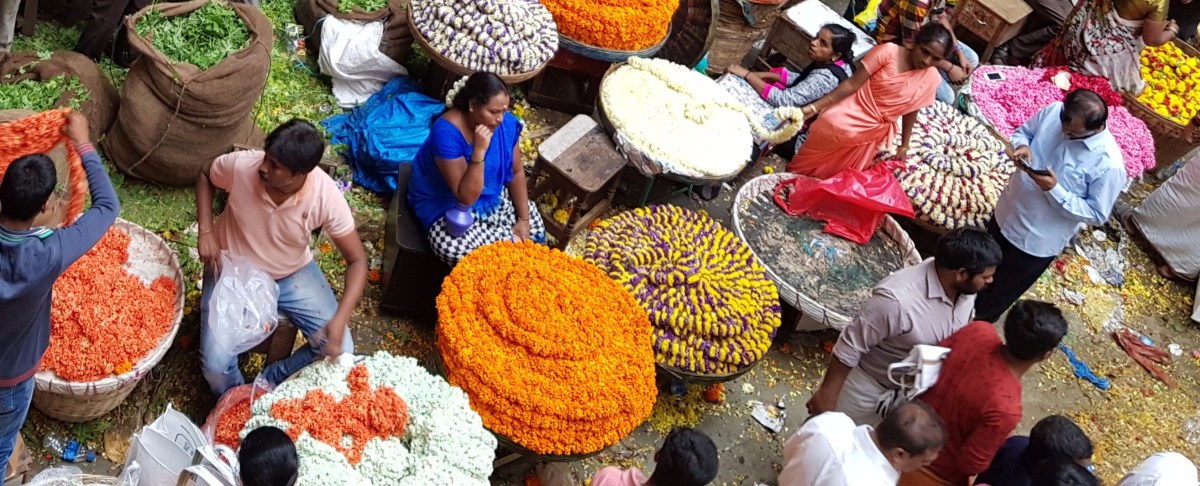
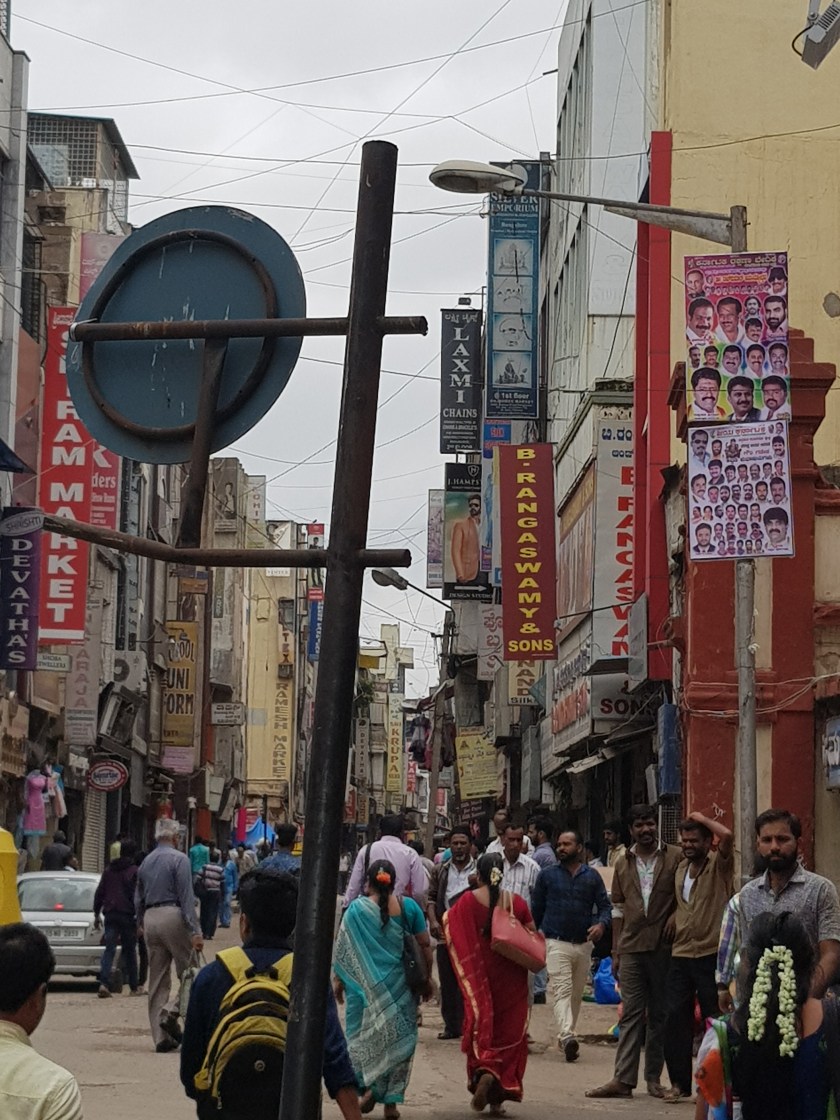
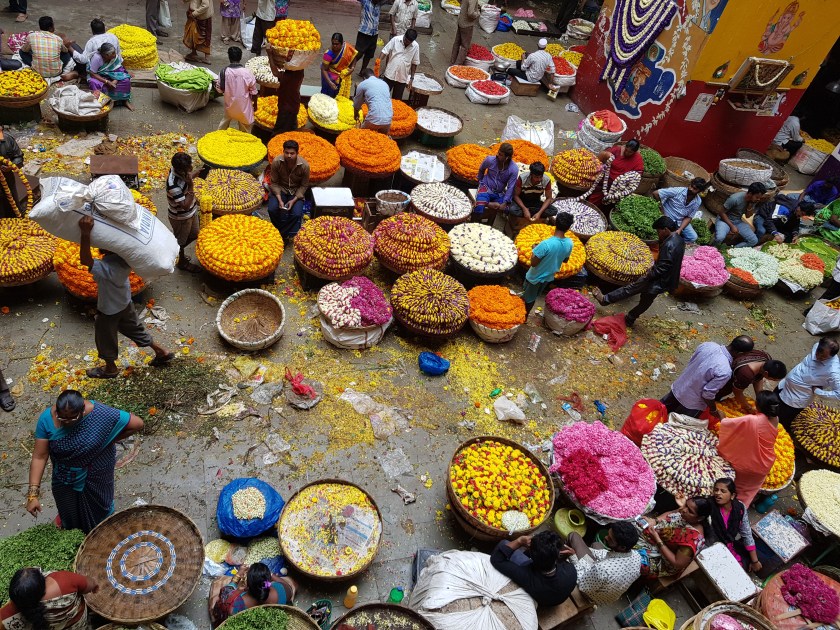
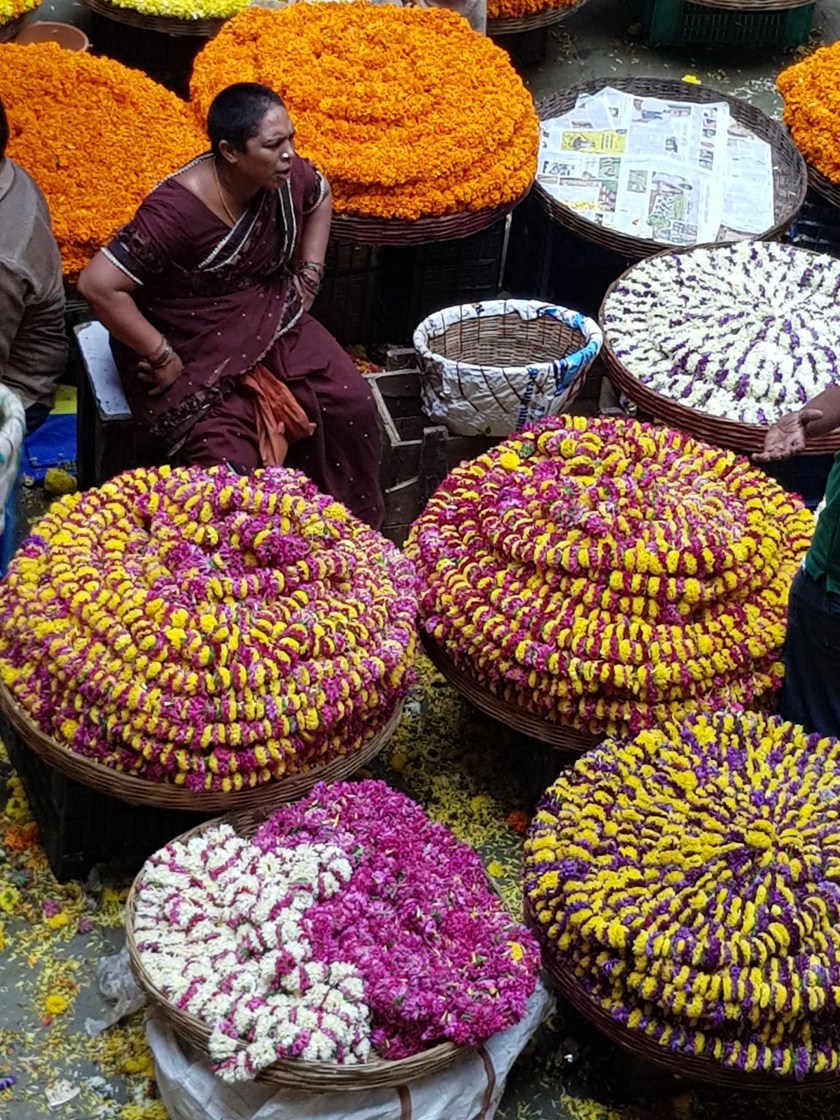
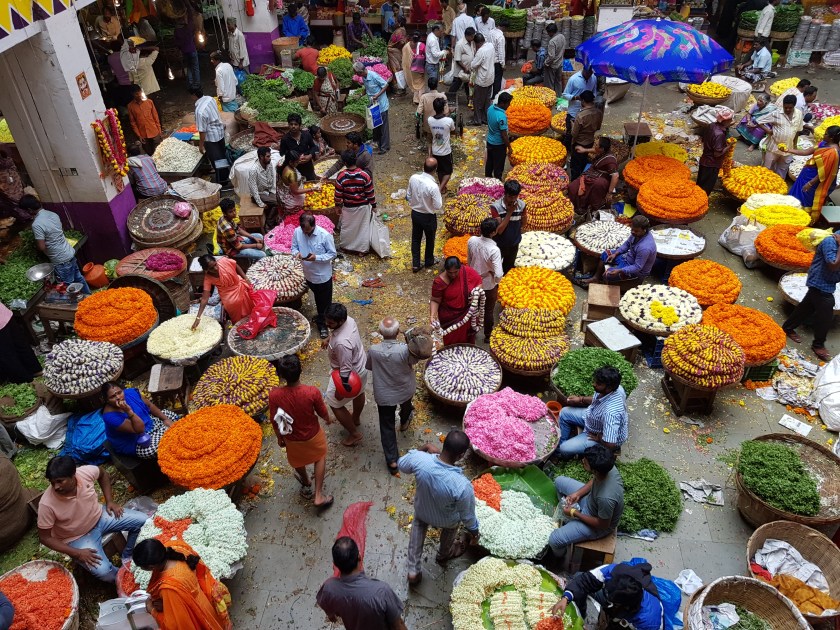
Then we were ready for the chaos of the market where we saw beautiful produce, stunning flowers, huge metal cookware, bangles, and all manner of other things for sale. Between the aroma of the fresh herbs and the vibrant colors of the strings of flowers, we were in heaven.
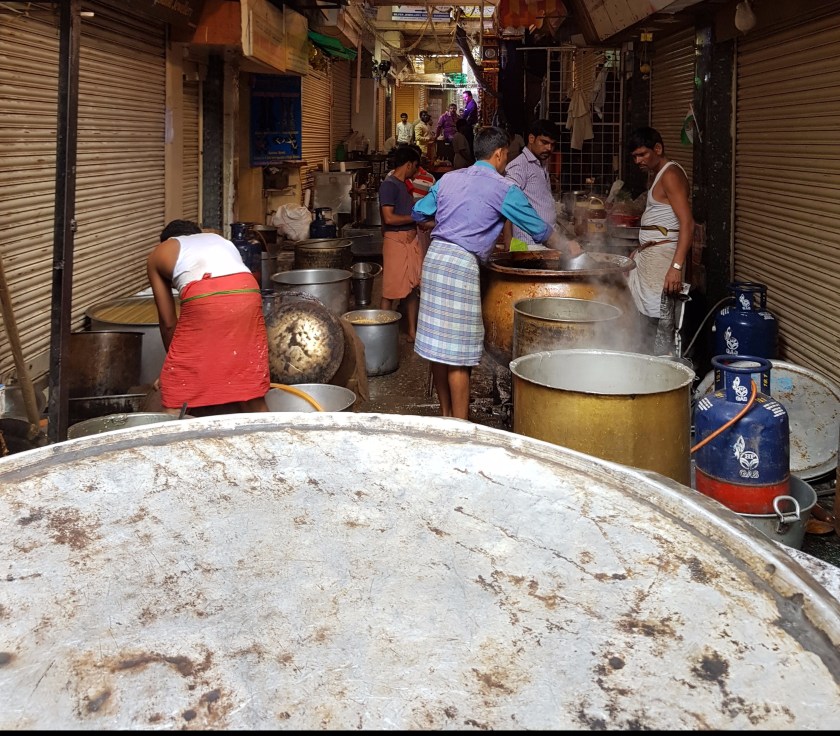
Alley way kitchens like this are attached to Hindu temples to feed the poor.
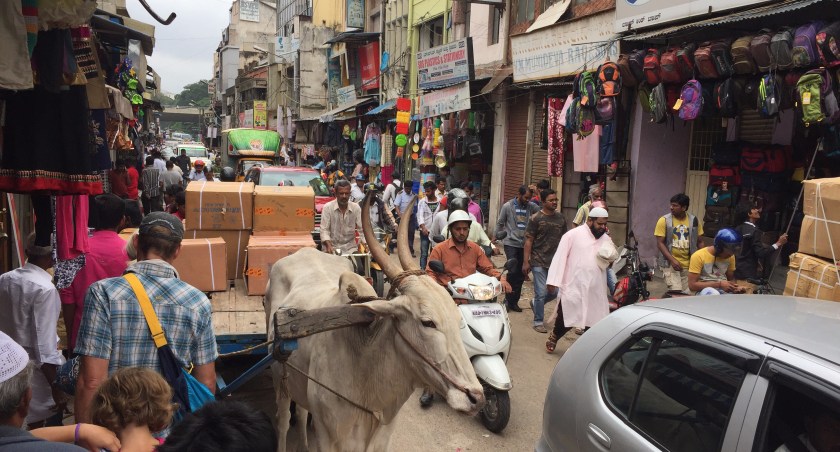
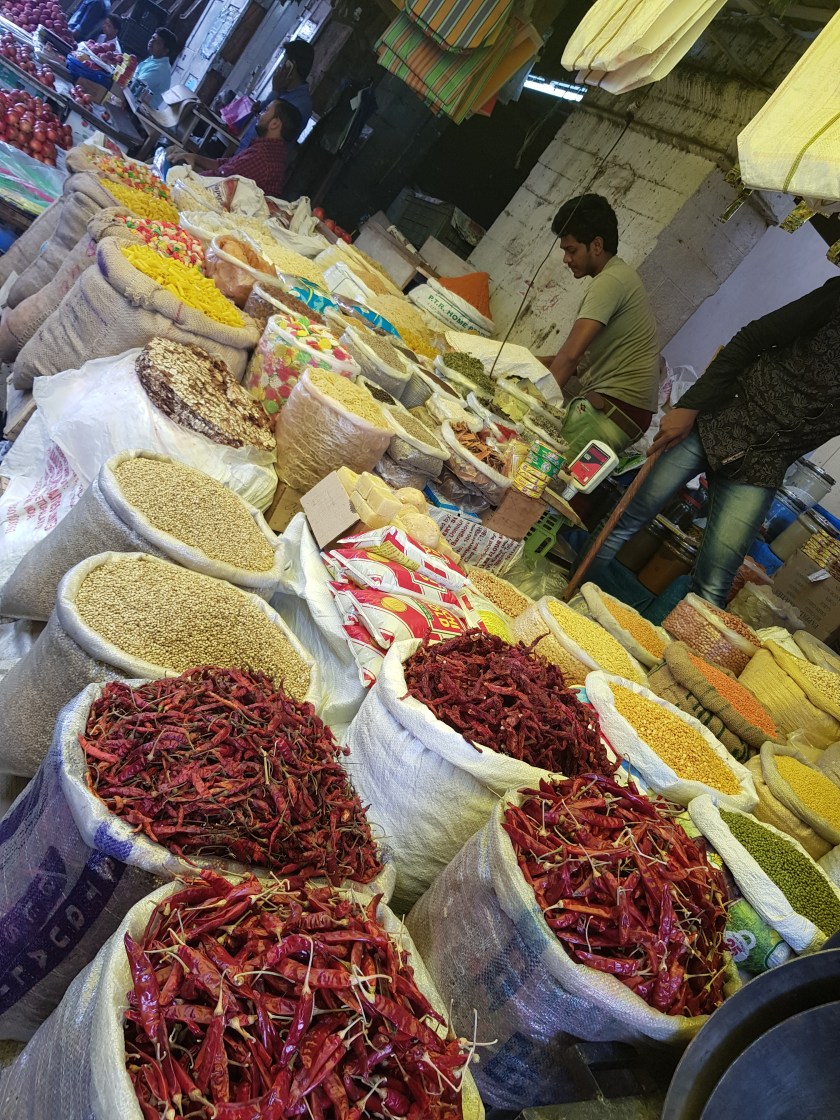
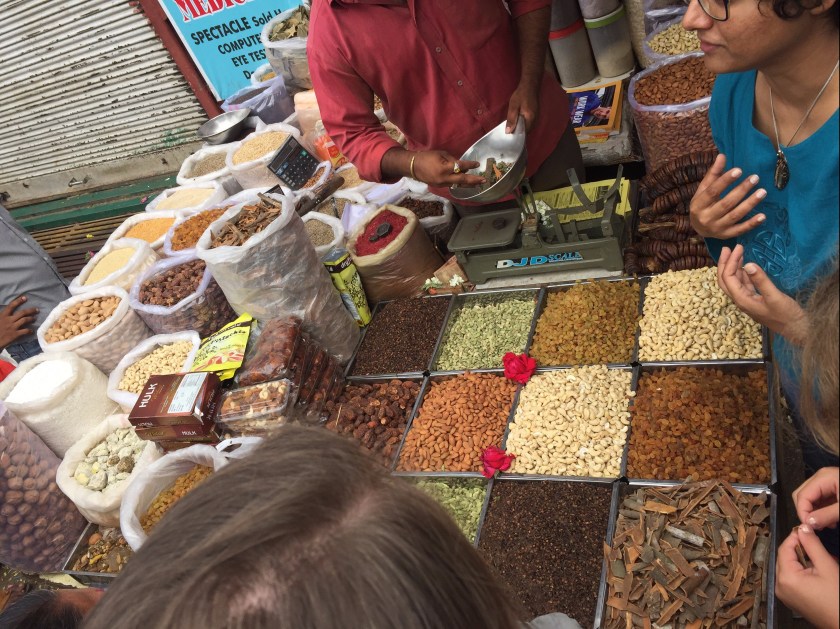
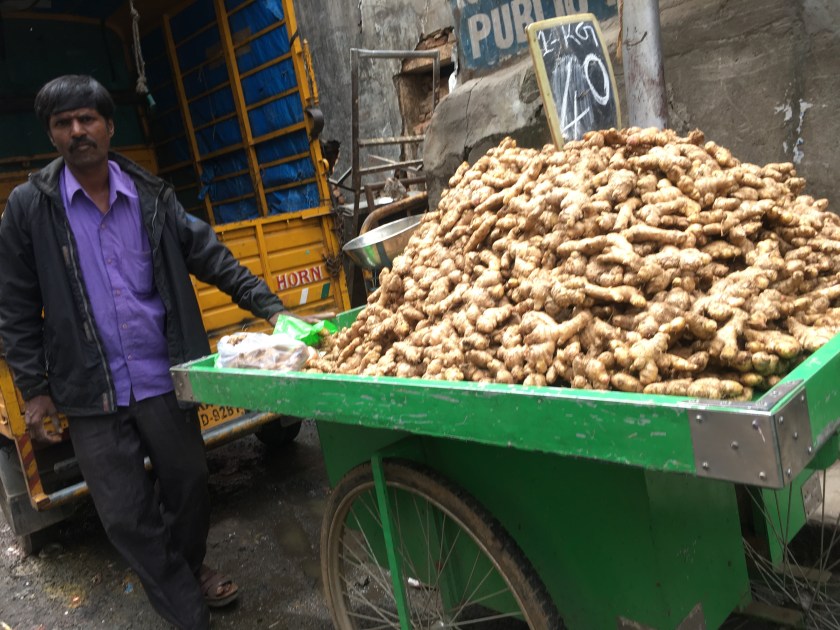
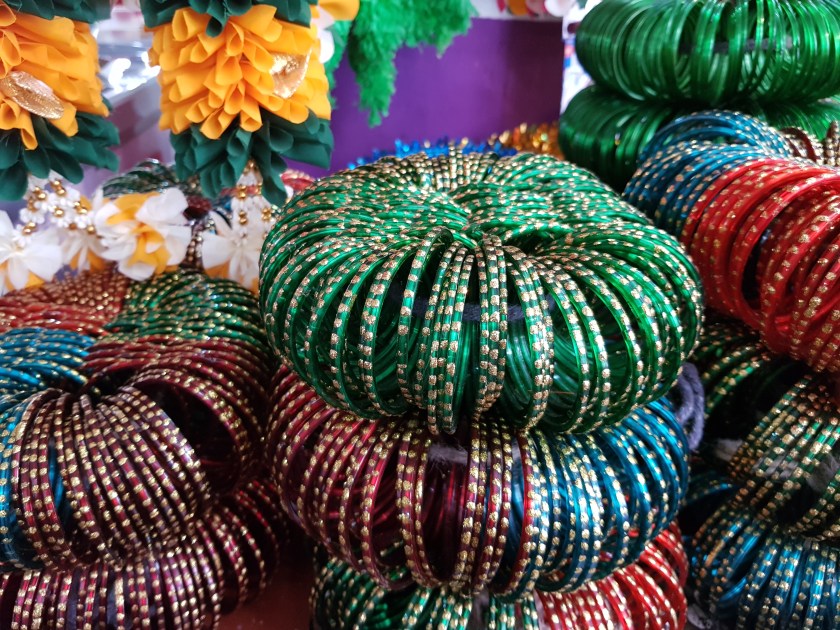
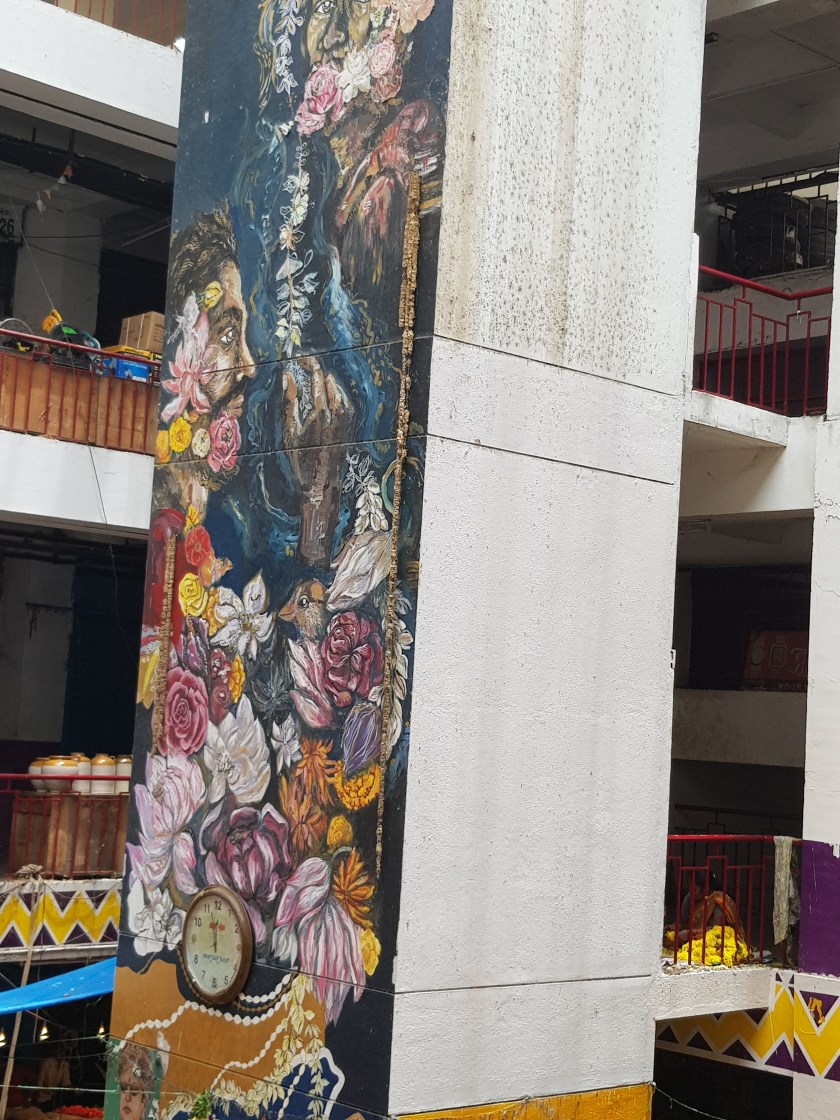
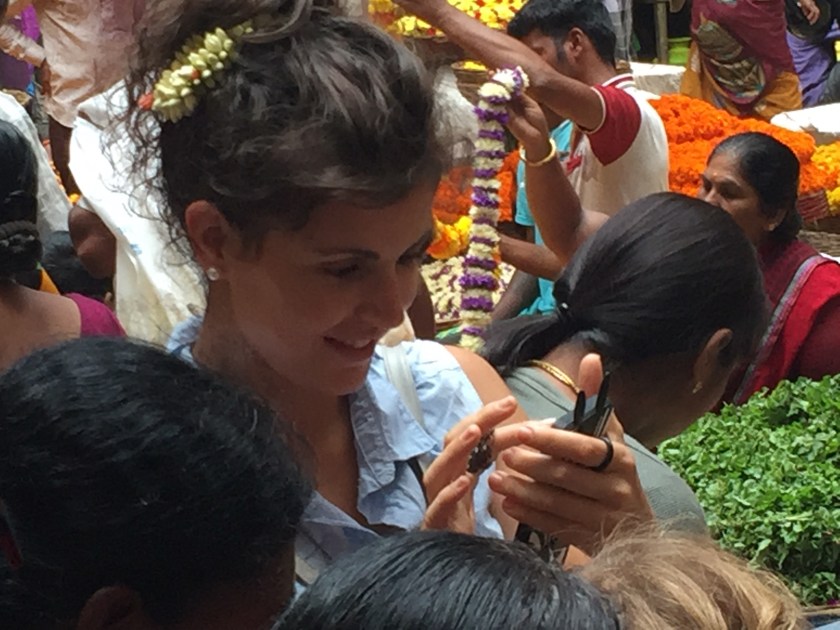
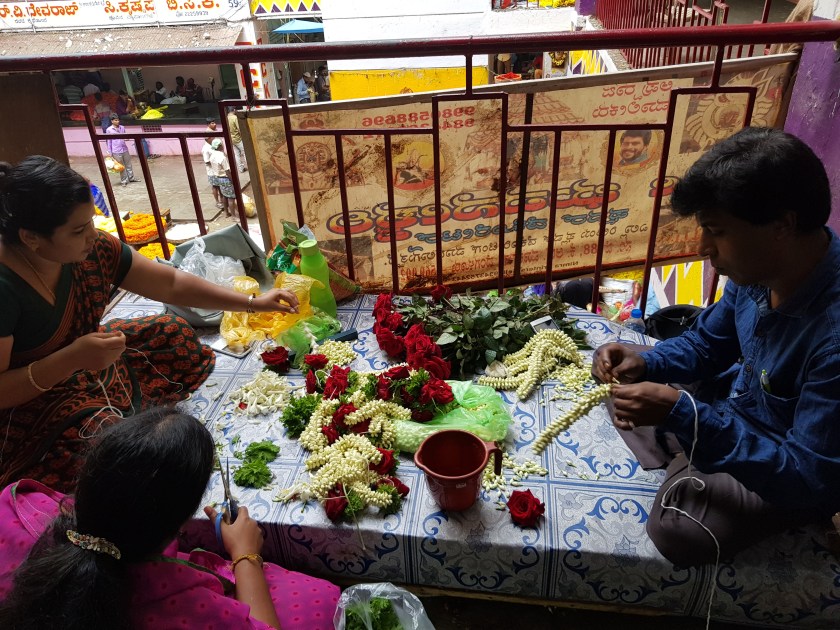
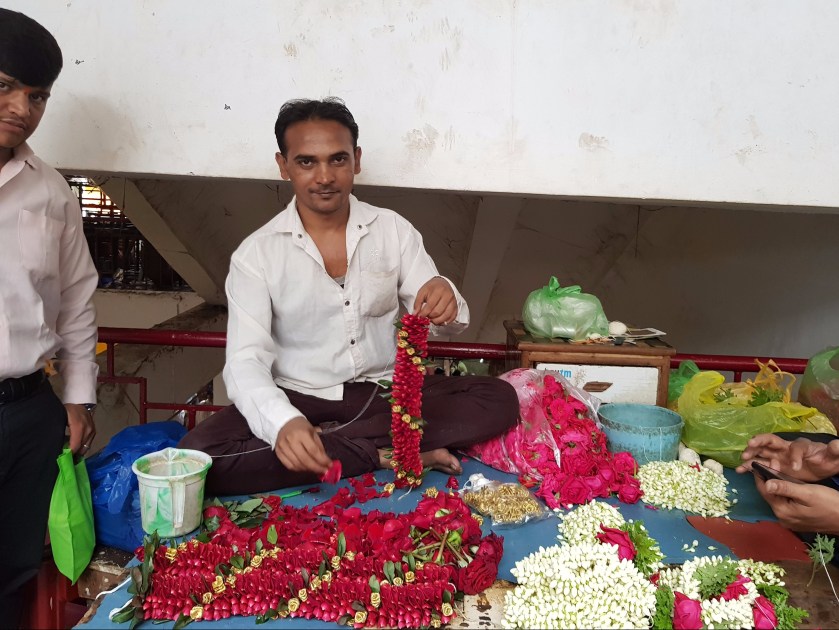
The chaotic street scene outside the KR MarketScenes like this are starting to feel commonplace: buffalos, motorbikes, cars and pedestrians all sharing the same very narrow streets.Pasta and other dry goods outside the market.A spice vendor outside the market. That’s Tej on the right explaining some of the spices to us. We learned we’d been using mace wrong. Oops.Now at last entering the market.Our first indication we had found our people. We couldn’t find fresh ginger that didn’t look like it was already starting to decompose. As soon as we stepped inside, we found it! (if you’re trying to do the math, that’s about 63 cents for 2.2 pounds of ginger)These are the turmeric and vermilion powders that create the beautiful colors everywhere in Hindu life.These are the powders in bulk. Be careful!We found our future housewares in the market, too!A very generous salesman gave the ladies four bangles each. Traditionally, the green is for fertility and the red is for love and passion. The younger members of our party were given both colors. Others whom we will not name here only got the red. The other colors are modern and just for fashion. Worn properly over the pulse point, they protect the wearer’s chakra.Oh, my goodness, the colors of the flower market!The mural standing high above the flower market.More colors.And more.We were struck by the fact that there were no cut flowers — only these strings of blooms intended for worship and ceremony.Melissa with flowers in her hair
Our new friend Ivana with flowers. The video that follows is taken of a woman threading this same type of string of flowers. It is not sped up. That is just how fast her (and others’ doing similar work) fingers move.
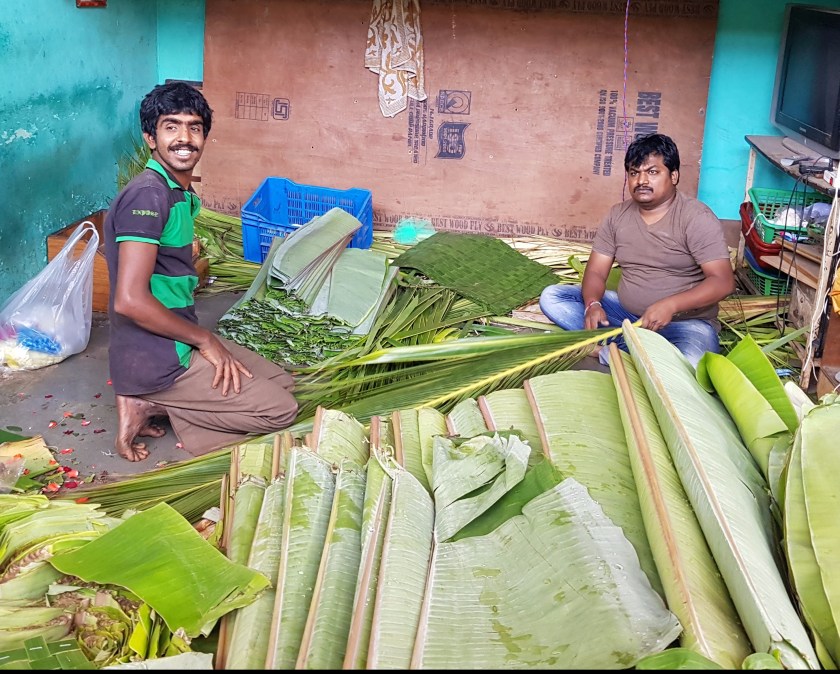
A station where they create the strands.The final product of this man’s hard (and quick) work.These two gentlemen were making place mats out of coconut tree leaves. Tej told us that she and her family would buy new ones every week here at the market.The beautiful beautiful produce.A cute little baby cow among the produce.Another National Geographic picture that has become commonplace. This is how all of the booths and stores in the market were stocked. That’s our new friend Colleen to the right.
Throughout this entire tour, we just kept looking at each other, saying, “Wow! I love this!” Tej was a terrific guide, ensuring that at each step of the way we understood the context for the things we were seeing, which made all the difference.
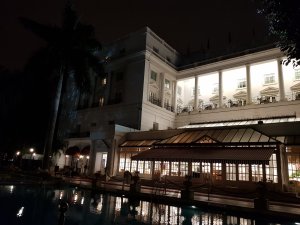 sweet desk clerk walked us through other beautiful restaurants to get to ours where Melissa was greeted by name at the entrance (one benefit of making a reservation). We were led to a table apart from all others, right next to the pool. It was lovely with a nice view of the building and grounds, although the peace was a bit broken by the honking of cars on the other side of the wall.
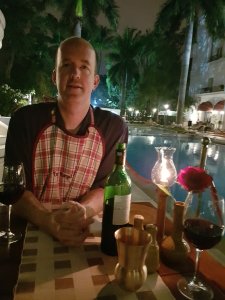 is a barbecue place) and bringing an array of wine bottles for us to consider. They actually had Erath on the wine list, which would have been an obvious choice if it
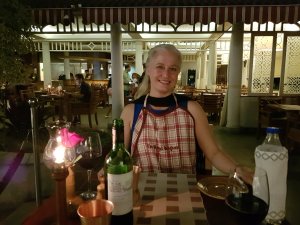 hadn’t cost $150. Knowing Erath as well as we do, we also knew just how inflated that was and couldn’t bring ourselves to do it. Melissa chose the shiraj sangiovese Vino Della Casa, made by Fratelli, an Indian winery who we think brought in an Italian wine maker. It isn’t necessarily our new favorite, but not bad for Indian wine. They also brought us hand towels and explained that we would be eating with our hands, although they said they could bring silverware if we needed it. We assured them that we would eat the food the way it’s meant to be eaten, which made them happy.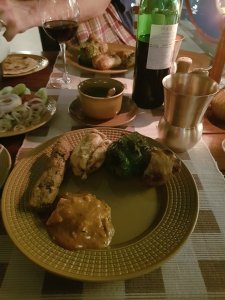

 The sushi-go-round style Asian appetizers had veg items on green plates and meat items on red. The veg sushi had lots of wasabi, and the chaat with crispy crackers and delicious sauces was really tasty. We wanted the garlic spinach served in a little bamboo basket, but kept missing it as it came out.
 The pasta/pizza station was very much the highlight of the kid-friendly nature of Flechazo. Melissa made us a very tasty pizza. The waiter recommended a pav bhaji, a sort of a sandwich on a soft grilled bread with a potato lentil patty. As with everything else our waiter recommended, it was delicious. We ordered pasta from the pasta station – though it sounded delicious, we were kind of relieved that it didn’t show up. There was simply too much good food!
 Although we were getting full, the Indian main courses awaited. We had the familiar — biryani and aloo muttar — and some new to us dishes — such as dal makhani. These were as good as any other we’ve had here. They delivered fresh made butter naan to the table as we returned with our full plates.




 doesn’t sleep on the floor where it’s often damp. Like Kamala, she has three older children at boarding school and one at home with her. She told me that she visits a different child each month so only sees the older kids every three months. She also told me that she is not sad when she says good-bye “because they must have a beautiful life and they can’t have that here.”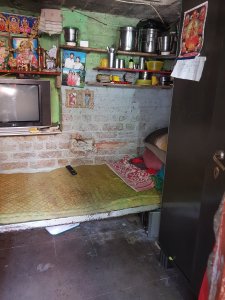






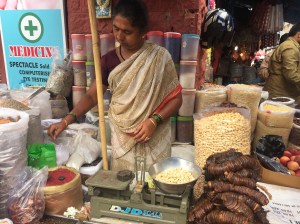 language beyond a number, eventually figuring out that we had to first give him the money and then he would weigh and package the pasta. We then moved onto the fruits and nuts lady, who was very disappointed that we were only purchasing cashews. We were disappointed that the cashews weren’t much cheaper than the packaged ones in the store. We were even more disappointed that we allowed ourselves to be bullied into eating yucky raisins that we didn’t want to sample.




 hours walking nearly every path of the park. The gardens are lovely, and it would have been entirely relaxing if not for the 15 or so “selfie” requests. These requests are difficult because
  there is absolutely nothing wrong with any one of these lovely, happy people asking for a photo – it just becomes a problem when we don’t get 10 minutes free between posing. We’re not models.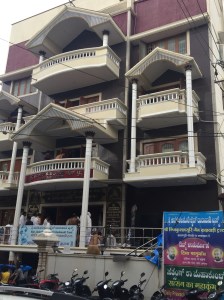
 an 8-10 day holy event focused on forgiveness, but we didn’t know that when we happened upon the temple). Right next door to the Jain temple was an equally impressive Hindu temple.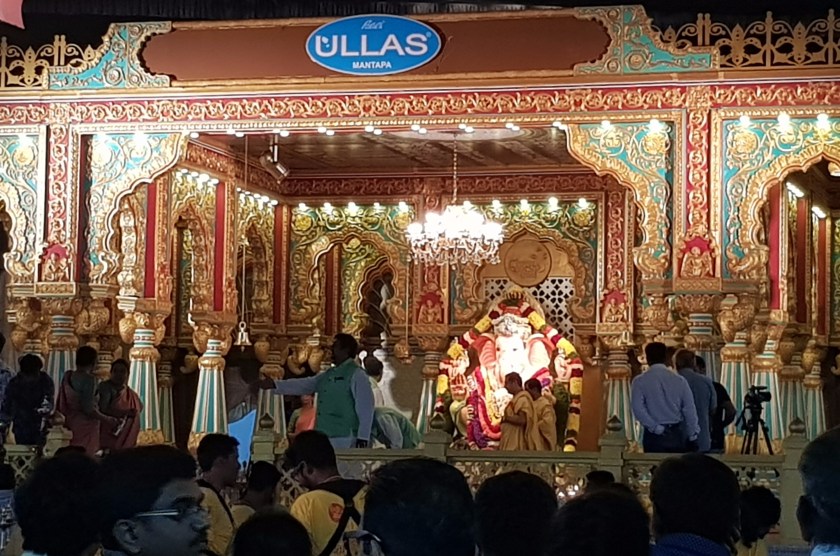












 Wellserton Wanderings