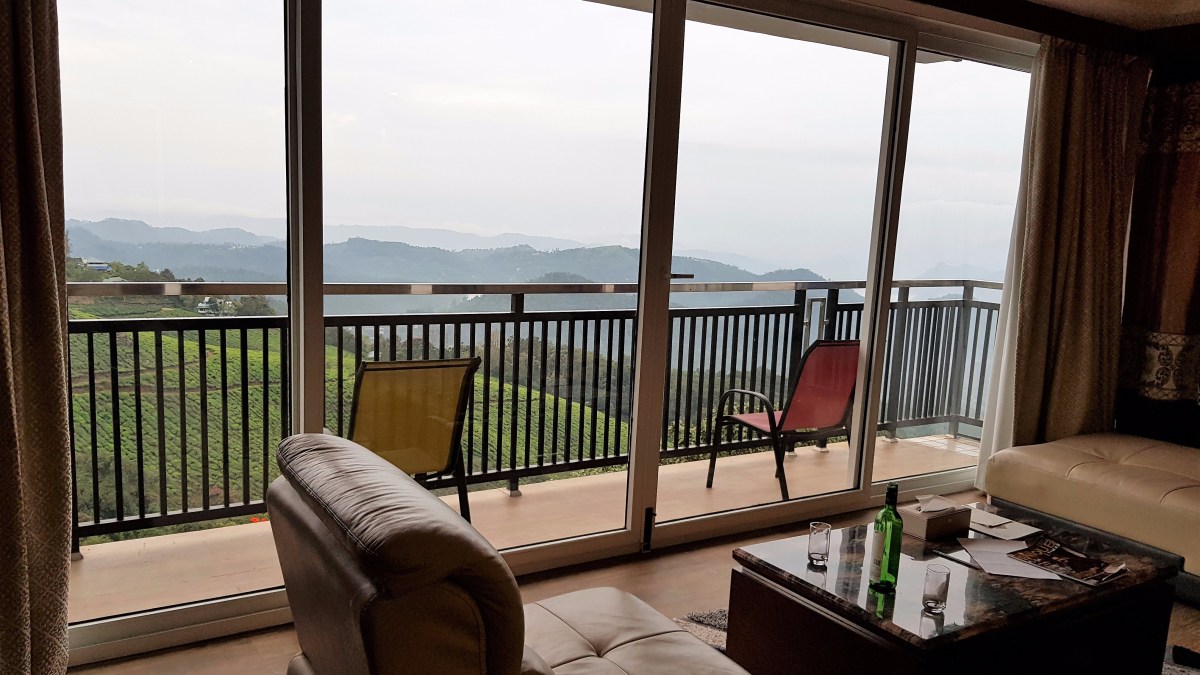
Our first attempt at escaping civilization met with mixed results, mostly through no fault of the Resort itself. It was billed as providing an isolated experience, but it is part of a small village on a fairly busy road. To their credit, the rooms are situated to minimize the effects of being part of a bustling community. Our room, an upgrade to a suite thrown in by the resort, looked out over a beautiful tea plantation which we toured just before sunset.
Our attempt at the tilty selfie.
In the tea plantation.
The tour guide wanted us to pose for him.
That’s our hotel perched on the side of the hill on the right.
The tea plantation tour was both weird and fun. Our guide, an eager if less-than-knowledgeable young man from the hotel, took us on a very brisk walk that started on a shoulder-less, well-traveled road. Just when we thought this was our entire tour, we turned into a Tata tea plantation. He described the difference between white, green and black tea — process, not tea varietal — and the difference between the different types like Assam and Darjeeling — there is none, there is only one type of tea plant grown in different regions, suspiciously like terroir of wine. Every other question was met with a recommendation that we go to the Tata Tea Museum up the road; they’ll have the answer. We spent most of our time posing somewhat awkwardly for pictures we assume he really wanted us to post on social media. The best part was walking up to a large boulder perched on a hill where we watched the sunset. It was ridiculously beautiful. Our trust issues came up again when we walked the opposite way of the hotel and hopped on a city bus, a step for which we were not anticipating nor prepared. The bus was fine, we just would have much rather walked home.
Dinner was good. The restaurant has two choices: a la carte or buffet. We went with the buffet. We find sometimes that we discover a new favorite something-or-other on a buffet. Everything we had was very good, but there were nine things that excited us on the a la carte menu, and we ultimately wished we’d ordered off the menu. Still, we were full and happy. After dinner, we were a little concerned abut being directly below the restaurant with a table being set up for a large party. As it turned out, that wasn’t a problem. The problem was the kids who were screaming and playing in the hallways late into the night. Yes, we were those hotel guests . . . we called the front desk. Fortunately, it had the desired effect. Clearly, the staff responded promptly, because the noise quieted down almost immediately.
Because of the Kerala-wide strike (described here), we missed out on the chance to enjoy the breakfast buffet while seated on the veranda overlooking the tea plantation. That was a bit of a disappointment. We enjoyed Parakkat Nature and appreciated the good service, but would probably seek a more secluded resort on a return visit.
If our goal in coming to Kerala was to escape the crowds and urban-issues-gone-amok of Bengaluru, we finally succeeded the moment we pulled into Amaana Plantation Resort in Thekkady. The general manager welcomed us with necklaces of cardamom pods and a lovely fresh juice. With only five units located in a small glen surrounded by a cardamom plantation, it is the very picture of isolation. Because we had to get through the state-wide strike (described here), we arrived at 10:30, with plenty of time for the important business of the day: reading, naps, games, walking in the plantation, and lunch brought by room service.
This slideshow requires JavaScript.
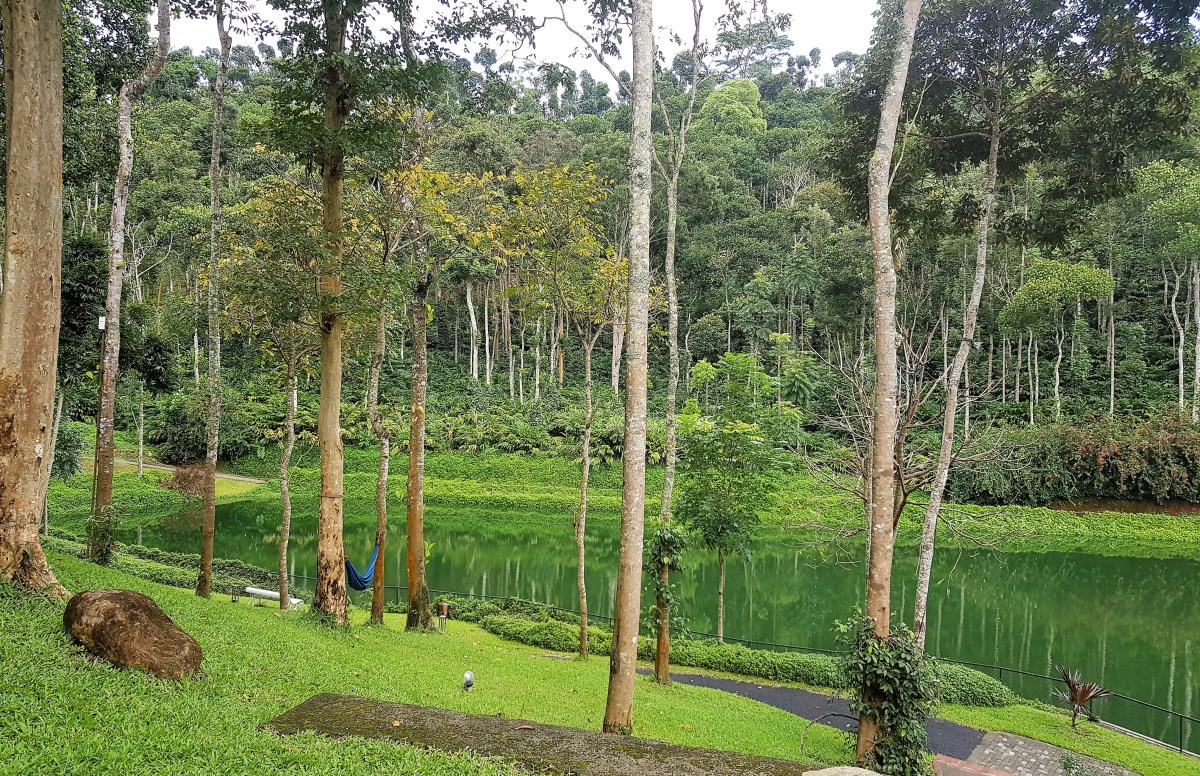
Our room was lovely, with a big four-poster bed and a bathroom nearly as big as the bedroom. Perhaps the best part, though, was the deck with comfortable chairs from which we could gaze across the pond to the greenery all around us. Although there were other guests there, we rarely saw other people, which was kind of perfect for us.
Our oh, so comfortable room.
All of the food we had at Amaana was amazing. We enjoyed lunch in our room, two fabulous breakfasts, and two dinners. Although we considered finding another restaurant on our second night there, we couldn’t really think of a good reason to do so. One of the effects of such a small resort is that there is a small enough staff that you get to recognize them as you encounter each other in the dining room, on the walking paths, or delivering things to your room. We even got to apply our bit of learning from the Chiramel Residency. When the manager asked how we wanted our eggs and toast for breakfast the first morning, we asked if they had masala dosas. They were delighted that white people wanted Indian breakfast, and were willing to have it ready for us before the dining room is usually open, since we were racing off to our day at Periyar. The second morning they brought another amazing Indian breakfast, including some dishes we had never had before: Uttapam, a flat dosa with onions and other deliciousness on top, and poori (a puffed bread), with the same potato masala from the dosas. It was all amazing, and served in a perfect setting.
We ate every meal at the table in the corner.
The food was so tasty. And they understood that not all white people like bland food. Yum!
Banana Split!
We can be certain: when we return to Thekkady, we will return to Amaana Plantation Resort.
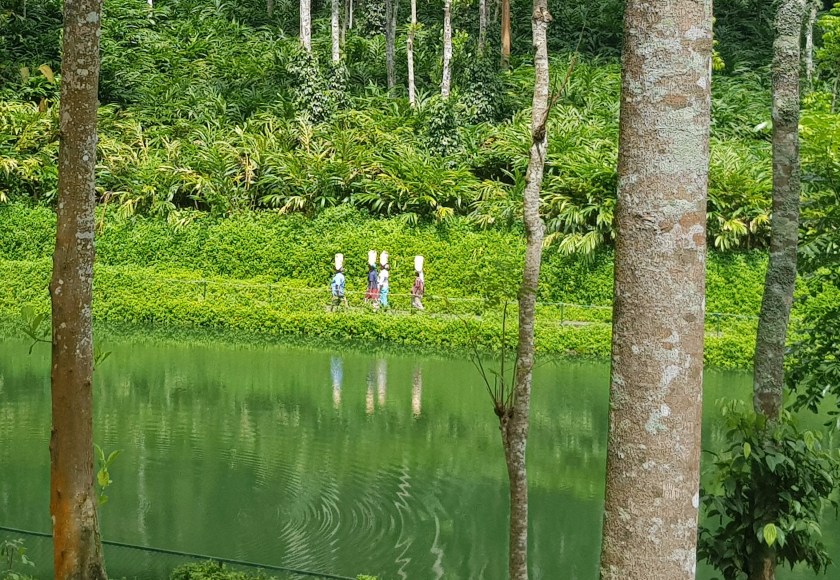
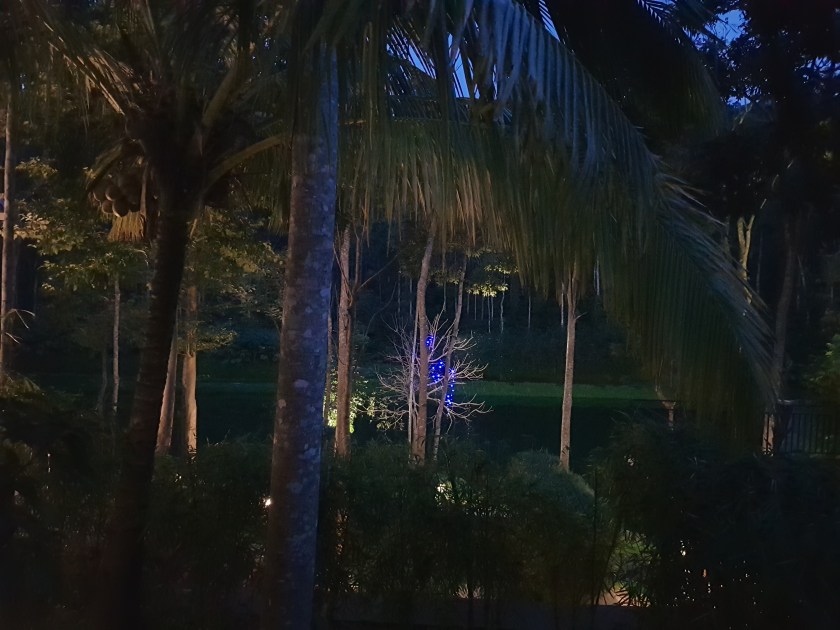
Women arriving for work on our last morning.Tinkly Lights! Happy Diwali, festival of lights!
After three wonderful days in the mountains of Kerala, we returned to the coast, this time to Alappuzha (also called Alleppey, thanks to the Brits). We spent very little time in town, but went straight to our lovely resort north of the city. Kondai Lip was a delightful surprise – it had been recommended by the tour company that arranged for Ansu, our driver, and we knew next to nothing about it before getting there. It continued the theme of peace and quiet that we had so valued in Thekkady, and which we truly needed after all of the bustle of life in Bengaluru.
We found a happy place.
While they told us about options of things to do (we could get a cab to a nearby beach or take out a paddle boat), all we really wanted was to sit and gaze at the beautiful view out our window. We interrupted the gazing only to read our books or play cards. This afternoon just felt like one long contented sigh. As dusk fell, the mood changed a bit. As we were reclining on the bed reading, we noticed a couple little gnat-like insects . . . and then a couple more . . . and then we looked toward the foot of the bed where the white cover was coated in insects and up toward the ceiling which was equally covered. Suddenly the peace was gone and Melissa called the front desk to tell them about it. They immediately sent two men over who said it was because of the rainy season, but that they would take care of it. Since it was almost time for dinner, we headed for the lovely outdoor dining room a bit early and left them to work some magic.
Dinner was entirely pleasant (if a little bland because we forgot to mention that even though we’re white, we still enjoy a bit of spice), and we were happy to see no evidence of the bug apocalypse when we returned to our room. Peace was restored!
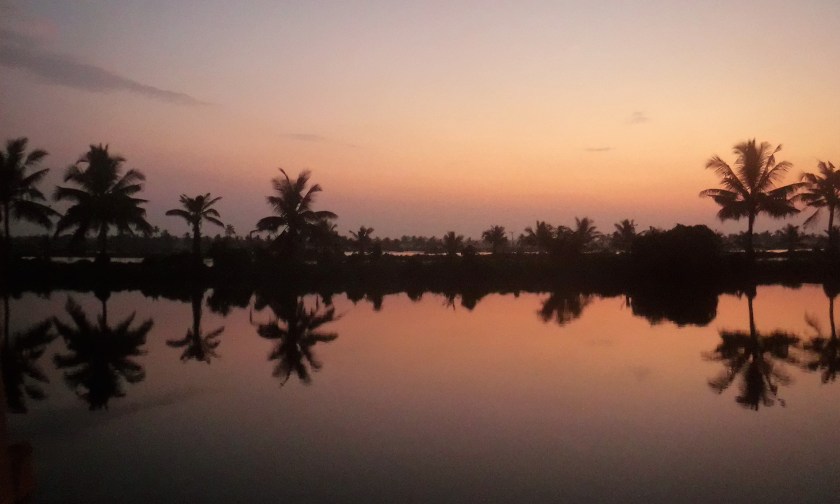
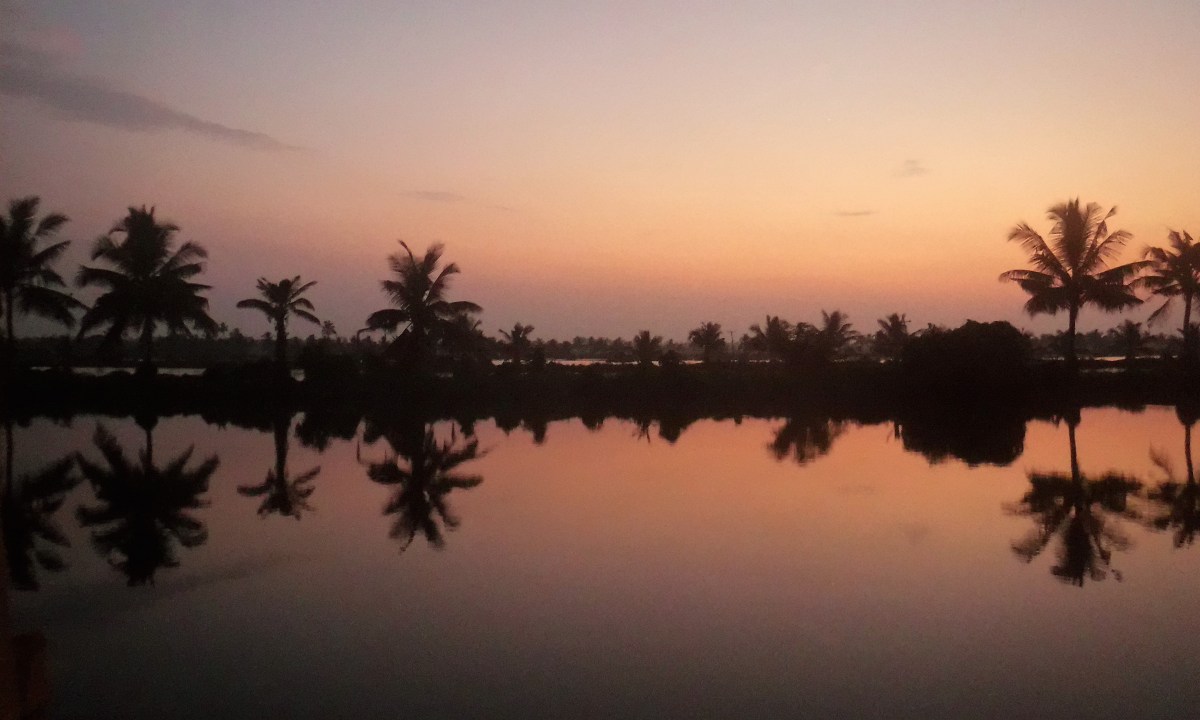
Melissa got up early to take in the sunrise from our deck.
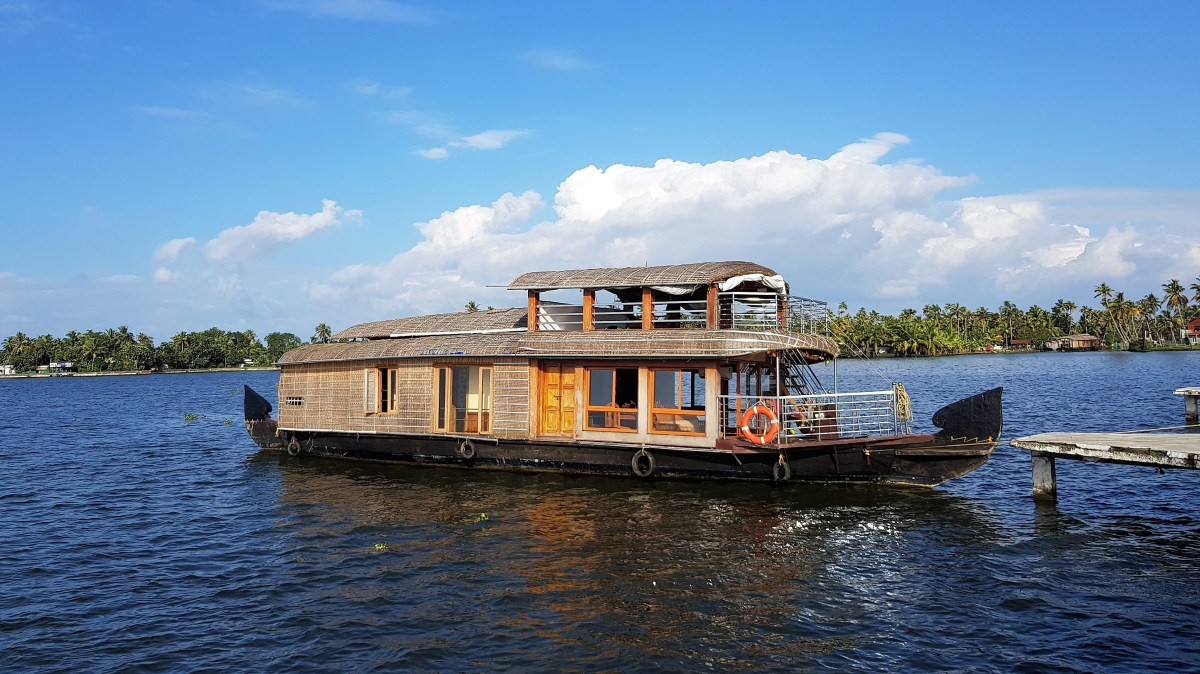
Early the next morning, Melissa got up to watch the sun rise over the pond and backwaters beyond. The gorgeous view was worth the interrupted sleep. A few hours later, it was time to leave Kondai Lip and head for our houseboat. While sad to go, we were full of happy anticipation. Ansu met us back at the car and we drove an hour to a busy little dock area right at the edge of the sidewalk where we waited for our houseboat to arrive. When it pulled up, we were greeted by two young men who ushered us aboard our Bethel Tours boat and gestured for us to head up to the upper deck where two comfortable chairs were waiting for us. And so began 20 hours of watching the world go by as we cruised through the busy, idyllic backwaters of Kerala.
This slideshow requires JavaScript.
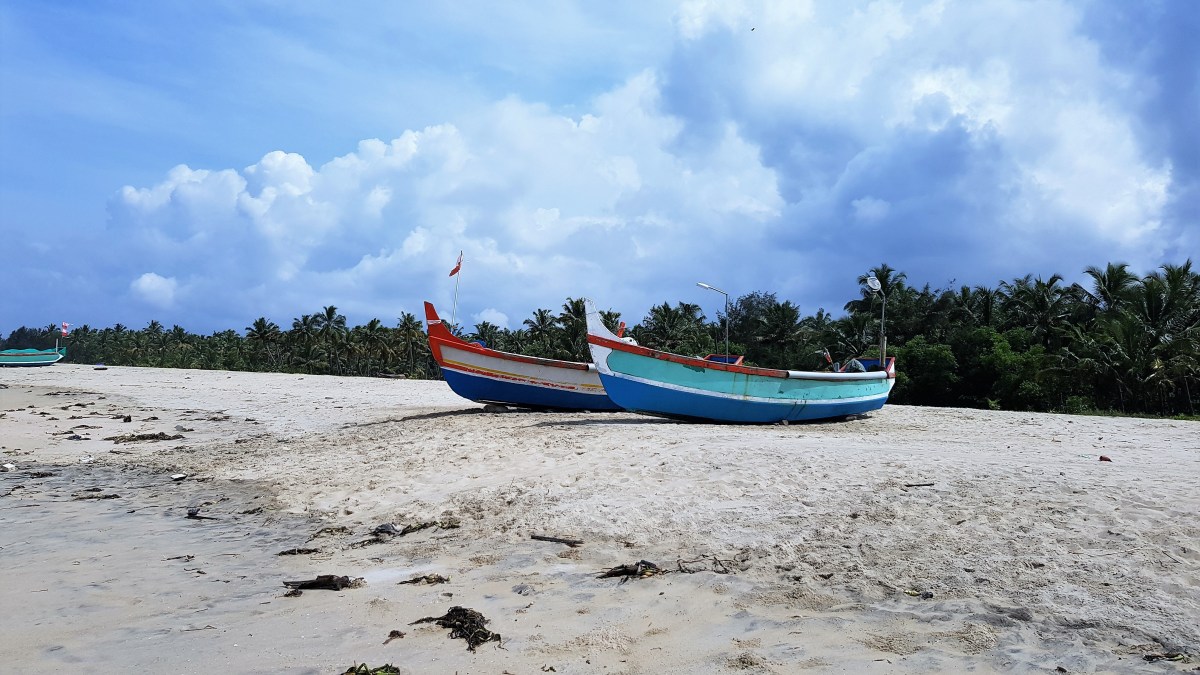
The next morning, our final morning in Kerala, we were greeted by a smiling Ansu who took us straight to the long, beautiful Marari beach where we put our feet in the Indian Ocean for the first time. Surprisingly few people were there, perhaps because we were there a bit early. All those on the beach with us seemed entirely happy about it. We took
Ansu was a fabulous fellow and delightful driver
a nice walk along the beach, joined by Ansu who seemed perplexed by our lack of destination, but willing to go along. As we walked, we saw fishing boats and birds, and beautiful shells, but mostly we saw the vast blue ocean. With the temperatures and humidity rising, we agreed with Ansu that it was time to move on. He suggested that we spend the day at a big mall in Kochi. While that wouldn’t normally be much of a lure for us, the thought of air conditioning was appealing, and there really wasn’t anything else on our vacation agenda. Besides, we had the distinct feeling we were a bit of a disappointment to Ansu because the entire week we were on a mission to relax and didn’t really let him pick our activities based on what past tour goers enjoyed. We were in such a good mood after all of our relaxing, we even agreed to stop at a “local handicrafts” store that Ansu wanted to take us to. There wasn’t actually anything local about it, other than one small corner of the big 3-story store, and the many people working there were eager to the point of pushiness. We once again suspected that Ansu would get some kind of kick-back for taking us there, although if it was dependent on our purchasing anything, he was out of luck. The store was full of beautiful things, but our bags were full and we weren’t there for shopping. Our afternoon at the mall was largely spent walking in circles around each of the 5 floors, eating some adequate pizza and delicious ice cream, and brainstorming ways to take our restored equilibrium home with us.The flight home was effortless and uneventful – just the way we like it. It was good to be back home to our own bed and our own things, but Kerala will remain in our minds for a long time and we’ll certainly return.
The canoe that took us to and from the entrance to Kondai Lip.
Kondai Lip didn’t meet our expectations . . . because we didn’t know to dream about a place like this. From the moment the canoe delivered us to the entrance, we knew this place was different. We were in for total isolation. The resort was built in skinny strips of land around pools that provide the fishing grounds for the people living there. Because of the lack of land, there wasn’t enough room for roads large enough for the ubiquitous traffic (hence the canoe). We were just a little late for a boat ride to the ocean beach (which we think was just a few minutes away), so we took a short walk around the area. It was beautiful and different than anything else we’ve ever seen. Melissa was particularly taken by the house with the fence that extended into the water to contain a large flock of ducks, explaining in part the piles of duck eggs for sale on the way in.
Our deck.
The view from our deck.
We then commenced our relaxing. We sat on our deck overlooking the ponds, read, played cards. It was all we could do. It was rough. The only downside was the bug infestation. At some point, we realized we were being surrounded by bazillions of tiny bugs, especially all over our white pillows and comforter. We kept sweeping them aside, but between the squished bugs and the fact that they just kept coming, it was out of hand. We called the front desk, and just minutes later a couple of guys showed up to take care of it. It was dinner time, so we left them to it. When we got back, we were pleased to see that the guys had cleaned it all up, including the bedding. We were back to being totally satisfied.
Candles lit on the edges of the lanai that stood as the dining room.
Yummy . . . if spiced for white folk.
Tom in the “dining room”.
Speaking of satisfied: dinner. The “dining room” was in fact a lanai surrounded by the beautiful grounds and palm trees. The food was delicious. The lesson we have learned many many times related to the whole “white people need to ask for Indian breakfast” issue is that we need to tell people we’re ok with spice. We forgot yet again, so the food was a little bland, but we don’t really blame them; they were simply responding to their
Delicious breakfast.
experience with most tourists. Otherwise the food was delicious. Breakfast, too. They serve a buffet of both Western and Indian dishes. In particular, we loved the vada, delicious little chickpea donuts served with the deliciously ubiquitous coconut chutney. Kondai Lip takes vada to a new place. The lightest, fluffiest vada we have ever had.
Kondai Lip was a unique, delicious, and relaxing stop.
We spent our last night of our Kerala vacation on a houseboat on the backwaters near the coast. Our houseboat was run by two sweet, eager young men who did everything they could to ensure our happiness while we relaxed on the upper deck. Until evening on the first day and a couple hours of the second morning, we cruised around the backwaters, admiring all of the other houseboats and all of the life going on along the banks.
We made three stops along the way. First, we stopped in view of a rice paddy while the guys made a tasty traditional Keralan lunch, though without the banana leaf. Next we stopped at a long pier that appeared to be part fishing, part coconut water sales for tourists on houseboats. It was a beautiful spot, and nice to take a walk on the pier. Finally, we stopped in a little channel where our captain asked us if we wanted to go for a canoe ride.
Rice paddy where we stopped for lunch.
Coconuts on the pier.
The canoe ride turned out to be a little stressful, largely due to language barrier and our confusion. When we were first asked about a canoe ride, we thought we were being offered the option of taking a canoe out on our own. We gave a non-committal response along the lines of, “sure, that might be nice a little later.” Ten minutes later, a man paddled up in a large canoe with a covered area for two people to recline while he paddled from the back, and we were told by the captain that it was time to go. We quickly started getting ready to go and asked our captain if this were something we needed to pay for. His response suggested to us that it was included in our houseboat price, and we happily headed out.
The shore along the small canals.
Our canoe paddler, who for the first half of the ride was super charming, then not so much.
Lotus flowers in the water.
Our view on the canoe.
For the first part of the canoe ride, we were in heaven. He took us down narrow canals that our houseboat couldn’t access, and we greatly enjoyed watching life go by. All along the canals there are homes that essentially use the canals as roads. Every home has a boat, and other “taxi” canoes are moving around delivering people where they want to go. There are also walkways along the sides where people are out and about. It’s beautiful with lush lily beds and beautiful trees and flowers everywhere. It was absolutely amazing . . . until the mosquitoes started to bite us and we realized that we’d neglected insect repellent in our haste to get to the waiting boat. We started casually asking when we’d go back to our houseboat, but got only vague responses. It quickly became dark and we were enjoying our canoe ride less and less. And then our canoe man told us that we had to pay him 800 rupees. We hadn’t brought any money with us and told him we’d pay him back at the boat, at which point he told us that we were to pass it out the window without our captain seeing us. That sounded fishy and we asked again when we’d get back to our boat, at which point he started singing. As we got back to the point where we’d left our boat and saw that it was no longer there, we were officially no longer having fun but could not get a coherent response from the singing man paddling our canoe. Finally we found our docked boat and hastily boarded, asking our captain about payment. It was clear then that we were expected to pay, but not as much as he was asking. We gave him 500 rupees and he eventually left, but we felt a bit badly about it. It was our fault for not establishing the fee before getting on the boat – we know better – but it still left us a little unhappy about something that we should have enjoyed.
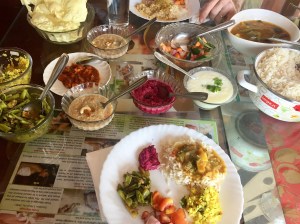
Lunch on board. It was by far the best meal of our stay.
Dinner was ready in due course. Our hosts had not gotten the message that we were vegetarian, so dinner was pretty basic since we were not served the fresh fish that we’re sure a fish-eater would have loved. We spent the evening and night docked on the side of a canal in a cute little neighborhood. Our bed was very hard, the boat was a bit askew, and the bathroom was a bit malodorous. When we woke, we were happy to return to our upper deck to watch the neighborhood folks stirring and getting ready for the day, including bathing and laundering in the canal itself. Breakfast was ok, if a little disappointing — idly that didn’t really hold together and watery sambar.
So often in life, happiness is a matter of expectations. If you expect A and get B, you might be disappointed. But if you expect B and get B, you’ll probably be delighted. And changing expectations in mid-stream can be difficult. While Melissa carefully selected most of hotels for this trip, she left the houseboat selection to the tour company that also supplied our terrific driver, Ansu. This was not the wisest choice since they didn’t know what our expectations were and definitely delivered B. If we’d expected it, we might have loved it, but as it was, we didn’t feel quite as blissful as anticipated. Our houseboat was definitely rustic with plastic flowers, slightly grimy surfaces, a bathroom we that we avoided as much as possible, a bed without a full set of linens, and very simple food.
We loved our crew, and we loved having a upper deck that was both covered and totally open on four sides. We learned that there are clearly different houseboat companies, though. If we return to a houseboat, it won’t be the same one.
“God’s Own Country” is the tourism slogan for the southwestern state of Kerala. If there were such a thing as a god and that god were to pick a place for its very own, it may well choose Kerala. It is a gorgeous region with a little bit of everything: a long coastline with rocky ports, calm sandy beaches, and (apparently) surfing to the south; a series of connected lakes called the backwaters; mountains that include the highest peak in southern India; the perfect conditions for growing tea and every possible kind of spice; beautiful forests; dense jungles; and thrilling wildlife. What more could anyone want, god or otherwise? It was definitely all we wanted for our Diwali week break.
Kerala is a fascinating place, not only for its beauty, but also for its political history. The communist party has had a strong presence here since the 1930s and has led the region since the 50s. Between the Communist Party of India or CPI, the Communist Party of India (Marxist) or CPI(M), and the Socialist Party, they hold 19 of the 20 seats of congress, with the remaining seat going to the India National Congress Party. In the 1970s, they launched a 100% literacy campaign and have come pretty darn close with literacy in this state at 94%, as compared to 74% across India as a whole. For comparison, the US literacy rate is around 86% and goes down below 80% if we’re looking for a reading level above 5th grade. Healthcare is free in Kerala, regardless of the need, and anyone can request funds from the state to buy or build a home, ensuring no homelessness. Kerala is also plagued by strikes. We experienced the 100th strike (or hartal) of the year while we were there. In India, a strike does not mean the closure of a single business or group of supportive businesses, it means the total shut down of the region – all businesses are to be closed, people are to stay off the road, everything stops. Definitely a challenge to productivity (and tourism).
We started and ended our week on the coast, beginning in the lively port town of Kochi and ending in the beach and backwater community of Alappuzha. In between, we visited the mountainous tea plantation region of Munnar and the spice plantation region of Thekkady (see Into the Keralan Mountains), with one fabulous day in a tiger reserve. For most of our trip, we had a terrific driver named Ansu, provided by Iris Tours, although we enjoyed our first couple days at a lovely homestay, exploring on our own.
Tuesday, we set out on an adventure we had been looking forward to since we signed on to work in India. We set out to see elephants in the wild. After a fabulous masala dosa breakfast at our hotel, we were off to Periyar Tiger Reserve, a national park in Thekkady, on the border between Kerala and Tamil Nadu (though all our Keralan hosts would want us to be clear – it is almost entirely in Kerala). We had signed up for a full day trek, part hiking and part bamboo rafting, into the heart of the reserve.
Ancient tree we later learned was a cotton tree.
Monkey in the bus/coffee/restroom area.
We took a bus ride a few miles in to the park to the boat launch. It took us a minute to make sure we were in the right place – there is also a boat dock for a larger, less trek-y boat ride to see wild life. After a quick cup of coffee, we made our way to our little hut by the river.
Preparation for the trek was both a relief and eye opening. A relief because we met our fellow travelers. It was a very small group – eight tourists and five guides. We were joined by two very eager grad students doing an exchange semester in Gujarat, one Swede and one German; and a family of four Angelinos in Kerala for a wedding. The guides were charming local men who clearly love what they do. They were eager to tell us about everything we were seeing and worked very hard to make sure we had a great experience.
Our leech booties.
Gearing up was eye opening because of the gear. First, it was a little bit of a relief that they gave us leech-prevention booties to put inside our boots and outside our pants. We’re pretty sure that leeches aren’t fatal, but they’re just unpleasant enough that we were happy to be protected from them. The other eye opening bit of gear was the shotgun. We don’t usually hike with shotguns. We were going to be consorting with some dangerous critters indeed.
We got started with a very small taste of the bamboo rafting to come with a rope-pull ferry of a bamboo raft to get us across a small arm of the lake that would be our host. The first leg of our trek amounted to a nature hike through a beautiful, lush jungle. The two of us kept getting separated from the rest of the group, essentially meaning we had two of the guides to ourselves, who loved pointing out what we were looking at.
The bamboo ferry that got us launched.
Our own personal shotgun wielding guide.
The guides seemed to have assigned jobs. One led the procession. Another had the shotgun. One fellow seemed to be the bring-up-the-rear guy. The other two carried supplies and helped us along the way. None of them spoke perfect English, but all of them were super excited to share this beautiful park they had all worked in for years.
They set our expectations early. Not only are tigers rare (about 50 of them in the 975 square km park), but they are nocturnal. The odds of seeing a tiger are almost nil. In 10 years, one of them had seen tigers twice. There are 1000 elephants, so that’s possible but still not likely. They were clear that we needed to be there for the splendor of the place, not to check a sighting off our bucket list.
This slideshow requires JavaScript.
The two guys helping us, the shotgun tender and the rear guide, indeed helped us appreciate the splendiferous place. On this leg of our trek, we saw trees – a cobra tree that looked like the hood of a king cobra, a spiny Indian corral tree, and ancient cotton and jack fruit trees. We saw otters, a black monkey, a giant squirrel (the name of it, not a descriptor, though it was indeed giant), and some kind of a lizard. We saw a banyan tree growing over a teak tree, eventually killing it since it will suck all of the water out of it. We saw evidence of the grand animals we were after: the skull of a bison that had been killed by a tiger; a tree where a tiger had “cleaned its claws,” leaving deep marks that reminded us while we would love to see one, we wanted to be no where near it; many trees elephants had rubbed against, massaging themselves; and scratchings in the ground of three kinds, elephants doing something we were never clear of, wild boars digging for roots, and tigers marking their territory.
Another fun element of this wonderland were the wild spices. We started trying to keep track of the delicious things we could make with the spices they pointed out to us: green pepper (the spice not, as they call it here, capsicum), cardamom, ginger, turmeric, curry leaf, cinnamon, and allspice. We’re pretty sure we were just missing hot peppers and cloves, and we could have made ourselves a really nice masala with all of the wild spices.
Wild boars having their own breakfast as we get ready to have ours.
Just before we stopped for breakfast (or second breakfast in our case), we had our first major sighting. A collection of wild boar (complete with mynah birds perched on top) were digging away for their own meal across the river.
This slideshow requires JavaScript.
Breakfast was a chance to start chatting with our fellow travelers and rest up a bit for the next leg of the journey. We took a quick walk to where we got on our bamboo rafts. Eight people could fit on one raft, so we took two: four tourists on each with two or three guides accompanying. The paddle was pleasant and relaxing. This was the point where we were moving slowly enough that we could realize one of the best parts of the day – no human noise outside of our little, quiet group. No traffic noise, no airplanes, no yelling, no nothing. Just birds, quiet conversation, and the dip of the paddles. It was heaven. We were keeping our eyes on the tree line of the shore for critters coming to the lake to drink. No takers. We had to settle for simply being in a little slice of paradise.
Fishers hightailing it out of the rainstorm just like us.
Occasionally in the pictures that involve water, you can make out in the background small gatherings of people. Periyar has an interesting and almost tragic history. As the tea plantations, which are everywhere in this district, started encroaching in the late 19th century, the maharaja protected the area as a hunting ground in order to save the forest. Then, as the hunting threatened the existence of the tigers, elephants, boars, sambar deer, and others, the government in 1978 turned it in to a national park. In order to pull that off, the government had to relocate the indigenous communities who had lived there for millennia. In exchange, the communities were given almost free access (they can sleep only one night inside) to the park to continue the fishing they had always counted on. What you are seeing are small groups of fishers upholding generations of experience.
Self indulgent selfie at lunch.
Lunch time wanderings.
We stopped for lunch on shore. One nice thing about this trek is that they supply a small backpack filled with food for the day – dosas with a curry for breakfast, pulau with an egg curry for lunch, an orange, an apple, mango juice, and a couple of other things we never did really figure out what they were for. The family from Los Angeles entertained us with their first attempts at eating rice with their hands. It was good food, especially for packing it up for a trek.
After lunch, we loaded up for a trek through the jungle behind us. Two of our guides stayed back, so we were able to leave our life jackets and lunch packs behind, allowing us to move a little faster. Just as we were starting, the three remaining guides told us very sternly that this was the silent part of the trip, so we headed off in silence.
The lead guide was on a mission. We started realizing what that mission was when he took off, leaving us between two meadows, to check out an area beyond where we could see. He came back, shaking his head. It turns out he was trying to find some elephants for us. We were told that he had been guiding in Periyar for 25 years, and it showed. We scooted through large meadows, deep woods, and stretches where it didn’t seem like there was any path at all. At every transition he would stop, listen, look around, shake his head, and move on. Once, he even made like he smelled something, but to no avail.
At one point he ran off ahead to check out a meadow, and he looked back with a very different reaction. He looked like a little boy who just scored his first goal. He waved us over, and we were ecstatic to see the back of an elephant in some very tall greenery. Then we moved on and saw a big old tusked elephant in the tree line behind the first. Then we realized it was a mama elephant because the baby elephant was several feet away from her. THREE ELEPHANTS! IN THEIR HOME!
This slideshow requires JavaScript.
We made our way slowly around the edge of the meadow, both to get different angles and to see if we could get just a little bit closer without spooking them. The guides were obviously very nervous. Every once in a while, we’d be so distracted taking photos and just generally being in awe of them that we’d get separated from the rest of the group, and the guides would physically herd us back together. Then the elephants started moving. The silence was broken as the guides started imploring us to move now, we have to get out of here. Sure enough, those huge beasts turned nimbly back to the woods and started powering up the hill. They even started trumpeting as they went. We were told later that if not for the baby, the larger elephants probably would have charged, but they had to stay back to protect the baby.
It made our day. Already this was a glorious trip, what with the silence and the peace and the beauty and the nice travel companions. But elephants in the wild? Even our guides kept telling us, “You are very lucky.” Very lucky indeed.
Our trek back to the boathouse was a bit quicker. After a break back at the lunch spot, we got back on the rafts for an occasionally rain-spattered paddle. Then the rain became a downpour. We high-tailed it out of there. The guides took us through several short cuts, making it clear that the first leg of our day really was all about pointing out the natural splendor of the place. Our soaked sprint home was only interrupted by a huge herd of bison, big enough that our guides also seemed impressed.
What a great trekking crew. Four of our five guides. Swedish and German young men in the back. Family from Los Angeles to the right of Melissa.
Drenched and ecstatic, we arrived back at the boathouse and met the bus to go home. This was exactly what we had hoped for. It would have been enough to be able to take a hike and a boat ride in a beautiful place. Even better that the people we travelled with were charming and had the same priorities for the trek. Even better that it wasn’t simply peaceful; there was no traffic noise at all, not even airplanes. Even better to do this all with the knowledge that we are walking in the homes of some of the most powerful, impressive animals in the world, and if they didn’t want us there, we were in trouble. And best that we saw what we came for: elephants in the wild.
Today I had the pleasure of another Five Oceans/Bluefoot tour (the first was to a Bengaluru slum). Five Oceans is a social club that generously offered two-month memberships to teachers and parents at Tom’s school. I had assumed that I would get as much as possible out of the trial membership and then let it go, but their offerings are so varied and so consistently good that I will definitely continue. They also have a strong relationship with Bluefoot Tours which introduces cultural activities that I really value. India is a fascinating place, but as a foreigner, it’s so easy to look at the ornate, bustling, baffling surface and miss all of the context that provides the richness. With Kaveri as guide, our small tour explored an old neighborhood of Bengaluru, and got to hear the stories that explained its origins and continued life.
Malleswaram clearly has ancient origins dating back to the earliest days of this city (we’ll get to that), but also a more recent creation story. In the late 19th century, Bengaluru was hit by the plague, driving many residents to look for new homes further from the city center. At that time, Malleswaram (also spelled Malleshwaram) became the first planned suburb of Bangalore with streets actually arranged on a grid. It has lovely tree-lined streets with broad, functional sidewalks. It has a residential feel with thriving business all around.
In the 1930’s, Shri Sagar (also called Central Tiffin Room or CTR) opened its doors in the heart of Malleswaram. It’s just a little younger than the Mavalli Tiffin Room, and just as delicious. This is where we started our day with strong, milky South Indian filter coffee, masala dosas filled with tasty potatoes, kharabath which is almost like a spicy risotto made out of semolina (ok, that’s kind of a stretch, but trust me when I say it’s wonderful), idli which are like flat steamed dumplings made of rice and dal, and vada which is a savory lentil donut. Yum.
From there we walked to the first of three temples on today’s tour. The Sri Venugopala Krishnaswamy Temple is devoted to Krishna, with the stories of his life in detailed, painted carvings on the walls facing the sidewalk. Kaveri walked us along the wall, telling us the stories of this avatar of Vishnu the Sustainer, who has come to earth nine times in nine different guises to restore balance to the world. We left our shoes outside, carefully stepped over (not on) the threshold, and entered the courtyard where a group of men were working on a new carved structure. The impressive buildings of this temple and some of its idols may only be 100-150 years old, but the priest at the temple told us that the main Krishna idol in the shrine is itself 1000 years old. The inner temple had a wonderful serenity, with one man seated cross-legged practicing the balancing pranayam while another man sat wrapped in a purple stole chanting vedic scriptures along to the accompanying music playing on his iphone. This combination of old and new felt just right in this setting.
Krishna with his wife (and a couple others women)
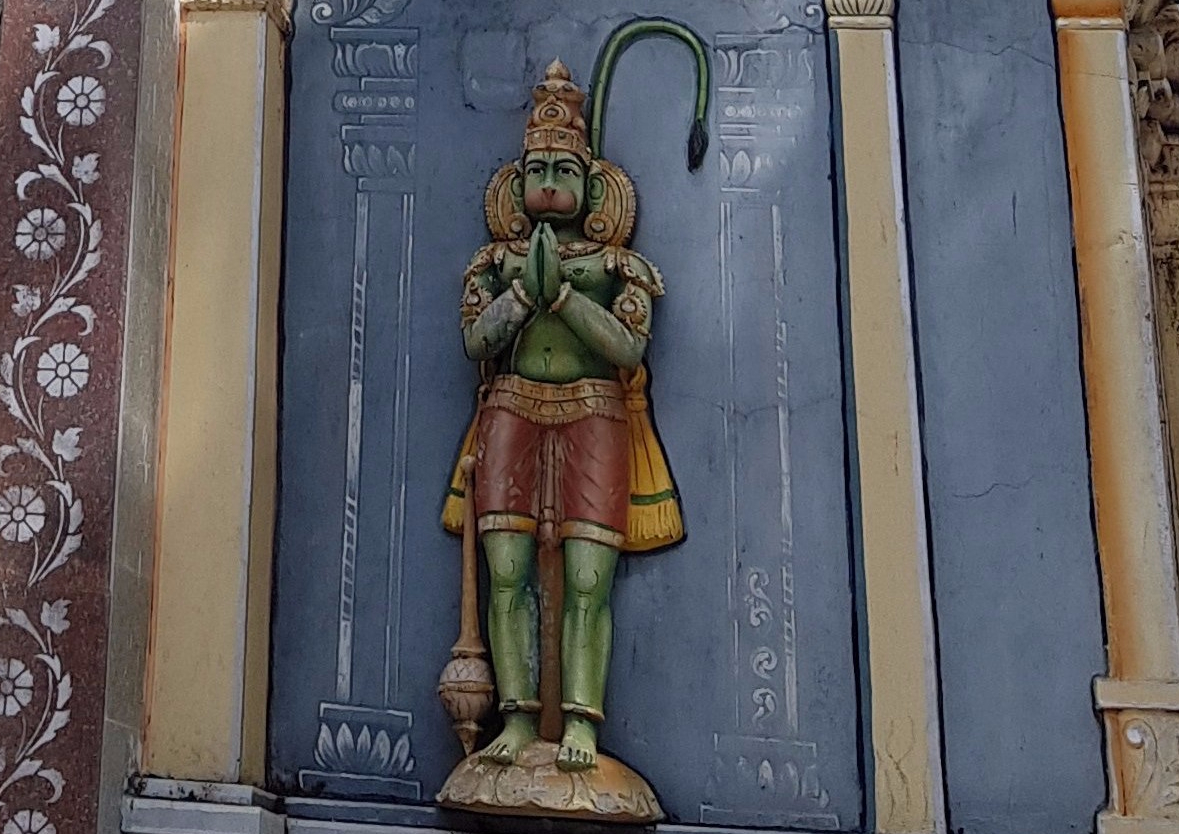
A rare image of the Creator
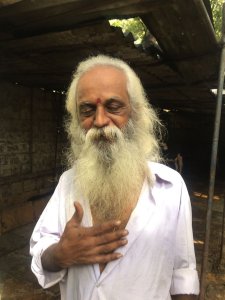
Our next temple was the 17th century Kaadu Malleshwara Temple to Shiva from which this neighborhood gets its name. Kaadu means forest in tribute to the lovely trees growing so densely in the area while Mallikarjuna is one of the names of Shiva. On the way in to this temple, we paused to greet the priest standing in front of his cow shed. This temple is entered on the backside, overlooking a gorgeous forested park area. Just inside is a large Nandi, or bull. This bull is Shiva’s conveyance, and also the closest creature to him. As such, people whisper into the ear of the bull all the things that they want Shiva to know, whether a painful confession or a wish for something better.
Leaving the temple, we descended the stairs and saw to the right a large statue of a hooded snake sheltering a god and a great collection of smaller snake idols behind it. Kaveri explained that when a new construction project is undertaken (like the creation of a new neighborhood), the snakes that live underground are disturbed. To placate the snakes and prevent harm to the new residents, a snake temple is erected. When people become ill or otherwise distressed, they may suspect that the cause is a curse from a snake that must now be given offerings before the curse can be lifted. It was a beautiful, peaceful setting, even with all the snakes.
Beyond the forested area was yet another temple, this one with an amazing story. The Shri Nandeeshwara Teertha Temple was, at some point, lost to time. It was erected in a topographical depression and, with disuse, had been completely covered by mud and disappeared. That is, until a group of boys saw something shiny in the mud and tried to dig it up, shocked to find a complete bull statue. They told their parents, and the community lobbied to unearth the temple and prevent the construction of a mall on this site. While there are claims that this temple is 7000 years old, it is likely that it’s closer to 700 years old. It features a nandi spitting water which falls onto the lingam of Shiva, ensuring the continued procreation of the world. In front of them is a pool fed by an underground spring with fish and turtles happily swimming about.
This slideshow requires JavaScript.
Aside from the amazing temples of this neighborhood, we also walked by Malleshwara’s vendors. They used to have a very popular and thriving market, but the government wanted to build a new mall (currently under construction). In the middle of the night when no one was there, they bulldozed the market structures to make way, entirely against the will of the community. People are remarkably resilient, though, and they continue to sell their wares along the sidewalks where the market used to stand.
This slideshow requires JavaScript.
We completed our tour with a visit to Dwaraka Plus, an organization that supports rural communities that create beautiful paintings on cotton or silk, using natural pigments that they create themselves from vegetable sources. The fabric becomes wall hangings, sarees, purses, boxes, and all manner of other things. Before the founder of this organization discovered these artisans, their community was dying – they were far from major roads or water sources and were struggling to feed themselves – but she helped them create a market for their goods and reinvigorated their expression of this art form.
I’ll definitely be back, to Dwaraka Plus and to Malleshwara.
We spent a glorious 4-day weekend in Mysore for Mysuru Dasara.
We spent a glorious 4-day weekend in Mysore, about 95 miles southwest of our home north of Bengaluru. This was a true weekend of firsts: our first India train travel, our first public bus, our first rickshaw rides, our first experience with elephants, and (our main reason for being there) our first big, city-wide Indian celebration event. We crammed in as much as we could while ensuring daily relaxation time, fabulous meals, long walks, and lots of sleep. OK, we didn’t really worry about cramming everything in. We focused more on having an enjoyable weekend and getting to know more about a lovely city that we look forward to visiting again.
Mysore is the historic capital of the state in which we live, which also used to be called Mysore. For 600 years it was ruled by the Wodeyars, interrupted only briefly by Haidar Ali and his son Tipu Sultan. After independence from the British, they ceded their rule to the new Indian state (as did all royal families across India), but retained their titles and government involvement until Indira Gandhi ended royal status in 1971. Even then, they continued to be among the wealthiest families in the world and the city they created and lived in is full of the gorgeous buildings and monuments they created.
With independence, Bengaluru was named capital of the soon to be formed state of Karnataka. To us, this looks like a blessing for Mysore. While Bengaluru continues to grow exponentially with each year, with all of the challenges brought by a rapidly swelling population, Mysore’s population is only about a tenth that of Bengaluru. There is less visible garbage, more manageable traffic, and easily walkable streets. Given the crowds of a festival weekend, we expected issues with all three of those things.
We took the train back and forth (see Our first Indian Train ride), visited the temple of the Goddess Chamundeshwara (See Chamundi Hill), took a tour of the central core (see Royal Mysore Walks), attended the Jamboo Savari and Bannimantap Torch Light parade (see Mysuru Dasara Events), had wonderful meals (see Kamat, Southern Star, and Tiger Trail), and visited the Mysore Palace where we got up close and personal with elephants (!) (see Mysore Palace).
This slideshow requires JavaScript.
We also visited the famous Mysore Zoo where we were most excited to see giraffes, hippos, rhinos, and a baby elephant sheltering between his (her?) mother’s legs. We were a bit overwhelmed by the crowds at the zoo, but managed to find some quiet spaces where, bafflingly, no one else seemed to go. The crowds seemed to instead cluster densely around the reptile houses where people waited in long lines instead of taking a turn to the unvisited arbor lined promenade where they could watch the baby elephant. Strange, but definitely our gain.
From there, we found a brief air-conditioned respite at the lovely bar in the Radisson Blu before heading for a walk around Karanji Lake, a beautiful, quiet, forested bird sanctuary that we sincerely hope is the model for the renovation of Lake Yelahanka near us. Again, lots of people were there.
Our next visit to Mysore will definitely be timed for a less crowded experience, but oh, how we loved it!
When in Mysore for Mysuru Dasara, one must visit the temple dedicated to the goddess for whom the celebration exists, the goddess Chamundi, slayer of Mahishasura. Tom is not a big fan of religious tourism, but Melissa loves a good temple, so we dressed in our knee-and-shoulder-covering clothing and asked the concierge for some advice on how to get there. We had assumed that we could just call an Ola to take us, as we would when going anywhere in Bengaluru, and just asked for advice on where to have the car drop us off. It was a good thing we asked, because we were told that during the festival weekend, we’d have to take the bus rather than a car. The incredibly friendly concierge told us how to get to the bus terminal just a 20 minute walk into town, and told us that the bus would be free today.
Once at the bus terminal, Tom asked for guidance and was told the bus number we needed at the far bus stand. The bus was there when we arrived, nearly ready to leave so we were gestured on quickly. Turns out it wasn’t free, but it only cost 20 rupees each (about 30 cents), which was only an issue because our supply of small bills was much smaller than it should have been. Tom had to ask the bus conductor for change once we were underway.
This bus was an adventure all by itself. It was jam-packed and we were standing, Melissa with her head in the armpit of the man holding a handle above her and Tom glaring to fend off a would-be-pick-pocketer fondling his phone in his pants pocket. It was hot and sticky with no apparent air movement given everyone pressed so tightly together, and people continued to get on at subsequent stops. Finally we got to a stop near the zoo where lots of people got off and we were able to grab seats, albeit not together. Sitting was an entirely different experience; no one else was touching us, and we could feel a clear breeze from the low windows. Aaaah. The other part of the adventure was the driver. We’re used to the craziness of Bengaluru drivers, but we didn’t expect it from a bus in Mysore. Wow, was this bus driver aggressive, constantly honking his horn and speeding around the narrow winding road up the steep hill. Miraculously, he didn’t hit anything, and we got off at the top with great relief.
In this weekend of firsts, we knocked off our first bus ride. Sure, it wasn’t ideal, but it also wasn’t as intimidating as we expected. It probably won’t ever be our first choice for travelling about town, but at least we know we can handle it in a pinch.
We’d expected a solemnity to the temple area, but this felt more like a carnival. There were little booths set up everywhere with either food or plastic tourist junk, so many in fact that we couldn’t find a place to see the view from the top of the hill. We decided to venture through the archway toward the huge temple and discovered a long winding line and people milling about everywhere. While tickets were required for the temple, our Gold Cards purchased in advance covered our admission and expedited our entry. As we were trying to figure out where to enter (there were no signs or officials anywhere), we were approached by a young man telling us that we needed to remove our shoes. And of course we did – we knew that, but just forgot in all the hubbub, and clearly walked right past the shoe check. He said we could leave them with him and the three men standing there with him and gave us offerings of flowers, incense, and idols to take into the temple. It was definitely a risk to just leave our shoes with a stranger, as we would have been very unhappy to have lost them, but we took a chance (Tom was assuming that eventually there would be a fee once our shoes were delivered safely back to us) and it worked out fine.
Ravi
We entered a short line that went almost directly into the temple, separated by a rope from people who had stood in a line that wound around the temple. It made us feel a bit guilty and added to our frustration with the people in our short line who were pushing or obviously cutting. While there was little solemnity outside the temple, we expected to find it inside – but didn’t. There were clearly people there for whom this was a religious experience, bowing their heads, and finding meaning in the steps along the way, but it really seemed more like a social, habitual rite for the majority of people there. And the pushing only intensified as we moved through the temple. We couldn’t look around because we needed to focus on maintaining our footing and moving forward. We passed the priest with incense and waved it over our faces , we passed the priest with the holy water which he spooned into our hands to drink and then sprinkle on our own heads, we passed the priest who put vermillion dots between our eyebrows, and we paused with the priest who received our offering and returned our idols with vermillion dots on their brows (and then looked annoyed until we gave him money as well). We pretty quickly made our way out of the temple and breathed a sigh of relief as we headed back to where we left our shoes.
Happily our shoes were waiting right where we left them, and so were our shoe-protecting, offering-providing new friends who (no surprise to Tom) requested 200 rupees from each of us. We paid up, realizing we should have suspected something of the kind. The one we’d spoken with most was very friendly and introduced himself. Melissa thinks he said his name was Lavi, but Tom thinks he said Ravi because Lavi is not a name. He offered to take us to another temple right next door, but we weren’t really into it after the shoving match we’d experienced in the Chamundeshwari Temple. We did ask him where we might find a view, though, and he walked us to a lovely spot from which we could see all of Mysore below us. Lavi/Ravi kept pushing this other temple, the Mahabaleswara Temple devoted to Shiva, explaining that it is the ancient temple of the hilltop village where he lives, that this temple is 2000 years old where the Chamundeshwari Temple is only 800 years old, that it is peaceful inside. Melissa was finally sold and Tom agreed to come along. We were glad we did. There were only a couple other people inside and it really was just lovely. After walking us to another viewpoint, Lavi/Ravi asked us for money “for the children.” We gave him 200 rupees which he did not seem to find satisfactory, but accepted nonetheless.
You can make out the devotional marks on the edges.
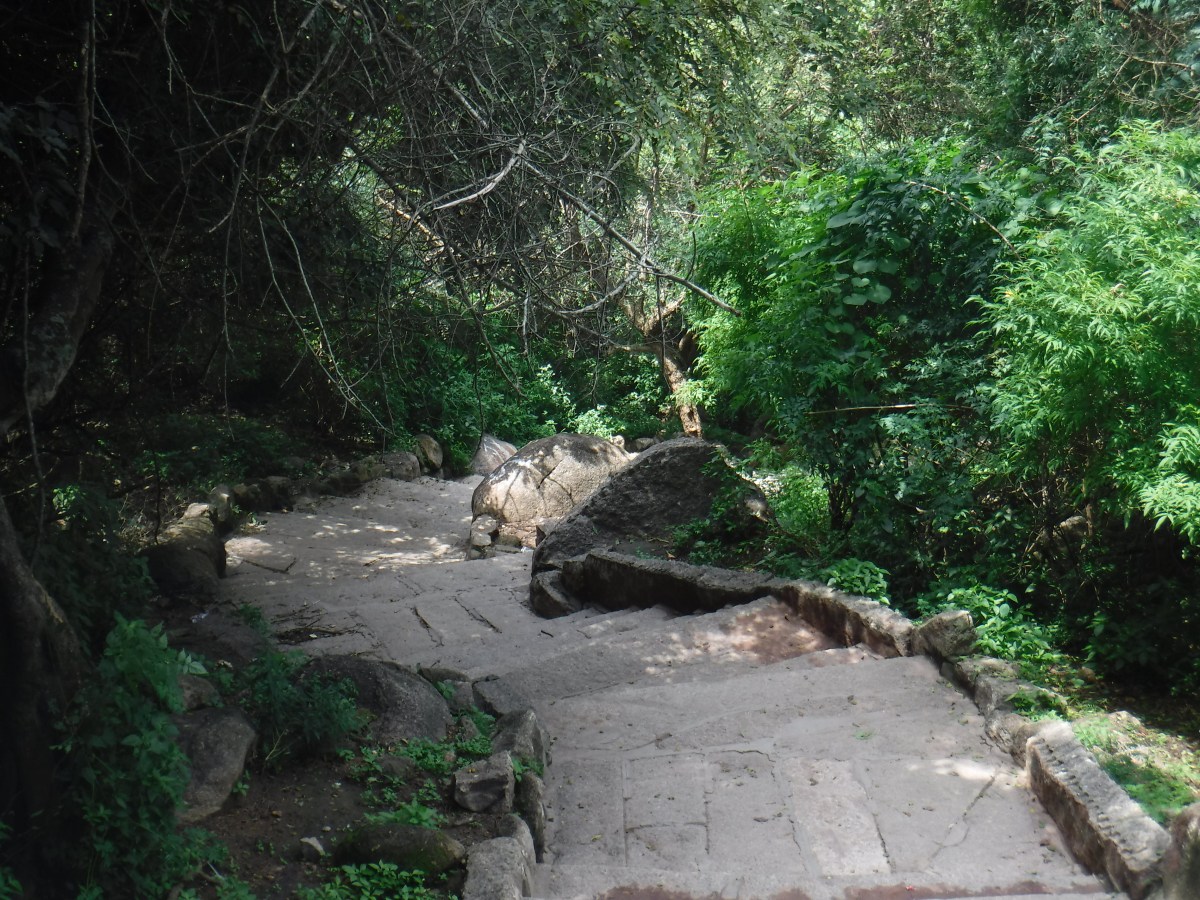
We decided that we’d had enough of Chamundi Hill and now just wanted to leave, but didn’t know how. We couldn’t call a car, we didn’t want to get back on the bus, and we were having difficulty finding a path to safely walk down. And then we bumped into some Americans who animatedly asked if we’d come up the 300 steps. We hadn’t, but only because we had never heard of them. We were suddenly very eager to go down them, and they weren’t that hard to find once we knew what we were looking for (and Tom found them on Google maps). The walk down was great. It was frequently shady with stunning views off to the left, and a slow but steady procession of people walking up the steps. Most of them were alone, but some were in small groups, and as they walked, they stopped to put dots of turmeric and vermillion on the face of each step. This was the focus and solemnity we’d expected to find at the temple. We both agreed that it felt like more than 300 steps going down, and the faces coming up made it clear that they would have agreed had we asked them. With shaky legs, red faces, and a serious consciousness of our own dehydration, we began the walk back toward town, looking for a place to stop for water, food, and a little relaxation (see Kamat).












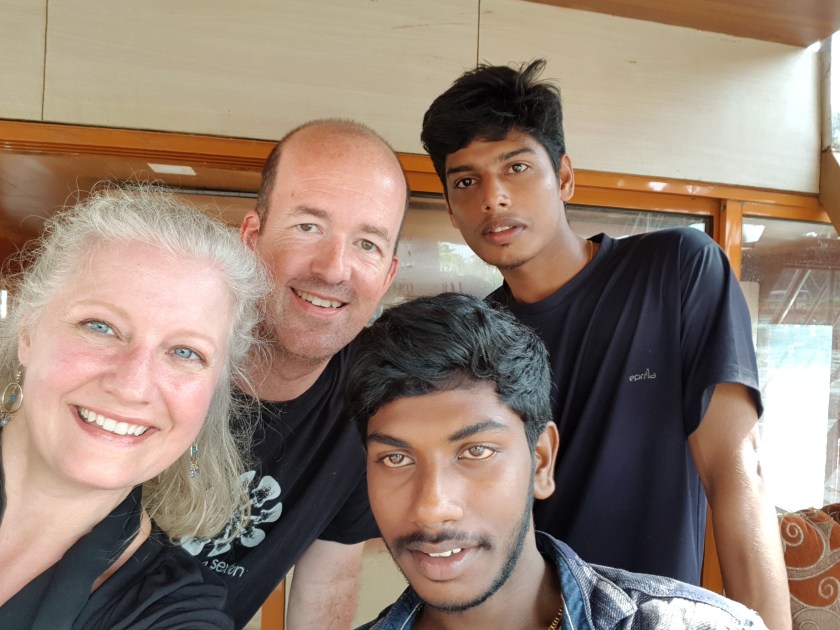 We loved our crew, and we loved having a upper deck that was both covered and totally open on four sides. We learned that there are clearly different houseboat companies, though. If we return to a houseboat, it won’t be the same one.

 Kerala is a fascinating place, not only for its beauty, but also for its political history. The communist party has had a strong presence here since the 1930s and has led the region since the 50s. Between the Communist Party of India or CPI, the Communist Party of India (Marxist) or CPI(M), and the Socialist Party, they hold 19 of the 20 seats of congress, with the remaining seat going to the India National Congress Party. In the 1970s, they launched a 100% literacy campaign and have come pretty darn close with literacy in this state at 94%, as compared to 74% across India as a whole. For comparison, the US literacy rate is around 86% and goes down below 80% if we’re looking for a reading level above 5th grade. Healthcare is free in Kerala, regardless of the need, and anyone can request funds from the state to buy or build a home, ensuring no homelessness. Kerala is also plagued by strikes. We experienced the 100th strike (or hartal) of the year while we were there. In India, a strike does not mean the closure of a single business or group of supportive businesses, it means the total shut down of the region – all businesses are to be closed, people are to stay off the road, everything stops. Definitely a challenge to productivity (and tourism).


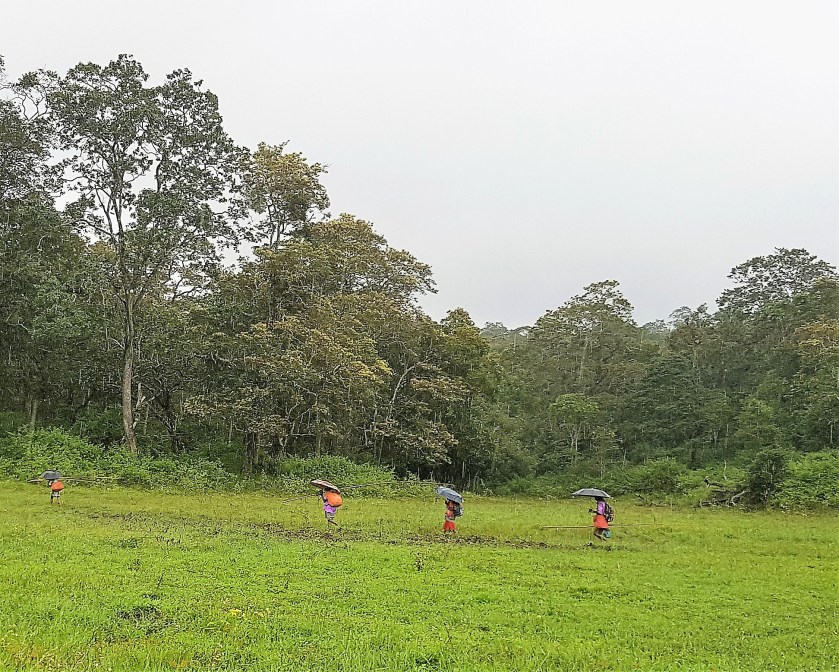


 Our trek back to the boathouse was a bit quicker. After a break back at the lunch spot, we got back on the rafts for an occasionally rain-spattered paddle. Then the rain became a downpour. We high-tailed it out of there. The guides took us through several short cuts, making it clear that the first leg of our day really was all about pointing out the natural splendor of the place. Our soaked sprint home was only interrupted by a huge herd of bison, big enough that our guides also seemed impressed.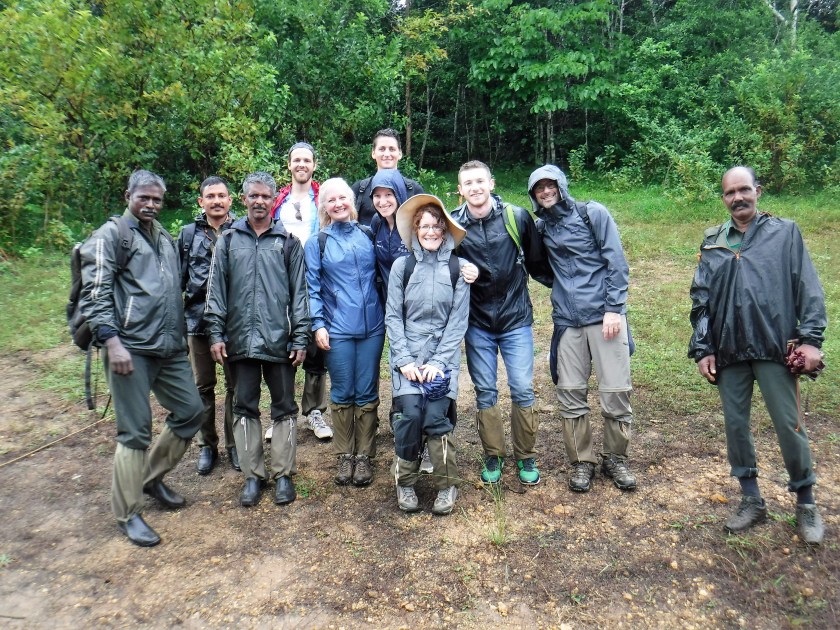

 the heart of Malleswaram. It’s just a little younger than the

 this neighborhood gets its name. Kaadu means forest in tribute to the lovely trees growing so densely in the area while Mallikarjuna is one of the names of Shiva. On the way in to this temple, we paused to greet the priest standing in front of his cow shed. This temple is entered on the backside, overlooking a gorgeous forested park area. Just inside is a large Nandi, or bull. This bull is Shiva’s conveyance, and also the closest creature to him. As such, people whisper into the ear of the bull all the things that they want Shiva to know, whether a painful confession or a wish for something better.


 We completed our tour with a visit to Dwaraka Plus, an organization that supports rural communities that create beautiful paintings on cotton or silk, using natural pigments that they create themselves from vegetable sources. The fabric becomes wall hangings, sarees, purses, boxes, and all manner of other things. Before the founder of this organization discovered these artisans, their community was dying – they were far from major roads or water sources and were struggling to feed themselves – but she helped them create a market for their goods and reinvigorated their expression of this art form.
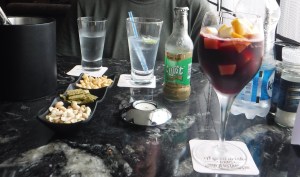 From there, we found a brief air-conditioned respite at the lovely bar in the Radisson Blu before heading for a walk around Karanji Lake, a beautiful, quiet, forested bird sanctuary that we sincerely hope is the model for the renovation of Lake Yelahanka near us. Again, lots of people were there.




 Wellserton Wanderings