When we last visited Mysore, it was for Mysuru Dasara, an important celebration that brings an extra million or so people to this sweet little city, so we were eager to return at a quieter time. It felt to us, minus the extra million people, a city that could have the feel of Portland — a big enough city that there are always a variety of things to do, but small enough to feel personal and homey. Rachel and Laurence’s visit gave us the perfect opportunity to visit the city at a quieter time. This would be our second stop on our three week vacation, after a visit to a lovely private home in Bokkapuram, so it has a lot to live up to.
It turned in to a weekend of showing Rachel and Laurence some of the things we enjoyed doing on our first visit: we toured the Mysore Palace, walked through the market, went to the temples at the top of Chamundi Hill, dined at some fabulous places, and stayed at Southern Star Hotel (complete with their delicious paid-for-in-the-price-of-the-room breakfast buffet). All of these, minus the million extra people, were far more enjoyable and relaxing and meaningful the second time around.
This slideshow requires JavaScript.
There were some things that were different. We checked out the Cauvery Arts and Crafts Emporium (very cool). Our dinner at The Royal Orchid (next door to Southern Star) was at the courtyard restaurant Shikari instead of the indoor restaurant Tiger Trail (way more beautiful and way more delicious, but that might be because we remembered to ask for hotter than white people spice). Melissa, Rachel, and Laurence walked up the thousand steps to the top of Chamundi Hill instead of taking the bus up and walking down. Tom thought it was a good idea to get a nasty chest cold, so he spent the one full day in Mysore in bed ordering mediocre room service food. He could have done without that part, but all of the rest of it was just what we hoped.
As part of the pilgrimage up the 1000 steps, the faithful mark the riser of each with vermilion and turmeric, making for an impressive sacrifice of a walk, and for a beautiful stair way. Also, most of the photos on this page are by Laurence. Thanks, Laurence!
Mysore is just simply a nice little city that moves at a much nicer pace than we are used to. Now we are off to the coast, Mahabalipuram and its awe-inspiring antiquities.
Once in a while, if you’re very lucky, things turn out even better than you planned. This is the case with the first stop on our 3-week adventure with Rachel and Laurence. Our friend Kaveri connected us with her aunt Jagu, uncle Mohan, and cousins Hari and Aarti in Bokkapuram (between Masinagudi and Ooty for anyone searching on a map), who opened their home and made us welcome. Their property borders a national forest that is home to abundant wildlife which they love and respect, always maintaining an awareness that they are on the animals’ land rather than the other way around.
A beautiful banyan tree in the yard at the house.
The small 200-year-old temple on the property.
The ever-changing beauty of the rock face.
More lush beauty in the yard.
Bison killed by a tiger eight months ago.
The western ghats as seen from the yard.
At every moment of the day, there’s something to see, but the property really comes to life at dusk. The moment we arrived, we sat on the deck, enjoying first tea and cookies and then chips and wine while gazing toward a pool fed by water pumped from an underground stream. In the space of two hours, we saw the resident herd of spotted deer, a large sambar, a powerful old bison, a trio of younger bison including a small calf, two wild boar, a bounding rabbit, a peacock, and rooster-like jungle fowl. We also heard a variety of distinct birdcalls and the “sawing” call of a leopard. It was thrilling. The next day we added to that list a giant Malabar squirrel scampering in the nearest tree, and the next evening a large elephant showed up just after dark, still visible with binoculars. Perhaps most exciting was our final morning when an 8-year-old elephant emerged from the forest and spent quite a while enjoying the water in the dappled sunlight. He also enjoyed shooing away the birds. Apparently, he’s a known bully who was forced out of his herd, a common occurrence at his age. When not actually seeing live animals, we heard stories from Mohan and Hari about their animal sightings: an elephant who broke a large branch from a tree by the house, a tiger who brought down a bison calf in the yard, a herd of wild dogs who rather gruesomely attacked a spotted deer, and a boar who used to visit regularly and knew Mohan’s voice. So incredible. And then, when it was too dark to marvel at the animals, we were awed by the stars.
This slideshow requires JavaScript.
Mohan and Hari also liked to talk about their unique philosophy of co-habiting with the animals. Bokkapuram is starting to fill with resorts serving tourists who take safaris in an attempt to have the wildlife-communing experience that we had in our front yard. They build amazing compounds with beautiful flora, some of which attract the elephants, bears, big cats, and other critters that show up regularly at Mohan and Jagu’s home. Then, when they realize that these very dangerous animals are coming around and threatening their guests, they go to great lengths to keep the animals away — electric and barbed wire fences, plants that are supposed to repel the animals, firing weapons, and all kinds of things that aren’t good for the animals. In other words, they invite the animals to come around, then threaten them with bodily harm when they do. A long time ago, Mohan decided he would be different. He built a beautiful home that also serves as a barrier when dangerous animals threaten. He planted a few things the animals like, and then sat back to watch the show every night. Over the years, the animals have come to trust Mohan’s property, so deer and bison sleep in his meadow every night, and the menagerie inspires Mohan to exclaim, “Who needs television?!” Also, he and Hari both are very careful to make sure their guests know that they are not to wander aimlessly — there are dangers out there.
Jagu outdid herself with the fresh, home-cooked meals. Each one was beautiful, varied, and so very delicious, with special meat dishes for Laurence, the lone meat-eater among us.
When we weren’t eating or animal gazing, we were either going for long walks or relaxing with books in this idyllic setting. The walks were simply lovely. We walked through Bokkapuram, a cute little village; we climbed a hill to a temple with an incredible view; and we walked through a gorgeous back lane by a little creek. In addition to reading, we even napped, something we never do, but which felt perfect here.
This slideshow requires JavaScript.
We may have set the bar too high with the start of this trip. It will be very difficult for anything else to measure up! First attempt at living up to the standard Jagu and Mohan set, Mysuru!
Continuing with our previous blog on the normal life of India that seems strange at first, here are more of the things that jumped out for us when we were new.
It’s always my turn: It’s always your turn too. It’s also his turn and her turn and everyone else’s turn. It seems like the concept of patiently waiting for your turn is just not part of the culture. This shows up in conversation when people happily talk over each other, neither taking nor intending to give offense. It shows up in traffic when people just edge into any open space without concern for anyone else’s desire to be in the space. It shows up at the elevator when everyone enters when the doors open without regard for who was waiting first.
The children have the biggest eyes and brightest smiles: There is something so heart warming when you happen upon a group of children, their eyes light up as they yell, “hello!” and “how are you?” and “what’s your name?” Then when you try to engage them, they seem baffled, since those phrases pretty much tap their English skills.
Poverty and affluence live right next door to each other: There are probably affluent enclaves that we don’t visit where one can forget the extreme poverty that impacts people in this city. That’s not what we see, though. We see the big houses with impressive gates right next to groups of tented tarps where families are living. We see expensive western malls with small children selling pencils and balloons outside, gesturing for something to eat. We see fancy apartment buildings next to dirt roads where people live without plumbing. From what we see, it’s impossible to ignore the poverty that surrounds us everywhere we go.
Just because someone is speaking English doesn’t mean you can understand them: Some people do not speak English at all, but most speak some and many are entirely proficient. Yet even those who are fluent are sometimes difficult to understand. English is spoken both very quickly and very softly, and the emphasis on a word is often not where we would put it. Speaking on the phone with stores or delivery people can be very difficult and probably very frustrating for them as they wonder why can’t we understand what they’re saying when they are saying it in perfect English!
A tremendous number of people work in each store: It is not unusual for the number of workers to outnumber the shoppers. Some of those workers will simply be in the way while you’re trying to get down aisles, as they stand about and chat. Others will follow you, offering assistance that you don’t want while standing closely enough that it’s difficult to see the things for which you are shopping. As soon as one leaves (after you explain that you’re just looking and would prefer to shop alone), another one takes their place.
We are photographed all the time: We’ve written about this elsewhere, but it’s worth including here too. For most people here in Bengaluru, we are walking, talking flamingos and they can’t wait to snap a picture. Usually we are asked to pose for “selfies,” but then end up posing while someone else takes a picture. We are not celebrities for whom the paparazzi are a necessary evil to boost our careers. We do not have stylists ensuring that we are always photo-ready. We generally dislike being photographed. And yet we smile when asked and try to not to get snippy with the 5th request in an hour. It’s hard to imagine what people do with all these pictures.
Communication modes are different: Here in India, there is no voicemail. When you want to reach someone, you either just keep calling or you send a text. If it’s someone you know, you message them using What’sApp. Because of all this texting, it’s frequently used for advertising. We don’t even know how we ended up on some of these lists, but we delete 10+ spam text messages each day.
And yet, for all of these strange things, this feels more like home every day,
After our trip to beautiful, clean, green Kerala, we made a pact to get out of the city into nature at least once each month. For November, we chose a hike with the Bangalore Mountaineering Club to Utari Betta. We couldn’t find it on the map so had no idea where we were actually going, but trusted that we’ve have a nice day out. We were not disappointed.
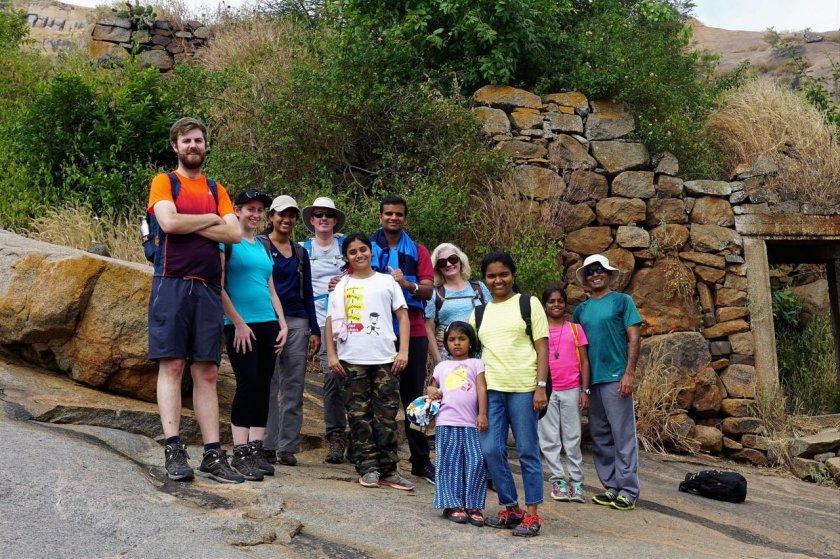
We left home at 6:15 in the morning to get to the downtown pick-up spot in plenty of time to meet our group: an Indian family of four, a 20-something British couple newly relocated to Bengaluru, an Indian woman recently returned after 13 years in the US, an Indian couple new to hiking, and our leader, Bhavani.
The day started with a 2 1/2 hour drive to our trailhead, although it was broken up by a stop at a roadside restaurant where we enjoyed delicious masala dosas and vada, and where Bhavani purchased the vegetable biryani that we would carry in our packs to have for lunch later.
This hike was described on the website as “easy” and we were concerned that we wouldn’t actually get much exercise, but that was not the case. While we did not hike quickly, we did hike steadily upward for quite a while over massive granite stones. In some places steps had been cut into the rock, in others we had to scramble a bit. There were occasional stretches through areas with dense foliage, but we were in the sun for most of the day. The youngest child moved slowly all the way up, so her parents did too, but she was a trooper, and they all made it, thanks to Bhavani stepping in to cheerfully keep things moving when needed.
Our first stopping point was a lovely temple to Shiva, newly whitewashed and festooned with lights for a recent festival. We walked around, relaxed in the much needed shade, and admired the views.
This slideshow requires JavaScript.
It turns out that Utari Betta is also called Huthridurga and is one of 9 “durgas” or hilltop forts in the region. This one was built by Kempegowda in the 16th century. While most of it is gone, there are still visible walls and archways along the way which were really cool to see. Bhavani pointed out Savandurga, visible in the mist across the valley, which is one of the largest monolith hills in Asia.
Our next stop was described as a cave, but was really a giant rock that one could crawl under and then climb between huge boulders to another spectacular view. Melissa elected not to crawl, but Tom said it was totally worth it.
From there, we returned to an open flat area for our biryani lunch. As we were finishing up, we encountered another large busload of people from BMC that were trailing us. We had always been pleased with our small, friendly group, but were even more so after encountering the boisterousness of the other group later in our hike. A group yelling, “Woo!” from the hilltops kind of ruins the peace of being out in nature.
We then leisurely descended, made our way back to the bus, and dozed on the way home, happy with our outing. We’ll look into other hiking groups as well, but will likely return to do more with BMC.
Grover Zampa Vineyards is about 40 minutes north of us toward the Nandi Hills. The drive there is lovely, as the city falls away and you gradually find yourself surrounded by the farms and greenery that our neighborhood used to be. And of course being at a winery gives us one less thing to miss from Oregon.
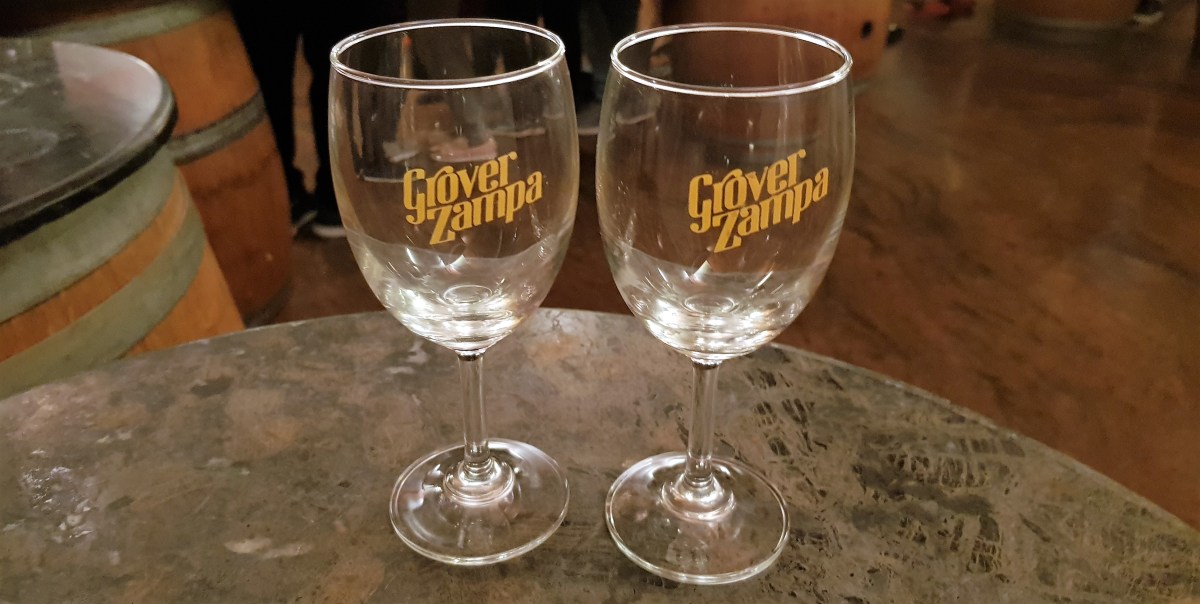
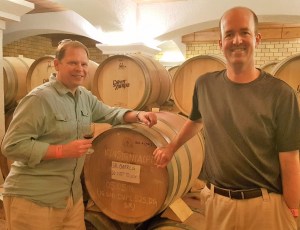
We’ve gone twice in the last couple months and look forward to going again soon. The first time was when we had a happy visit from our brother-in-law Michael. The three of us started the day with breakfast at the Mavalli Tiffin Room (yum!) and a stroll throughLalbagh Botanical Garden before heading out for a lovely afternoon. We arrived a little late for lunch, but were still so full from breakfast that we didn’t mind. Our 15-member tour group was first told about the history of the winery. Launched in 1988, it was the first winery in India – this is an incredibly new industry here – and the current winemaker is the granddaughter of the founder. We then walked through the entire process of winemaking, from the crush pad to fermentation tanks to bottling and labeling. Our guide, Vipin, is so knowledgeable. We’ve been on many similar tours, but still learned some new things. The tour ended in the cellar where Vipin first told us about the 27 wines they make from the 6 different grapes that they grow. As a new industry, the stores that sell wine don’t know much about it and don’t keep it in optimal conditions (e.g. Not Just Wine and Cheese near us keeps their wine on the upper floor with no air conditioning and many of the bottles standing upright). We were pleased to taste properly stored wine. It’s really good! Sadly, on that visit in October, we were told that a couple of their high end wines wouldn’t be released until November so we’ve have to return. Darn!
When we returned, we went with a big group of Tom’s colleagues. Ten of us headed out for the 10:30 am tour and tasting, followed by lunch. On this visit, the winery was very active and the machinery noise frequently drowned out Vipin’s explanations of things. Added to this, our tour group had 25 people, so it was difficult to see and hear everything. No matter! The tasting was still very enjoyable. And the lunch to follow (vegetable biryani with raita and gulab juman for dessert) was tasty. Unfortunately, the wines we were interested in have been delayed so we’ll have to go again next month. Looks like we’re going to be Grover regulars 🙂
The longer we live here in Bengaluru, the more normal it becomes. Things that used to make us stop and stare no longer get a moment’s consideration. Things that baffled us are simply the way things are. So now, while we still remember what it was like to see these things for the first time, we want to capture some of them here in no particular order.
Garbage is everywhere: The ever present garbage is probably the single most shocking thing here. We grew up in an age of litter prevention in the United States, where “Give a hoot, don’t pollute” signs were everywhere and the EPA was newly formed to make the world better. It is shocking here to see every sidewalk lined with wrappers and debris; sometimes big, broken bags of garbage will be sitting there by the sidewalk. Anywhere that there is a break in the sidewalk (and there are many), garbage will be stuffed into the opening below. Any empty lot is heaped with garbage. Nearly every body of water has garbage floating in it, causing a stench that now makes us instinctively hold our breath any time we approach water.
Animals are everywhere: This big, bustling city filled with cars and motorbikes and pedestrians, with IT facilities and shiny hotels, is also filled with what we think of as barnyard animals. Cows are everywhere; they stroll on sidewalks, snack on the weeds of highway medians, and sometimes just casually lie down in the road completely undisturbed by the cars around them. Can you imagine a cow walking down Broadway in Portland or New York? Can you imagine the uproar after it pooped on the sidewalk with no one scurrying behind to clean it up? And it’s not just cows. There are goats, chickens, pigs, and dogs all over the place. Goats, chickens, and pigs generally seem to have nearby owners, but the dogs are very clearly on their own. And there are monkeys, cleverly scavenging not just outdoors, but also inside the homes of people who leave windows or doors unlocked (although their adorable, little old man faces make us forgive them their transgressions).
Traffic is crazy: There are probably many rules for driving in Bengaluru, but the only obvious one has to do with never allowing an empty space to go unfilled. The lane lines on the road are mere decoration, ignored as vehicles swirl like water around any obstacle that appears (cows, bicycles, pedestrians, cars driving the wrong way down the road) despite signs that declare “Observe Lane Discipline”. There is no road rage, or even apparent tension on the faces of the drivers, as they maneuver their vehicles toward their destinations. When we were new here, we held hands and frequently flinched in the back seat of the taxi. Now we calmly chat or look at our phones, as relaxed as our drivers.
Everything goes on a motorbike: Family of five? Load up and head out. Long PVC pipes for a plumbing project? Your passenger can hold on. Several bags of groceries? A couple can go at your feet, your passengers can hold on to one or two each, and strap the rest on however you can. Many people don’t wear helmets, and many who do wear them unstrapped or little plastic cricket helmets, and in the case of the families, the father driving often is helmeted, the mom occasionally, and the kids never.
People carry things on their heads: Everything from bags of groceries to big bundles of sticks to cinder blocks to furniture are carried on people’s heads. Sometimes they use a single hand to steady the load and sometimes they don’t. Sometimes they create a pad on their head under the load and sometimes they don’t. We saw a man in the train station, balancing multiple suitcases on his head.
Electrical lines loop through the trees: There are some electrical poles, but more often electrical lines are woven through the branches of trees, with big coils of lines dangling at random intervals, often dangling most of the way to the ground.
Electricity outages are common: Perhaps there’s a relationship with the former, but electricity outages happen multiple times a day. There doesn’t seem to be any pattern to it – sometimes it cuts out while we’re using the electric kettle to heat water for morning coffee, sometimes it cuts out while trying to heat leftovers in the microwave for lunch, and sometimes it leaves us sitting in the dark in the evening. Luckily, our building has an effective back-up generator that kicks in quickly, usually in 10-60 seconds. It doesn’t, however, power everything. Hardwired things like lights, fans, and elevators (whew!) come back on board quickly, while anything plugged in like refrigerators, ovens, and air conditioners wait until power is fully restored.
Electric outlets have to be tricked: Most outlets have 5 holes, while many plugs have only 2 prongs. The top center hole where the missing ground prong would go has to have something in it before the holes below will open. So we have to stick something in the outlet in order to plug anything in, usually a plastic pencil. At least the outlets also have switches so we can turn off the power to the outlets before sticking anything inside.
TVs, not toilets: In every sector of the city, even the most impoverished, you can see Dish TV in action. Those same homes that have televisions connected to satellites via looping wires may not have indoor plumbing, or actual toilets of any kind. It is normal to see men urinating by the sides of the road, on the sides of buildings. People of all genders and ages just relieve themselves in open fields. Work is being done on this issue, for reasons of hygiene and the safety of women, but there is much work yet to be done.
Women dress like beautiful butterflies: At least 80% of the women in Bengaluru wear some form of traditional dress in beautiful, bright colors. Dupatta (big long scarves) are draped over the fronts of women’s bodies, trailing behind them to their calves. Women who clean our building dress far fancier for work than I do for a special party. Being dressed doesn’t just include clothing – it also means gold earrings, necklaces, bangles halfway up the forearm, and jingling anklets. In contrast, about 80% of the men wear western dress, and look painfully drab in comparison.
Men are casually affectionate: Male friends here commonly walk with entwined fingers or linked elbows or arms flung around each other’s shoulders. Fathers walk holding hands with their adolescent or teen-age sons. Groups of men will sit close together or benches, practically cuddling as they happily chat. It’s really nice to see the ease of physical contact.
There are no clothes dryers here: Clothes are washed in machines on the utility balcony and then hung on the line to dry. It means we do laundry many times each week and have adjusted to crunchy towels and wrinkled everything. The upside? Gorgeous, brightly colored sarees billow from the balconies in the morning.
Our stove is an independent unit: The stove sits on top of the counter with its two burners connected to a gas tank under the counter. When turning on the stove, we have to turn on the gas and then use a hand igniter to light the burner. We’re told the gas tank should last us 6 months.
One of the few things that Melissa and I don’t see eye to eye on is how excited we get to go see temples. She loves them. What I hear her say is that she finds them fascinating windows in to a little bit of the ancient culture of this place we live. I see that. I really do. Particularly in the differences between the different temples in the different cities or run by different sects. The history around whom, why, and how each temple worships says a little bit about the people who live near there.
Even acknowledging the education we get at the temples, I am uncomfortable. The best I can come up with why comes back to my religious background. I grew up religious, in a church (and church camp) community that was so important to me that it took me many years to realize that the community was everything and the religious structures and stories were different than how I saw the world. I have never believed in an omniscient nor omnipotent god; I spent my entire youth translating the stories of God and a divine Jesus into thoughts about love and common bonds. My faith was a very personal thing, and it was difficult for me to ponder outsiders looking in and wanting to understand. When we are at temples, I feel like that outsider. People are always friendly and welcoming, and if they aren’t welcoming, they make it clear with large signs outside declaring “No Non-Hindus Allowed”. Even as welcoming as they are, I feel like an interloper in a spiritual, important moment in these people’s day.
This weekend, we went on a tour with the fabulous Bluefoot Tours (led by one of our favorite people we’ve met here in Bengaluru, Kaveri — she’s amazing) that brought up all of the above feelings. We toured a graveyard and learned about a sect of Hinduism that believes spirits don’t go from this body to the next instantaneously, so if you cremate a body, the spirit is left to haunt until the next life is ready. As a result, they bury their dead in lotus position with their heads above ground in order to make it easier for the spirit to escape when its next life is ready. We learned about a little bit of black magic which enables you to quiet people who are being too pushy or gossipy (I’m pretty sure that’s not precisely what Kaveri said, but something like that). We learned a whole bunch more, too.
The part that mostly has me thinking about this whole religion thing on a broader scale than just the outsider-looking-in bit was the visit to the Sikh temple. I have been looking forward to learning more about Sikhs since arriving here. There is a lot to respect about the way they express their faith: Their doors are always open to anyone, Sikh or otherwise; feeding all visitors is a primary function of their temple; if you need a place to stay, you are welcome to live there as long as you would like as long as you are not lazy, drunk, or violent. The origins of Sikhism are kind of amazing. A twelve year old boy who would become Guru Nanak got tired of all of the wars and hate and set out to find the common bonds that might bring humanity together and end all of the bloodshed. He sent people to all corners of the world (or as far as they could go in the late 15th century) to discover what makes people tick and religions stick. What he concluded was that love will bring us together. He incorporated tenets of all major religions that spoke of love into a faith community that begat the welcoming, compassionate, nurturing space described above.
Here’s what has me thinking: Why does that idea only take hold when those bringing the message are made into the divine? Humans are love. We love each other. Our love of each other far too often makes us jealous of others, but I have always assumed it’s all part of the same package. Because we wrap this message of love all up with countless shapes of divinity, we are discrediting the amazing beings that we are. We are not love because a god told us to be love; we are love because we are. Why isn’t that enough? Guru Nanak was an enlightened young (and not-so-young by the time he crystallized his notions) man. Jesus told us to love those who don’t love us back. Buddha, Mohammed, the ancient teachers of Hinduism, so many others. They had their fingers on something about humanity that has persisted. Why do we have to make them all divine? I find Martin Luther King, jr. and Mahatma Gandhi all the more impressive because the were flawed people who sometimes treated people imperfectly; that doesn’t mean that they were any less enlightened.
Way too many wars are fought over the notion that my prophet of love is better than your prophet of love. Way too much hate is lashed out because someone thinks your way of connecting with love is blaspheming my way of connecting of love. In the global sense, it doesn’t seem to be working out very well for us. I wonder if we were to appreciate the fact that our crazy little biological/chemical/electrical processes that happen inside of these way too fallible vehicles are why we love, it will be easier for us to celebrate in what ever way we choose to celebrate without turning to hate.
I came to grips with my atheism 15 years ago (maybe)? I wasn’t able to articulate it super clearly until Melissa came along eight years ago. Members of my old church community are still the most important people in my life even though we have all drifted away from the church. I allowed my relationship to my church camp community falter as I felt more and more like an interloper in a place I used to think of as home; I’m hoping to figure out how to balance all of that in the months and years ahead. In the meantime, I love you. Not because a god has told me I should, or because I will be damned if I don’t, but because very wise people — my mom, Gene Ross, Sue Longaker, Jay and Mary Ann Watson, Sheryl Stafford, Mark Hardin, my Grandma and Grandpa George and Emma Morris, Melissa Parkerton — taught me how. I love you.
To this point in our life in India, we have stayed in four and five star hotels. Mind you, we’re not complaining; it has felt like we’re spoiling each other for less than half the price we’d pay in the States. For our first couple of nights of our Diwali vacation, we decided to try out something a little less Western. We found Chiramel Residency, a well rated homestay right in the middle of the old, charming neighborhood of Fort Kochi.
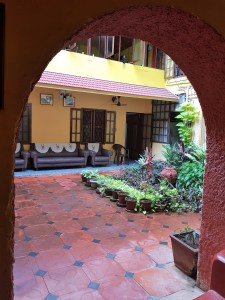
The rooftops from our room.
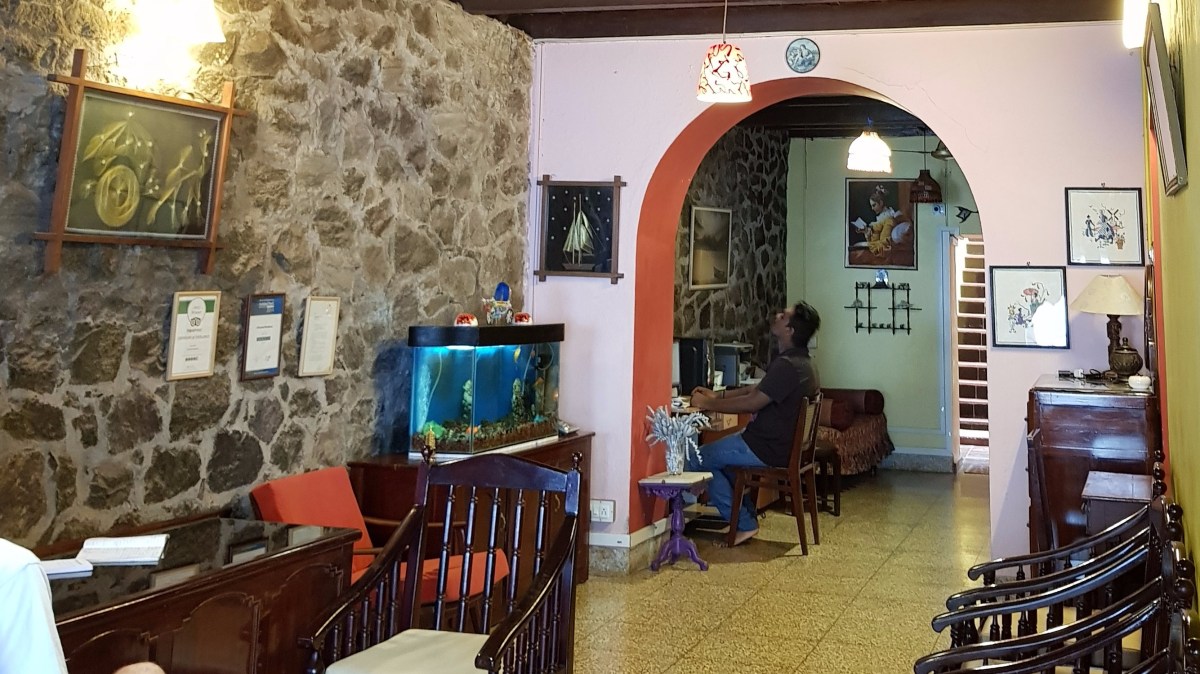
Everything about the place was perfect. All three people we interacted with were warm and eager to please. They gave us a choice of two rooms; we chose the one on the top floor that looked out over roof tops and let us listen to the rain as we fell asleep. The bed was a standard super firm Indian bed, but we expected that so it was fine. We weren’t intending to spend much time at the hotel, but if we were, we would have enjoyed the pleasant reading and game room.
We learned a very important lesson here that we believe is going to serve us well. When
The beautiful courtyard. Our breakfast was served in the windows you see above the courtyard.
we checked in, we were given a breakfast menu and asked us what we wanted and at what time. We were a little disappointed by the options: eggs, corn flakes, fruit bowl, and white bread toast. Patel, our taxi driver from the airport, had suggested that if we wanted a dosa we should ask for one, but we didn’t want to look like pushy Americans, so we didn’t ask. After eating our basic breakfast the next morning, our host chased us down with a question as we left for our walk around the Fort Kochi area. We figured this was our chance to ask about the dosas and were so glad the next morning! The dosa breakfast was incredible, every element — the coconut chutney, the potato masala, the sambar — was delicious. We were able to apply our little bit of learning a couple of days later at the Amaana Plantation Resort, and it paid off just as brilliantly.
Chiramel Resort was a wonderful first stop on our vacation, and we came away with a nice lesson that is going to make our life in India even more delicious.
Our stay in Kochi was a pleasant kick off to our Diwali vacation in Kerala.
Not wanting to waste a moment of Tom’s time off (but also excited to return to Bengaluru on Friday night to welcome our brother-in-law Michael for a visit), we decided to start our trip to Kerala with a flight to Kochi on Friday evening. It was our first time back to the Bengaluru airport since arriving at 3 am on July 31. Our first time through, we were a bit too bleary-eyed to appreciate what a lovely airport it really is. It’s clean and airy, with a wide variety of eateries. Not a bad place to wait for a flight. Once boarded, we arrived in Kochi (also called Cochin) less than an hour later. Our bags arrived quickly, and we were greeted by Patel, holding a “Ms. Melissa” placard. Patel had been sent by the Chiramel Residency, a really lovely spot to stay in Kochi, and he took us directly there. We arrived at the homestay around 9:30 and were greeted with question of whether we wanted to go have dinner now, but all we wanted was our bed.
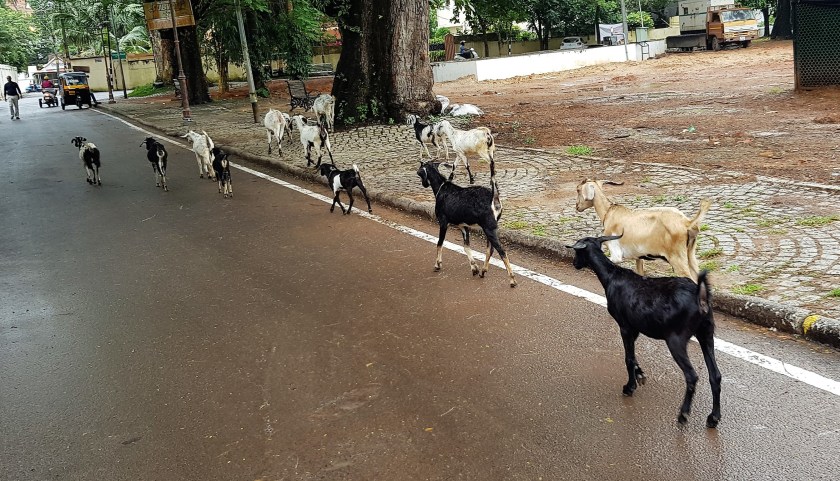
Goats walking the streets of Kochi.
Saturday was our day to explore Kochi. We got up to a breakfast of scrambled eggs, toasted white bread, and corn flakes, not having yet learned that we would only be offered bland white person food if we didn’t specifically ask about Indian breakfast. It was perfectly fine, though, and provided all the sustenance we needed for the morning. We then headed out to be greeted by an adorable herd of goats walking down the street. We were soon to learn that goats are everywhere in Kochi, mostly untended although some have collars. They were crazy cute.
From our homestay in the Fort Kochi neighborhood, it was just a short and pleasant walk to our first sighting of the Indian Ocean. It was cloudy and grey, but still kind of thrilling to be looking out over a whole new ocean. All along the rocky waterfront, it looks like they’re developing paths and patios that will probably be lovely public spaces in the coming years. Interestingly, the first 10-15 feet of the water are completely filled in by greenery that could be some kind of flowering kelp or maybe salt water lilies or lotuses. It’s so dense that it put Tom in mind of the man-eating island in Life of Pi, and made him wonder if this could have been the inspiration for that segment of the book.
This slideshow requires JavaScript.
As we walked along the water, we quickly came to the Chinese Fishing Nets, famous in Kochi. It is believed that they were introduced to the area by a Chinese explorer in the 14th century, and are still in common usage today. They’re really beautiful and kind of amazing to watch, as a system of pulleys and rock weights lower and raise theses huge winged nets in search of fish. We didn’t see much being caught, but we did see impressive displays of fish for sale very nearby, accompanied by places that would cook your fish for you on the spot. Not being fish eaters, we moved on.
From there we walked through nice neighborhoods, marveling at the minimal garbage and well-maintained sidewalks, totally charmed by the lovely storefronts and pretty buildings. We eventually found our way to Mattancherry Palace, built by the Portuguese as a gift for the Maharaja in the 16th century (largely as an apology for sacking the temple) and then expanded by the Dutch when they established themselves in the mid-17th century. From the outside, it doesn’t look like much, but inside there are magnificent 16th century murals covering the walls and an impressive display of old artifacts. There are also a lot of really informative panels that explain the history of Kochi and the whole Kerala region. We learned there about the matrilineal heritage of the royal family that ensured a valued place for women in the culture. One impact of this was an early commitment to educating girls as well as boys through the kingdom.
This slideshow requires JavaScript.
We left the palace feeling hot and hungry so happily wandered through the Heritage Arts Antique Shop to the Ginger House restaurant in the back on the water. The antique shop was chock full of cool old stuff and the restaurant provided a truly lovely setting for a tasty meal. The Heritage Arts Antique Shop is on Jew Town Road near the intersection with Jews Street in, you guessed it, an area called Jew Town. There is a very old Jewish community in Kochi that traces its roots to the time of Solomon. The community grew in the 16th century with Jews fleeing the Iberian Peninsula, and shrank in the 1950s with many emigrating to the newly formed state of Israel. Today, the community is quite small but well regarded. Their 16th century synagogue is down a lovely little alley with a big clock tower at the end (added in the 18th century). Sadly, it was closed when we were there, but we look forward to returning some time. The outside is a bit nondescript, but the inside is supposed to be beautiful.
Having walked the waterfront perimeter of this peninsular part of the city, we decided to cut straight across on our way back to our hotel. This gave a us a chance to walk through residential neighborhoods, encounter many more goats, and stop off at the Kerala State Beverage Center. The first two things were very nice, the last one not so much.
Kerala is not a dry state, but it seems a lot of people wish it were. We had read suggestions to bring alcohol with you and not to expect it to be served in most hotels and restaurants. In fact, we didn’t visit a single hotel or restaurant that served even beer and wine during our whole stay in Kerala. We thought it would be nice, though, to have some wine with us in our hotel rooms and it seemed easy enough to stop off and buy some. Little did we know that the alcohol buying process in Kerala is awful. There is a clear intention to create a furtive, shameful process. We almost walked right past the store, because it isn’t an actual store. It is a dimly lit storefront with a heavy wire cage in the front of the window, which you can’t even seen from the street because of the cement wall constructed to force you to move through an uncomfortably narrow opening to talk to the people inside. We waited in a long line with a bunch of men and one other western woman. When it was finally our turn to tell the men what we wanted, they refused to make eye contact and generally looked at us like scum, which seemed to be how they looked at everyone. They were willing to sell us the wine we requested because they had to, but they wanted us to know what a disgusting thing we were doing. We walked off feeling a bit demoralized, but perked up when we got back to our lovely little room for a rest.
At Restaurant 51
That night, we headed to a romantic dinner at Xandari Harbour’s Restaurant51. Such a lovely setting! We had the restaurant to ourselves since we arrived at the absurdly early hour of 7:30. There was a woman playing a keyboard softly as we listened to the waves from the water next to us. The food was very nice and the service was lovely. When we returned to the hotel, we headed to bed, ready for the next day’s adventures in the mountains.
On Sunday, we knew to ask for masala dosas for breakfast – yum! We expected to be picked up at 9 by Ansu, the driver who would be our companion until he left us at the airport on Friday evening. At 8, we were told that Ansu was already there. This was a sign of things to come – Ansu was always early, always prepared, and completely reliable. At 8:30, we headed down to load up the car and got on the road to Munnar (see Into the Keralan Mountains).
After spending a couple of days in Kochi, we were ready to get out of even that small city. We were headed out to the spice and tea region of Kerala for what we hoped would be a week of relaxation and isolation. Melissa had worked hard to find activities that got us out in nature and away from crowds, and hotels with a sense of isolation, which isn’t always easy to assess from a website.
We had had a wonderful and huge Indian breakfast at Chiramel Residency, so we weren’t ready for lunch. Ansu needed a bite though, so he stopped at a charming little restaurant mid-way to the mountains called Rasa Restaurant. Two things were clear: first, the food looked great and we wished we weren’t still so full; second, the little stream overlooked by the restaurant was actually clean. This was this first real indication we were truly somewhere different than Bengaluru, where most streams are not only not clean but gag-inducing. It was lovely.
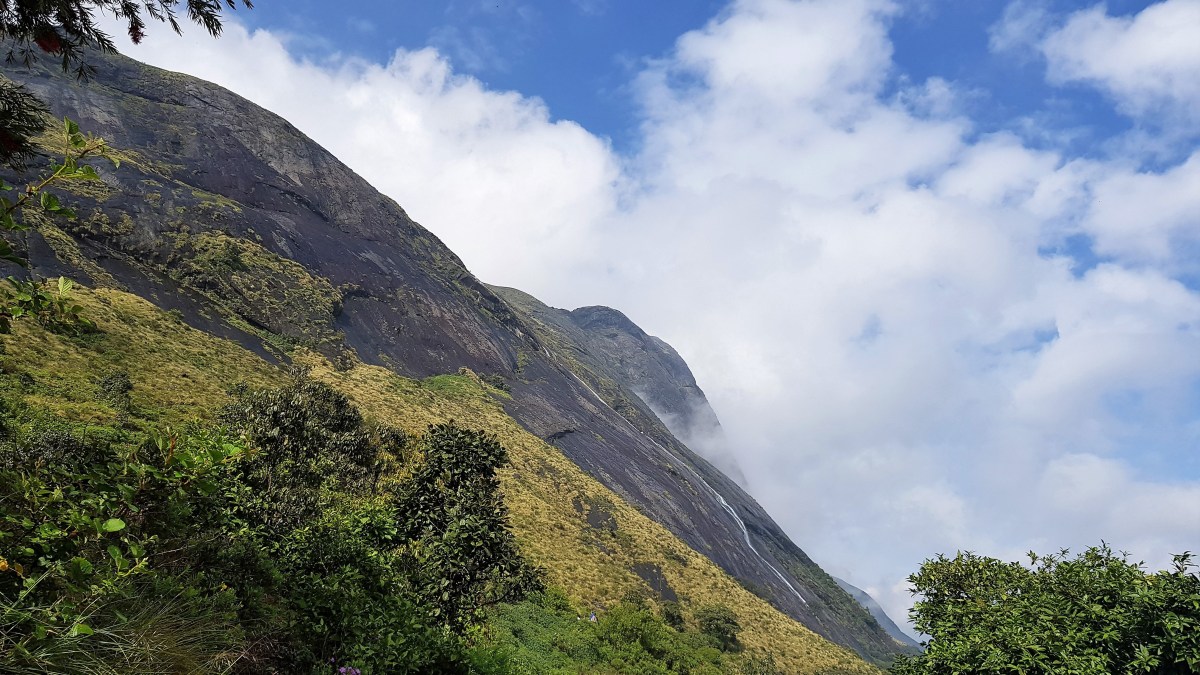
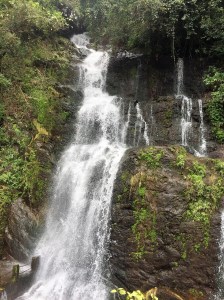
One of the many waterfalls along the road up into the mountains of Kerala.
It is a 4.5 hour trip from Kochi to Munnar, plenty of time for our driver Ansu to get to know us a little bit and listen to us talking about what we hoped to do. We talked a lot about how we were excited to go to a spice plantation, that we had heard they smelled amazing. We also knew we were up against a deadline, because Eravikulum, the National Park where we were headed, closed at 4:30, and we wanted to get to our hotel before it was dark. Ansu insisted on stopping at Periyar Spice Garden despite our weak attempt to protest. It was weird. Basically, we paid 100 rupees each for a 15 minute tour through a nursery, and were then asked to sit on a couple of stools for a hard sell. The tour itself wasn’t uninteresting; it just wasn’t what we wanted to be doing at that moment. Mostly, the tour guide described for us all of the Ayurvedic uses for the plants, including several, she was sure to point out to Tom, that grew back hair.
Back on the road to Munnar, we tried out our new-found understanding of just how insistent we needed to be with Ansu. He tried to push four wheeling on us. Hard. We’re guessing that most of the tours he leads in to the mountains love the four wheeling. We had the hardest time convincing him that it’s not our thing, that we were looking for quiet excursions. He even dismissed our explanation of Melissa’s motion sickness. Once we finally convinced him, though, and we made it clear that we were looking for a quiet, slow week, we had a great time with Ansu. He’s smart (speaks 5 languages), kind, and patient.
One tangent about this pushing stuff on us thing. We have struggled with trust issues. It starts with the rickshaw drivers who are insistent that you must you get in their autos, and that you don’t want to go where you’re going but over there to this other really great store instead. If you argue, you’re told (contrary to reality) that your destination is closed so you must do what they say. We have been told that they get kickbacks from the stores every time they bring in a customer. This then gets displaced to nice people like Ansu. Did we stop at the spice garden because he got a little on the side? It was feeling very clear, especially when he pulled over to get a brochure, that he was getting a kickback from the four wheeler outing he was pushing on us. If that was true, what can we trust as honest suggestions? It made us feel icky.
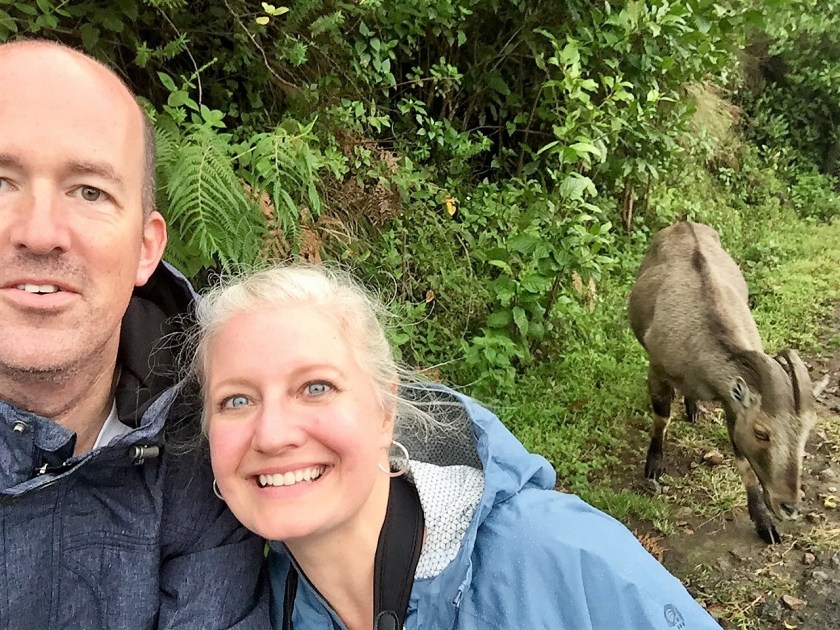
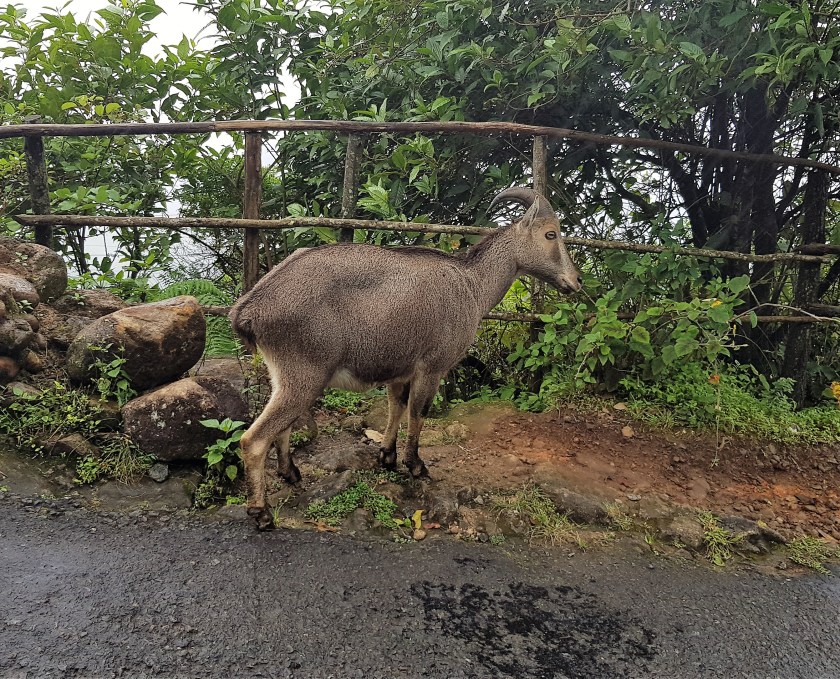
We finally got to Eravikulum National Park. The park is most known for the presence of Nilgiri Tahrs, described as an endangered evolutionary link between antelope and goats. The two hour time limit and early closing time were already signs maybe we wouldn’t be going out to the middle of nature. It turned out it was one big shared experience. After standing in line for their turn, visitors load onto a bus up a mountain, walk about a kilometer in close company with many fellow visitors, and then walk back. Most people seemed to be there for a fun outing with each other, but with very little regard for the nature around us – one group was particularly boisterous and almost kept us from seeing the one thing we were there to see by insisting that we pose for photographs. Our souring mood (mostly Tom’s souring mood) wasn’t helped by a good, steady downpour.
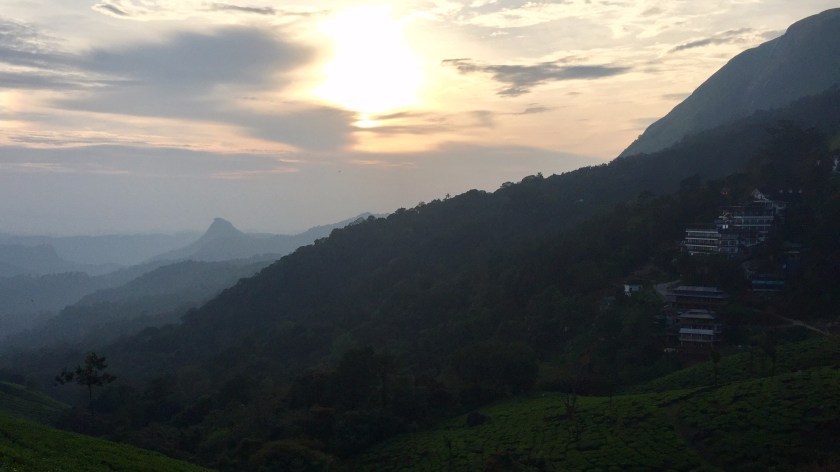
When we were able to put aside our frustration, it was quite stunning. We got to see a tahr up close, right by the side of the path. The views (what we could see through the rain and clouds) were stunning. This is, after all, the second highest peak south of the Himalayas. And the surrounding tea plantations were sights to behold. We simply had a case of missed expectations (and in Tom’s case, a healthy dose of burnout and sleep deprivation).
That’s our hotel perched on the side of the hill on the right.
Then it was off to our hotel, Parakkat Nature. It is gorgeous, overlooking a huge tea plantation. Here, we had one small case of missed expectations, where it wasn’t quite the isolated experience Melissa was led to believe. We did have a nice walk in the tea plantation led by an eager if not super knowledgeable staff member who mostly wanted to pose us for glamour shots for our social media.
On Sunday’s drive up the mountain, Ansu broke the news to us that there was going to be a state-wide strike on Monday, and if we wanted to get to Thekkady before dark on Monday, we should leave at 4:00 or 5:00 am, getting us to our next destination before 7:00 am. With our burnout, we couldn’t imagine getting up that early. We got him to reluctantly agree to leave at 7:00 am, still way earlier than we wanted to get moving. It turns out he was exactly right and we regretted not taking his advice, but again we were having trust issues.
The strike was called by Kerala’s Congress Party and its allies over petrol and diesel prices. At the major intersection of every town, there were small groups of men pulling cars over to question the drivers about what was up. All commerce was supposed to be shut down, including taxis and tourist activities. Ansu guessed there were four or five towns we needed to look out for. His worries appeared to come true in the first big town. The group of men sourly directed him over to the side of the road and told him to go get himself some tea — there was no use waiting around; he wasn’t going anywhere anyway. So we sat. And sat. The longer we sat, the more people gathered. The more people gathered, the more worried we got that this was going to be an ugly, all day thing, as the strike wasn’t scheduled to end until 6pm. Ansu came back when they let a couple of other taxis go, but still we sat. Finally, whether Ansu convinced them that he and his dad are proud members of the Congress Party, or they felt like they had made their point, or they just got bored of us, they finally let us go.
A few more strikers in a few more towns pulled us over for a few minutes each. Each time we worried that this was going to be the one that lasted until evening, but each time — once because we were following a car full of police who were instructed to bust them if they disrupted traffic, once because we were five minutes from our resort anyway, once from pure apathy — they sent us on our way pretty quickly with a bit of cajoling by Ansu.
The grounds at Amaana Resort that put us instantly at ease.
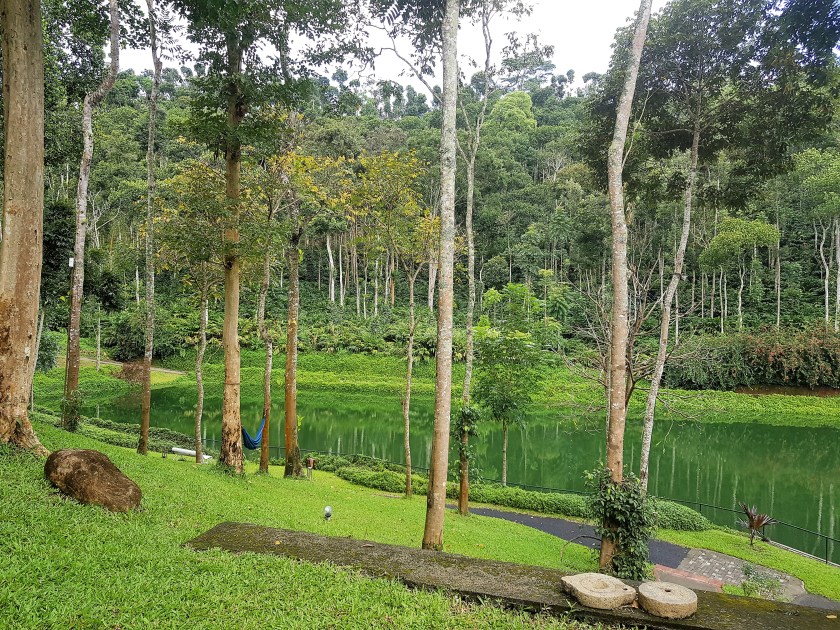
We got to Amaana Plantation Resort around 10:00, with all day to do nothing but deal with that aforementioned burnout and sleep deprivation. It was exactly what we needed. Finally, the quiet and isolation we came to Kerala to find was ours. The first sign of the kind hospitality we were to experience for two nights was that even at that crazy early hour, they had our room ready for us. All we had to do was kick back, take naps, read books, play games, take walks in the cardamom plantation, and eat delicious food. It was amazing.
You can read about the details of the next couple of days here: Periyar Tiger Reserve, and here: our review of the resort. The end result that sour, burned out moods were turned into relaxed, revitalised, happy folks. On Wednesday, we were ready for our strike free drive back to the coast for a night at Kondai Lip in Alappuzha, followed by a night on a houseboat. The trip into the mountains was exactly what we needed to turn our outlook around.
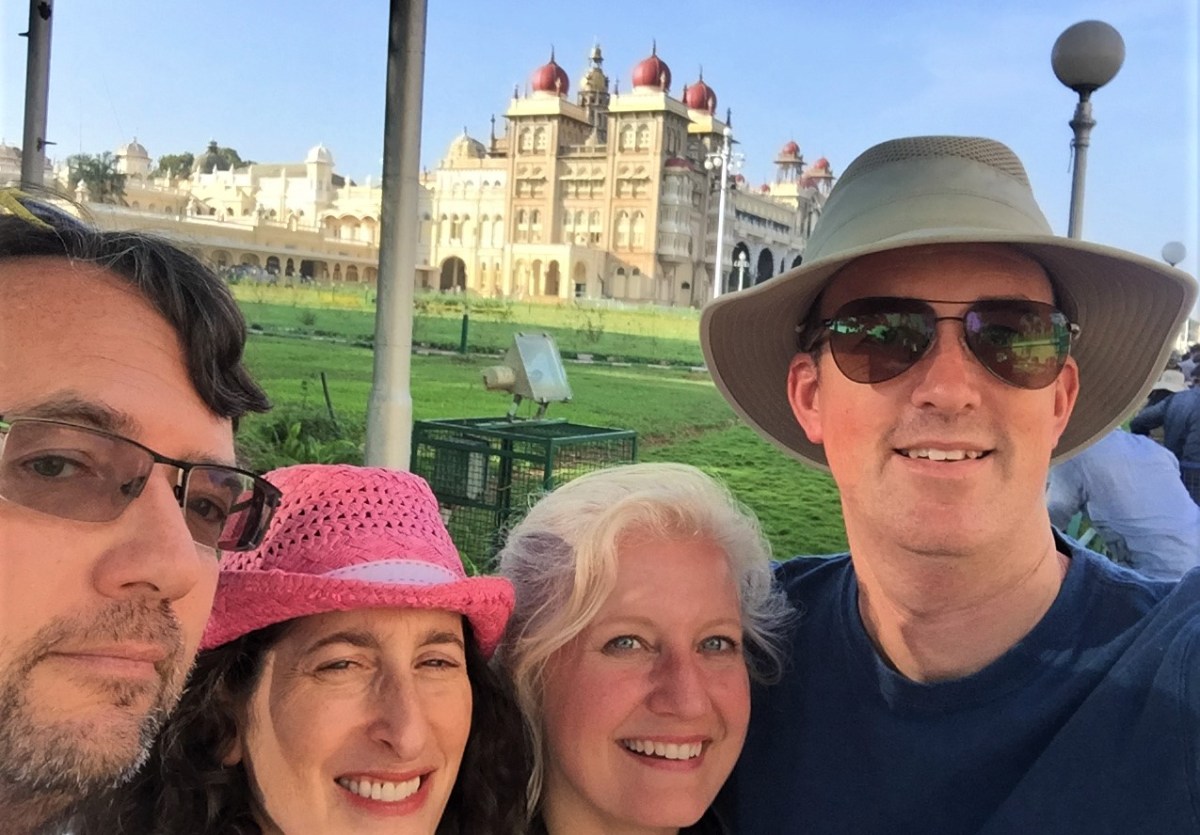
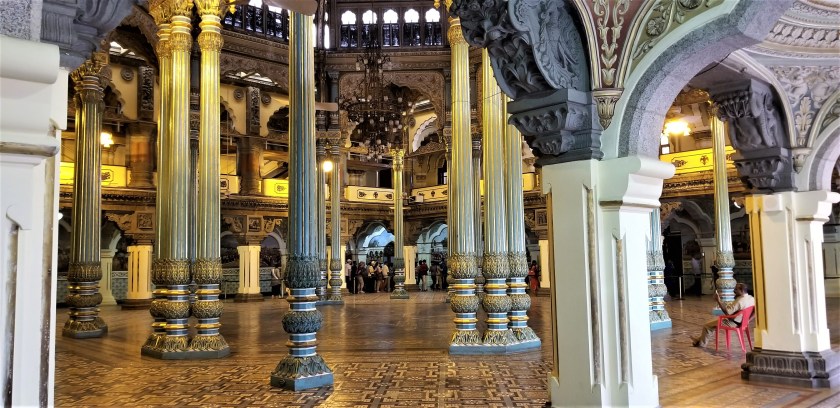 It turned in to a weekend of showing Rachel and Laurence some of the things we enjoyed doing on our first visit: we toured the Mysore Palace, walked through the market, went to the temples at the top of Chamundi Hill, dined at some fabulous places, and stayed at Southern Star Hotel (complete with their delicious paid-for-in-the-price-of-the-room breakfast buffet). All of these, minus the million extra people, were far more enjoyable and relaxing and meaningful the second time around.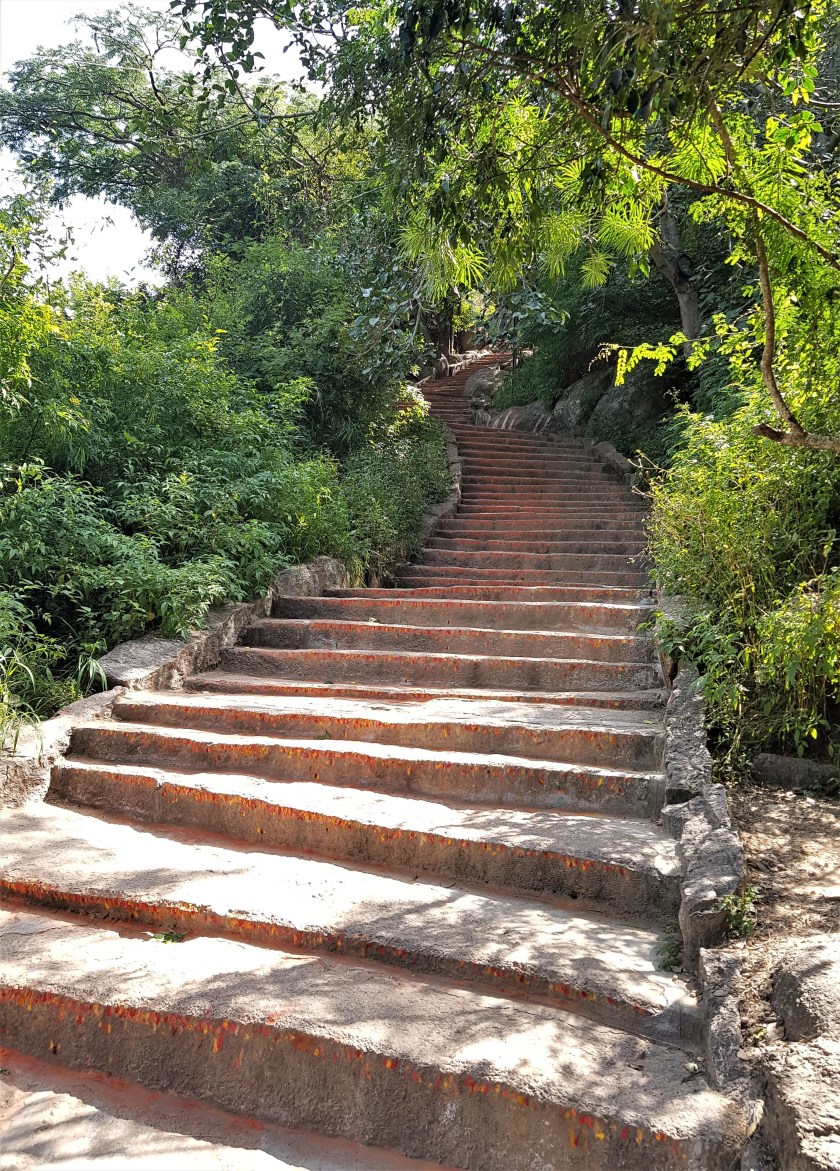

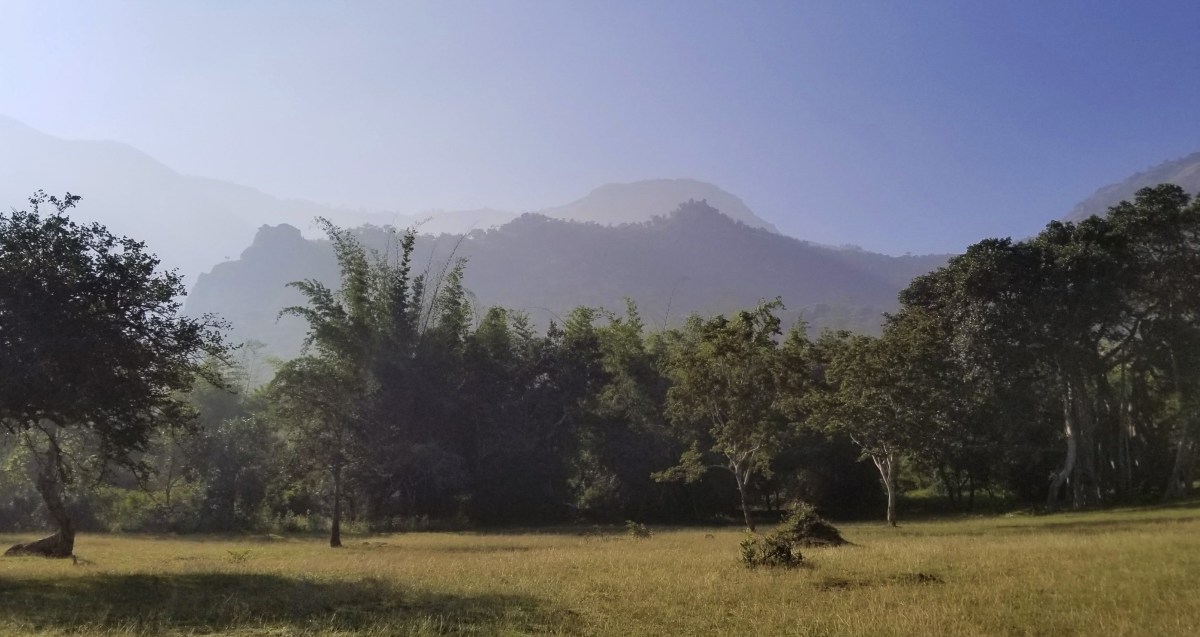





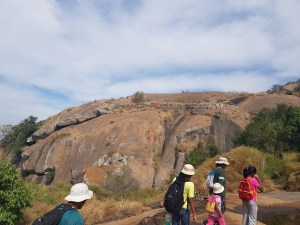 wouldn’t actually get much exercise, but that was not the case. While we did not hike quickly, we did hike steadily upward for quite a while over massive granite stones. In some places steps had been cut into the rock, in others we
 had to scramble a bit. There were occasional stretches through areas with dense foliage, but we were in the sun for most of the day. The youngest child moved slowly all the way up, so her parents did too, but she was a trooper, and they all made it, thanks to Bhavani stepping in to cheerfully keep things moving when needed.


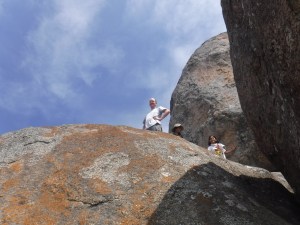 under and then climb between huge boulders to another spectacular view. Melissa elected not to crawl, but Tom said it was totally worth it.








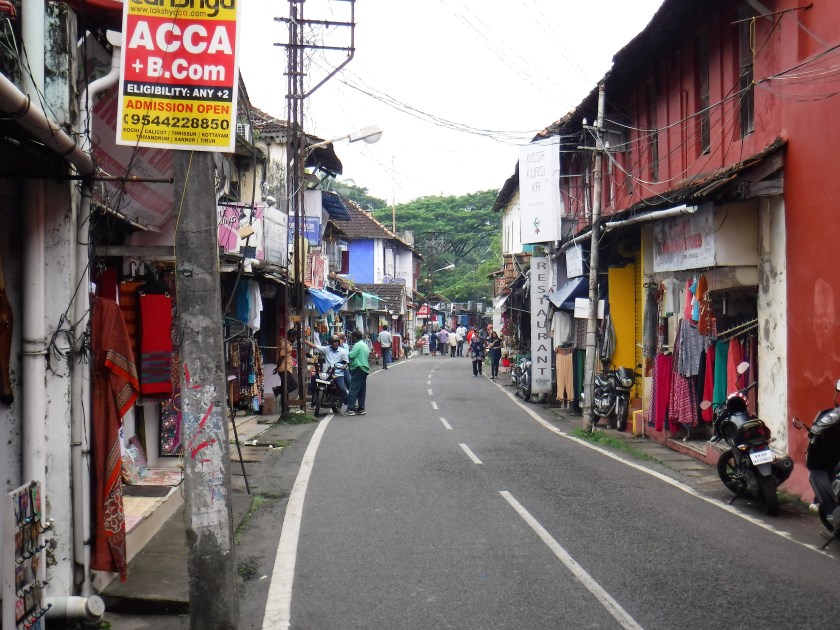 From there we walked through nice neighborhoods, marveling at the minimal garbage and well-maintained sidewalks, totally charmed by the lovely storefronts and pretty buildings. We eventually found our way to Mattancherry Palace, built by the Portuguese as a gift for the Maharaja in the 16th century (largely as an apology for sacking the temple) and then expanded by the Dutch when they established themselves in the mid-17th century. From the outside, it doesn’t look like much, but inside there are magnificent 16th century murals covering the walls and an impressive display of old artifacts. There are also a lot of really informative panels that explain the history of Kochi and the whole Kerala region. We learned there about the matrilineal heritage of the royal family that ensured a valued place for women in the culture. One impact of this was an early commitment to educating girls as well as boys through the kingdom.


 Wellserton Wanderings