Melissa’s Musings: I’m doing yoga. So is everyone else.

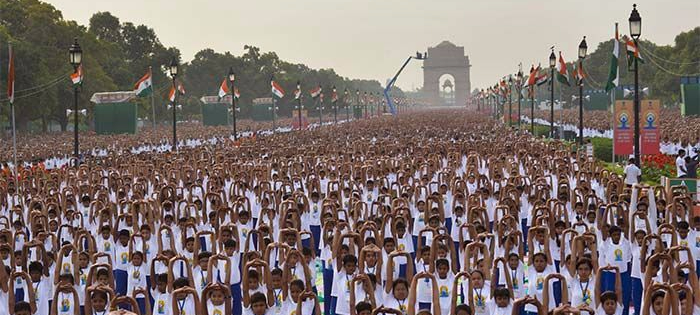
Yoga is just a part of regular life here in India. Its ancient origins in the vedic scriptures have ensured its place in the life of Hindus in India, not as a religious activity practiced on special holidays, but as an expected component of every day. With 80% of the population being Hindu, that has a big impact. It’s taught in schools and embraced by devotees of other religions as well. While controversy about that is worthy of consideration (check out “Why Muslims in India Feel Yoga Has Been Weaponized”), I’ve mostly been considering its impact on me.

This is my 5th week of regular yoga classes here in India. Our middle class apartment complex has a clubhouse, which sounds way fancier than it is. Basically, it’s a barren first floor room with lots of windows and a tiled floor; a second floor with a billiard table and a ping pong table (both largely unused); a small third floor gym with a couple treadmills, a weight machine, and some free weights; and a top floor where I have been told there is Zumba (although I’ve never seen it). As far as I’m concerned, the free yoga is the best thing about it, with classes available 4 or 5 times a day, 5 or 6 days a week. There’s no posted schedule anywhere so you just have to be in the know, which took me a while.

On my first day of class, I arrived at 5:30 am feeling anxious and inadequate, not sure where to be and just desperately trying to do what everyone else did (leave my shoes outside even though the floor inside is kind of dirty, set up my mat in the back corner and sit on my heels until the teacher arrived). Once Sima got there and smiled at me, I completely relaxed. For that class, she directed the other students with quick instructions, but stationed herself next to me, ensuring that I was focused exclusively on breathing in sync with simple movements. I looked up and down while inhaling and exhaling. I moved my hands apart and back together while inhaling and exhaling. I got nods of approval as my abdomen expanded and “collapsed” with my breath. Sima allowed me to join the rest of the class for two of their twelve sun salutations, but then had me again stand and breathe until we got to pranayama at the end of class, when I joined everyone else in, you guessed it, breathing.

On the second day, she asked me if I wanted to join the class and looked radiantly pleased when I said yes. She then told me that if I kept coming, after one month I would notice myself seeing things differently and responding to them differently. After three months, other people would notice these changes too. That sounded pretty good to me.

Each day of that first week, she allowed me to try more, checking in with me during the class to ask, “Do you want to try this?” and beaming her beautiful smile at me each time that I said yes. By the end of the first week, I was just a regular participant, following along as best I could. When I showed up for the second week of classes, I was given a page with the prayers spelled out.

The class opens with a chanted prayer, there is another prayer before the sun salutations, there is a brief chanted line before each of the twelve sun salutations, and there is a prayer to close the class. I imagined that these were prayers that everyone else in the class knew from childhood and wondered how I’d ever learn them until I was told by a classmate that they all receive these printed prayers after joining the class. I also wondered if it was even appropriate for me to be chanting prayers – praying is not a part of my life in any way – but the vibrations felt during the chanting seem like an essential part of the practice. So I awkwardly mumble through my prayers every day and feel less weird about it as time goes by.

Each class begins with “loosening exercises” to prepare us for sun salutations, and then we do 12 sun salutations (6 on each side) to prepare us for asanas (yoga poses). We always close with meditation and pranayama. Within that structure, there are variations. Loosening exercises seem a bit like old-fashioned calisthenics, some days standing, sometimes seated, and sometimes lying down. Sometimes we follow our 12 sun salutations with 6 more “dynamic” sun salutations at hyperspeed. Sometimes we follow them with two very slow sun salutations where we pause for three cycles of breath in each of the 12 positions. Once we did 24 sun salutations. The asanas are always different, and then pranayama (breathing exercises) are always different.

The 5:30 am class can be anywhere from 5 people to 11 people depending on the day, but is usually around 8. It’s about half men and half women, with most of them between 45 and 70, but a couple younger folks as well. Sima is ageless – I could believe that she is around my age or 20 years older. She just exudes a kind of calm acceptance, but also seems like a perfectly normal person with a perfectly normal body until she effortlessly places her forehead on her knees. I may need to redefine normal here. That might actually be normal. And speaking of normal, it’s clear that this is truly just the way my classmates greet the day. They are not doing yoga because they hope to achieve something – they’re not here to lose weight or treat that back problem or better manage their stress – they’re here because this is and always has been how the day begins.

I like that it’s becoming part of my way to start the day too. I’m not sure I actually notice the new perspective that Sima said I would see, but Tom tells me that I’m more patient now and less frequently jump in to finish his sentences. So maybe it’s reversed for me. Maybe other people can see the changes now and I’ll see them in three months. And even if I never notice any actual changes, I think I’ll just keep doing it because I like it.

Melissa’s Musings: A birthday in India

Today is my birthday. Today I am one year shy of half a century. Today I am the age my father was when he died. I’ve been so focused on turning 50 next year that I failed to anticipate the significance of turning 49 this year. As my father turned 49, he was already a few weeks into his battle with an aggressive cancer that killed him in 3 ½ months. When my mother turned 49 the following year, she quit her VP position with Kaiser, sold her house and most of her belongings, and moved to Ann Arbor to begin a PhD program. Twenty-three years later, at 49, I am sitting in my living room, listening to the birds and traffic of Bengaluru. I guess 49 is an age for transitions in my family. Tomorrow I will brainstorm the ways I can make this year important – I need a sense of direction and purpose to carry me into this next phase of my life, something with heart, something that matters. Today I will continue to celebrate.

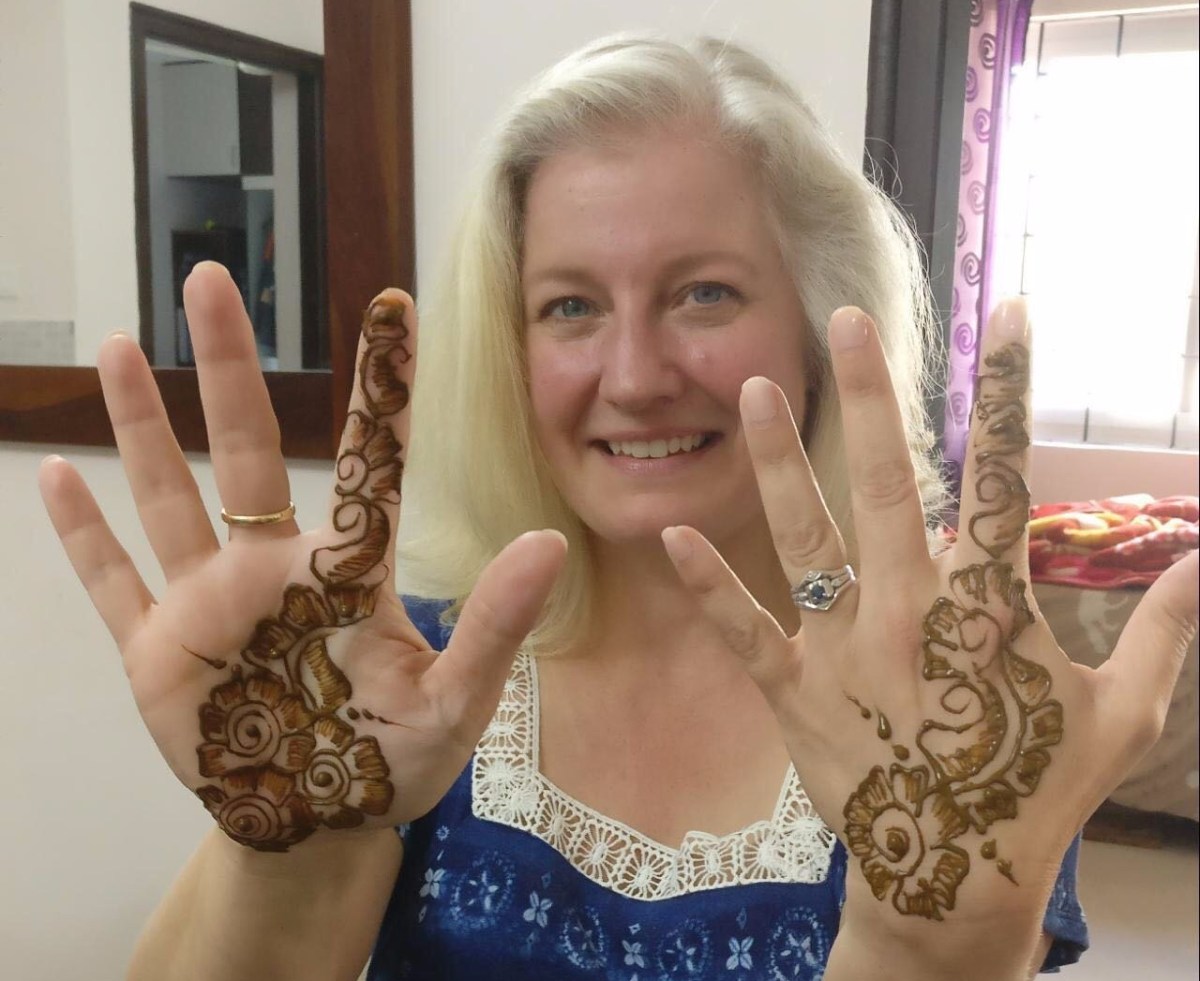
Of course my birthday celebrations are already underway, thanks to Tom who insisted that the whole weekend is about me. Yesterday morning, I went to an impromptu mehendi (henna) gathering at the home of some of Tom’s fellow teachers. They had planned a sleepover party for their adolescent daughter only to have most of the girls succumb to a nasty cold sweeping through the school. With a mehendi artist already booked to show up on Saturday morning, Nicolas sent out an open invitation, and I jumped on it. She was incredible, and I could not be happier with my newly decorated hands.

Once the mehendi had dried and flaked off with the help of a little coconut oil, Tom and I headed downtown. We’re preparing for our first Indian train trip on Thursday when we go to Mysore for a 4-day weekend. Since our timing will be tight on Thursday, we thought it would be a good idea to check out the train station and make sure we knew what we were doing. Things that are so easy to figure out at home can become overwhelming when faced with a language barrier and a sea of bustling people. We spoke with the woman at the inquiry counter, confirmed that this was the correct train station, learned that we should be 30 minutes early, and walked to the track from which our train will depart. We felt much more confident for our Thursday trip.

We then walked to the nearest Metro station and took our first Metro ride. As at every mall, hotel, or other large gathering place, we had to walk through a metal detector and have our belongings checked. We bought our tokens (22 rupees each, about 34 cents) and headed down the escalator to the track where a kind attendant told us where to wait. The Metro station is spotless, so different from the garbage-strewn street above. The train itself is clean, air-conditioned, and entirely pleasant despite being completed packed. Little screens tell you the upcoming stops and show ads about keeping things clean and safe, with great tips like “Don’t push your fellow passenger.” No one pushed me so I guess it’s working. The only problem with the Metro is that it only serves the central core of the city. There are plans to expand, but it won’t make it to Yelahanka where we live for many years yet.

Six stops later we emerged near 1 MG Road, a big fancy mall where we could explore the delights of Foodhall. Foodhall is every expat’s dream come true. When we first discovered it, we bought Bob’s Red Mill flour, our favorite raspberry jam, and a big block of Belgian butter. We’re all ready to make jammers! Yes, everything cost twice what it would at home, but it’s just so exciting to have it. Yesterday we were on a mission to buy food for my birthday dinner. From there we went to Fabindia where Tom got fancy clothes for India Night, the annual fundraising event for the OWC on October 7: a long teal kurta, cream pyjama pants, and a gold and cream stole. He’ll look great!

After some downtime (and Tom’s birthday breakfast prep time!), we went to the Royal Afghan for the perfect birthday dinner (see Birthday at The Royal Afghan).

Today I anticipate Tom’s amazing homemade masala dosas (I got to taste the filling yesterday and it was so good), a relaxing afternoon, and a fondue dinner to cap it all off.

I am a lucky woman. Forty-nine will be a very good year.

Melissa’s Musings: Struggle and Resilience in a Bengaluru Slum

Even though we don’t live in a cloistered expat community, there is still the potential to live in a bubble, unaware of many of the challenges around us. That is not the way I want to live here. Sure, I will occasionally seek the bubble, but I also want to truly understand and be a part of life in India. With that in mind, I went on a social awareness tour conducted by Five Oceans, a local club that gave memberships to teachers at Tom’s school.

I was part of a group of five women who met our guide, Kaveri, a cultural anthropologist who has long interacted with and supported the community that she took us to visit. This particular slum was initially formed when the government gave a 25-year land grant to villagers lured to Bengaluru to work on new road development in this ever-growing city. Twenty-nine years later, it’s still there, home to 25,000 people who live in small homes of their own creation without plumbing, running water, or garbage collection. Children who grew up there now raise their children there, and yet there is joy among the garbage.

This slideshow requires JavaScript.

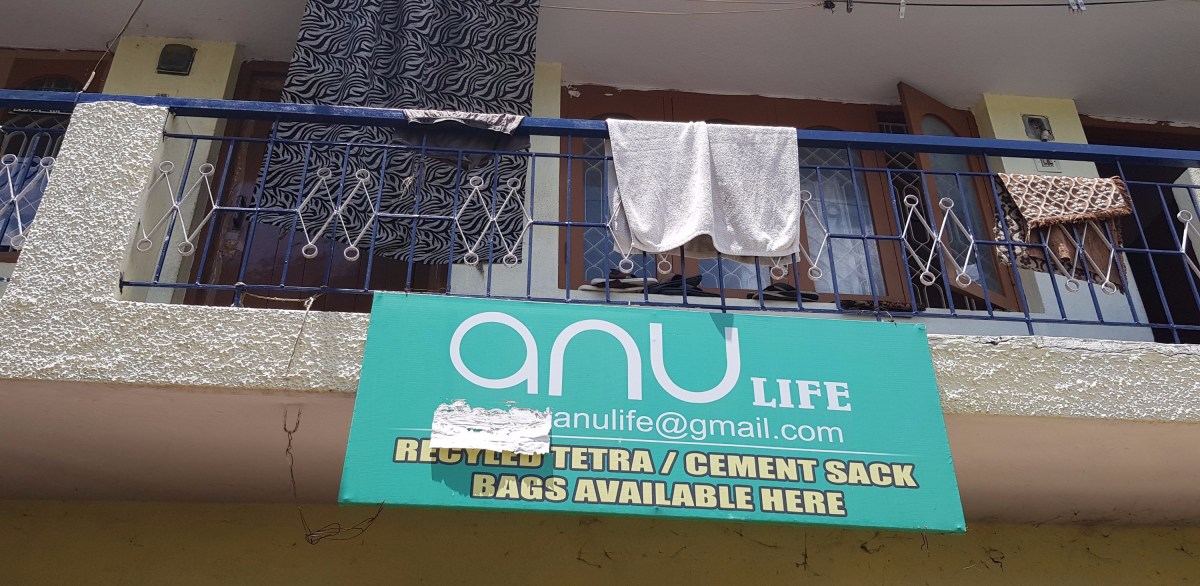
The focus of our tour was a group called Anu Life, created 8 years ago to give women in the Janakiram Slum the tools to support their families. It has done so much more than that for the 11 women who work there. Officially, it offers healthcare and education for the women and their children, helping them to learn the English that they need to succeed here. Unofficially, it offers pride and confidence, both unknown to these women before their involvement.

wp-image-1866520714
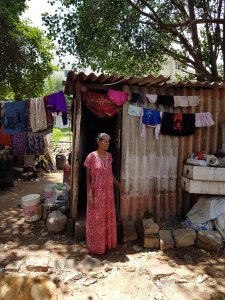
Kamala in front of her home

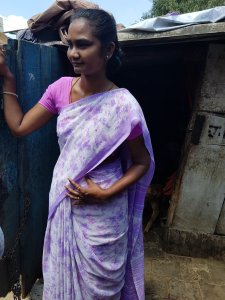
Kamala came to Bengaluru as a young child and worked with her parents on road building with no protection from chemical exposure or general safety. She grew up, got married, and had four children. When the fourth was born, she and the infant were both very ill with tuberculosis. Her husband sent her to his parents’ village, far away, where she was horribly mistreated. Eventually she was strong enough to leave with the baby and return to home in the slum. When she got there, she learned that her husband had run off with another woman and

wp-image-1350338195
Kamala tells us about her work with Anu Life

abandoned their children alone to scavenge in the streets. Kamala brought them all together again and got a job working nights for 100 rupees per night (about $1.40). It was a constant struggle. And then Anu Life recruited her as one of its first members. She is paid 200 rupees for every bag that she weaves (each taking about three hours to create), she receives healthcare for herself and her children, and she’s proud of what she does. She said that when she began, she was always scared and wouldn’t talk to anybody, but now she’s confident enough to talk to anyone. And she’s proud of her three older children in boarding school.


wp-image-1282926732
Sophia in front of her bed

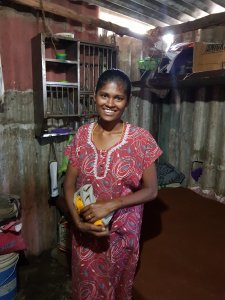
Sophia proudly invited us into her home to see her two prized possessions: a large blue plastic rain barrel and a double bed on a metal frame. Water is a major factor in these women’s lives – it is an effort to get clean water to drink, do dishes, wash clothes, wash themselves; they are also at the mercy of any flooding. Sophia is able  fill her rain barrel, occasionally with help from Lalitha, and wp-image-58364639doesn’t sleep on the floor where it’s often damp. Like Kamala, she has three older children at boarding school and one at home with her. She told me that she visits a different child each month so only sees the older kids every three months. She also told me that she is not sad when she says good-bye “because they must have a beautiful life and they can’t have that here.”
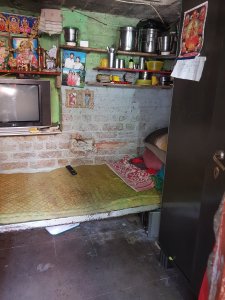
 

Lalitha’s home is up a flight of stairs. It’s tiny (about 5 feet by 6 feet with a 3 foot square L

wp-image-792831116
Lalitha’s home as seen from the doorway

off one side which serves as her kitchen). As small as it is, she has two distinct advantages: the height means that she is not subject to flooding, and she has actual running water for two days each week which she shares with friends in need. She also has a distinct disadvantage. She shares her small home with her husband and three children. When she was asked if her husband works, she said, “No, he drinks.” We were then told that he beats her often and she’s just getting over a black eye. She also told us, though, that through Anu Life she has learned to stand up to him so it’s not as bad as it was. The other women spoke of her strength and generosity.


Anu Life means a great deal to the women who serve as its collective workforce and owners. They were taught the craft of making baskets and bags out of tetra packs (juice boxes) and of embroidering on old cement bags. Their supplies are otherwise garbage, but the things they make with them are lovely. They do, however, constantly struggle to find buyers for their work and nearly had to end their operation last month when they had no sales. Happily, a woman placed a large order and kept them going, and everyone who tours their operation buys something (I bought two bags that I love). If you’d like an Anu Life bag, let me know and I’ll make it happen!

This slideshow requires JavaScript.


Melissa’s Musings: Ganesha Chaturthi

Tomorrow is Ganesha Chaturthi and we are excited for two reasons: we get to experience our first India festival and we get a three day weekend! We’ve decided to take advantage of the long weekend by spending time in downtown Bengaluru and doing some things that might normally be more difficult with the traffic between us and city center. That will also put us near some significant celebrations and allow us to visit some ancient temples.

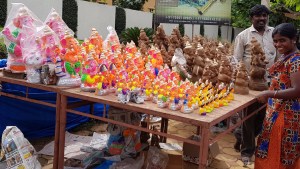
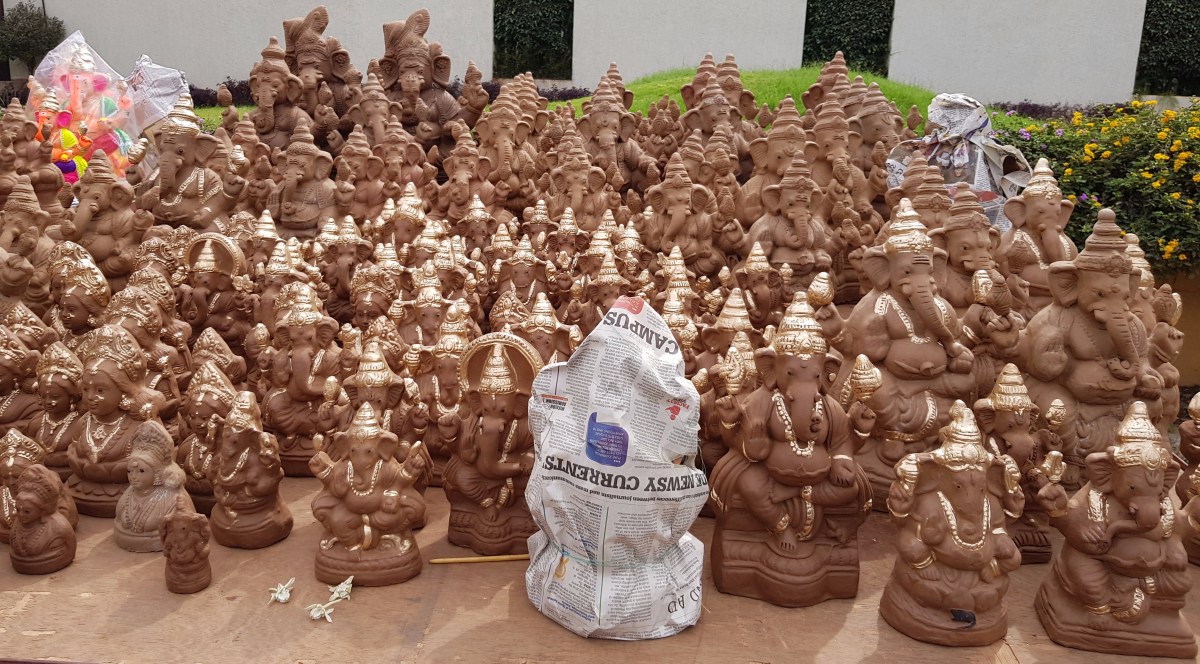
On today’s walk, I saw a vendor selling Ganesh statues. Tomorrow begins 11 days of celebration in honor of the birthday of Ganesh (via a complicated “birth” story that involves beheading and reanimation with an elephant’s head). In the next few days, people will mostly have family events with special sweets and altars to Ganesh set up in their homes. Toward the end, the statues from the altars will be submerged in bodies of water around the city, sending Ganesh home,taking all of our misfortunes with him. 20170824_151008Unfortunately, this practice has evolved from traditional clay statues to brightly painted plaster of paris statues that kill the fish in those lakes. There’s a big awareness campaign on right now, so hopefully this year will be better than last, although my local vendor was selling both kinds.
We look forward to having some great stories next week!

Melissa’s Musings: A Period of Adjustment

Some days I wake up excited to find myself living in India, conscious of my good fortune at being able to make this dream come true, and eager to see what the day will hold. And some days . . . I don’t.

Some days I wake up crushed by the weight of a thousand tiny irksome things that I can’t change or don’t understand. I don’t like my enormous hair, somehow inflated to twice its normal size by the humidity. I’m sick of the relentlessly itchy bugbites on my legs and shoulders (and last week on my right cheek). I’m tired of the frequent vague nausea that never actually results in anything, but somehow can’t be entirely ignored. The scaly rash on my eyelids is tremendously irritating. I don’t want to brush my teeth with bottled water. I don’t want to deal with the expense of a harrowing taxi ride to go anywhere. Neither do I want to walk along the filthy, smelly, noisy street to get to anything. I don’t want to use “toned” milk or part-buffalo milk butter or soak all of my fruits and vegetables in vinegar before eating them. And I want the stupid power to stay on, leaving the internet functional through the entire length of a TV show.

There are also particular challenges for a white American introvert in Bengaluru. I’ve found that I really kind of like the invisibility of middle age in America. I go out for a walk in Portland knowing that I can choose to be noticed, but am otherwise unnoticed and unremarked. Here, I do not blend. People will stop what they’re doing to stare at me as I pass. Strangers ask me to pose for photos with them – I was counting how many times until the numbers got too big. When I walk into a store, I draw a crowd of people trying to help me, all standing uncomfortably close and trying to interact intensively while we discuss rice cookers or mattress toppers or whatever I was vaguely interested in, but suddenly want to escape. I don’t want to be a jerky stranger in a strange land so I engage with everyone who attempts to engage with me, but it takes a toll and I generally arrive home exhausted.

The hardest part of the difficult days is acknowledging my own deficiency. I pictured myself living serenely in India, engaging happily with community, always up for any challenge that arose. I don’t like the reality that my nerves can fray and my tolerance for adversity is less than I’d like. But I know that in time I will grow a thicker skin and find it easier to deal with the challenges that life In Bengaluru throws my way. And even on the difficult days, I know I’ll probably wake up happy tomorrow, once again excited to find myself living in India.

Melissa’s Musings: The Overseas Women’s Club of Bangalore

Before the big move, I had a bit of a panic when I thought about my potential isolation in Bangalore.

How would I meet people if I wasn’t working? How would I learn how to function in a strange country if I couldn’t meet anyone? How could I be happy in Bangalore if I couldn’t figure out how to function on a daily basis?!

In my panic, I turned to the internet. I searched for meet-up groups, hiking groups, language classes, art classes, and lots of other search terms besides. One group popped up a number of times: The Overseas Women’s Club of Bangalore. The first couple times, I ignored it. The name made it sound like some kind of imperialist remnant, which was not what I was looking for. Finally, though, I clicked and was intrigued by what I read. The group has a lot of social opportunities, but also a focus on “giving back to the city that so warmly welcomed us,” by supporting 21 charities around the city with both money and time. This group might be able to help me find both friends and a sense of purpose! It was at least worth checking it out.

Fast forward to my first Thursday home alone, and I was ready for the weekly morning coffee at the Leela Palace. I had prearranged for Madesh, the taxi driver recommended to us by CIS, to pick me up – when I asked him what time he’d need to get me in order to have me at the Leela Palace at 10, he said 8 am. I was surprised he thought it would take so long, but it actually did take an hour and a half, and clearly could have taken longer if not for his fancy (i.e., vaguely terrifying) driving!

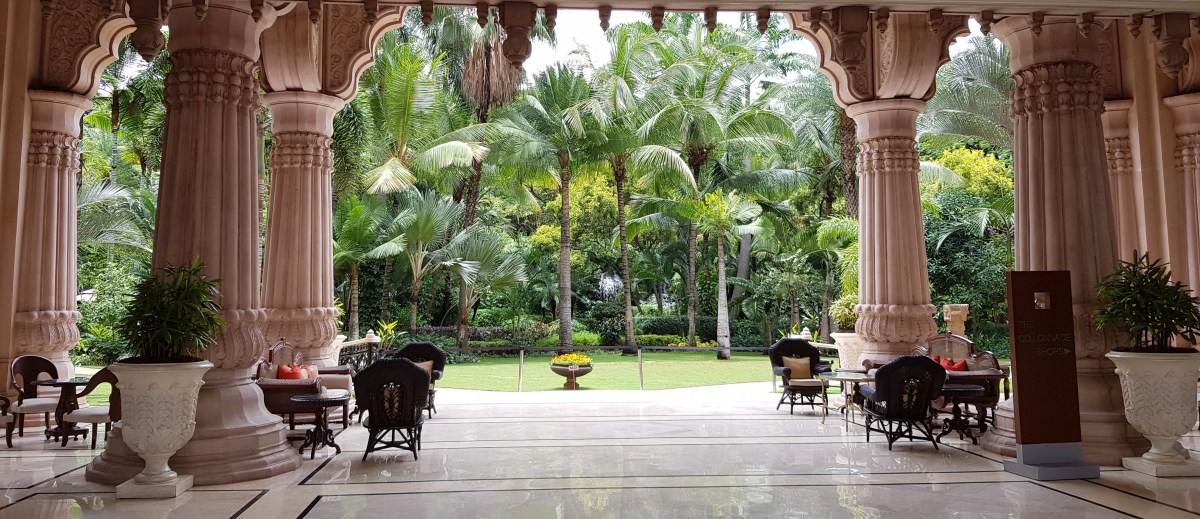
I arrived half an hour early and walked into the most beautiful place I think I’ve ever been in my entire life. The Leela Palace is truly gorgeous. A young woman walked me to the Library Bar as I’d been told that the OWC would be meeting just outside – she was very concerned that the bar would not be opening until 11, but I assured her that I was fine and needed no more assistance.

This slideshow requires JavaScript.

I wandered around awkwardly, taking photos, and looking about for women who looked as lost as me. At 10, I realized that the meeting was actually in the courtyard through the doors across from the Library Bar and women were beginning to gather there.

20170810_095642[1]
The covered courtyard where the OWC meets
I was instantly welcomed after heading outside and began to be introduced around to the early arrivals – a woman from Singapore who has lived in Bangalore for many years, a woman from the US who moved here with her Indian husband nine years ago (intending to stay for two), a woman from the UK, and two women from Japan. One of the Japanese women was there for the first time, having arrived in Bangalore two days after me. The two of us sat with Meredith, the American woman who has a leadership role with the OWC. She told us all about the different kinds of meetings and events we can participate in and gave me membership materials. She’ll be at the Canadian International School next Thursday for new student orientation, when there are lots of new international parents also seeking orientation to the city. I can send my orientation materials to school with Tom to pass off to her.

I then went to talk with a woman on the Charity Committee who could tell me about opportunities to volunteer. She was able to pull up a map of the charities they work with and recommended a couple that are based in Yelehanka where we live: the Bangalore Eduational Trust which runs a free school for poor, rural children and the Sai Shankar Loving Lights Trust which runs a residential program that provides education and life skills for 50 disadvantaged teens. I’m not ready to make a commitment yet, but I’m so glad to know that there are some good options when I am.

I then made my way over to a group of women sitting in the corner – one from Sweden, one from the UK, one from New Zealand, and one from New York. From what I gathered, they are all here in Bangalore because their husbands are working here and they are not. They all seemed smart and kind and are all very much enjoying this city. They also had some good tips for me – for example, apparently everyone who leaves the country takes an empty suitcase with them that they bring back filled with large blocks of cheese and other tasty foods that aren’t available here. If you don’t want your bag to be carefully searched, just put a layer of tampons on the top. Lesson learned. It was nice to talk freely about the things that I’m unsure of (should we really be doing the grocery shopping online?) or confused by (why does it take a million years to have a functioning phone?) or worried about (is it possible that I won’t be added to Tom’s bank account?) and get answers from women who have been there and already grappled with these very things.

While the coffee meeting was pleasant, I’m really looking forward to my first regional coffee – the Leela Palace coffee is weekly and brings women from all corners of Bangalore while the four regional coffees are monthly and take place in different parts of the city. These are smaller and more intimate so it’s possible to actually make friends. Once I’m a member, I’ll get info on all my other options too – regional coffees, the book club, the sundowners happy hour group, the monthly lunch group, and the monthly road trip group. I was glad to be able to assure Tom’s colleagues that this is not a group of “bitter women” who gather to complain, but actually a group of happy, interesting people who are enjoying the chance to delve into a new culture. I think the OWC can keep me as busy as I want to be, but I’m also starting to turn my mind to work.